Leo Tolstoy and the 1882 Census — the story of how a ready-made scheme to help the poor collided with the realities of life in the Rzhanov House. His rounds showed that giving out money did not address the causes of poverty, and that a benefactor knew little about the people whose destinies he intended to determine. Over the next several years, Tolstoy transformed this failed endeavour into an exploration of personal responsibility, work and social alienation.
The chronology distinguishes the census from the Tolstoys’ life at their Khamovniki estate. The Tolstoy family moved into a rented house in Denezhny Lane on 15 September 1881. The writer published his appeal on 20 January 1882 and took part in the census rounds from 23 to 25 January. He bought the estate in Dolgokhamovnichesky Lane on 14 July, and the family moved there on 8 October. The Tolstoys’ domestic life in Khamovniki began after the census.
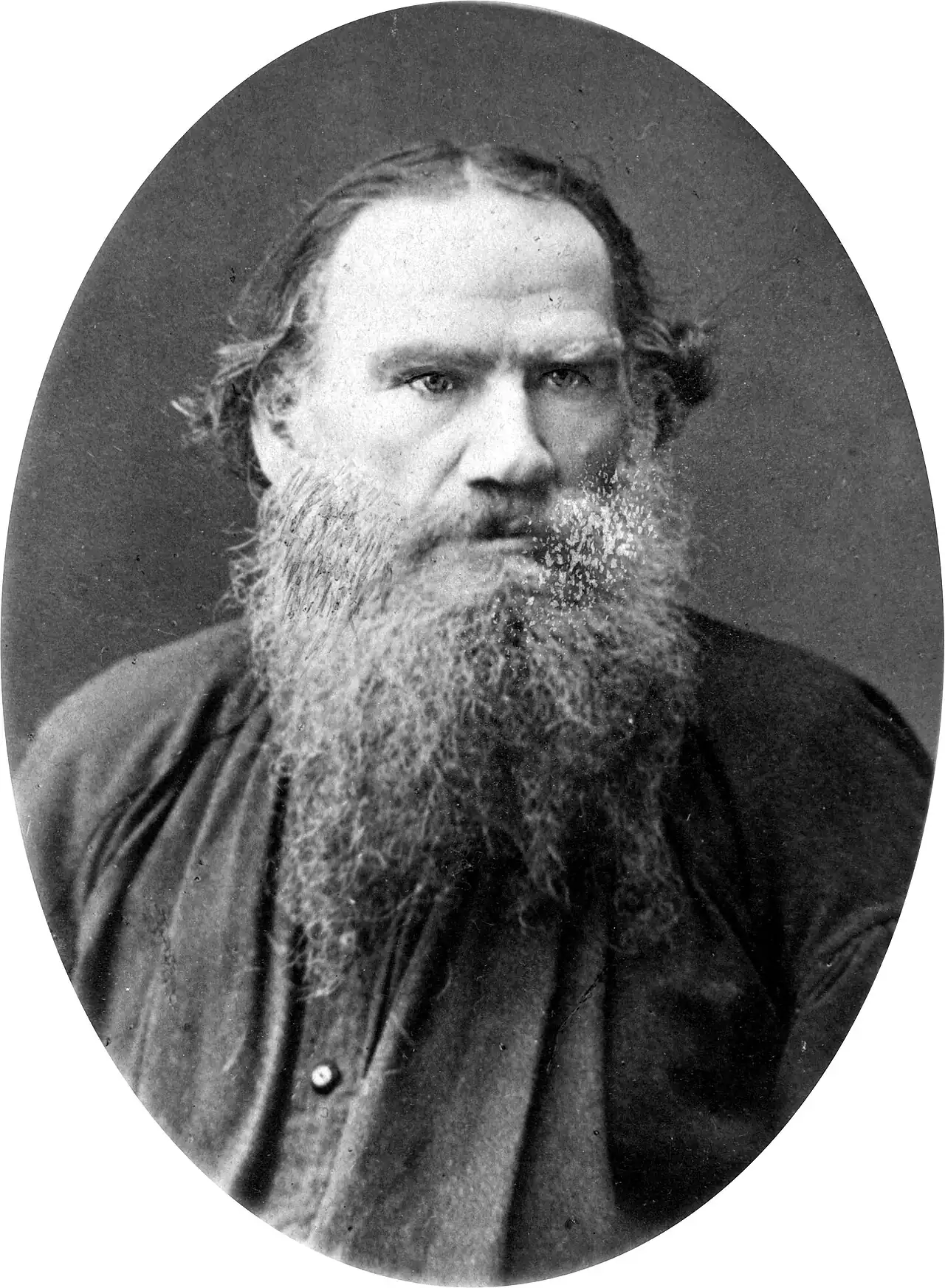
Leo Tolstoy during the Moscow census, portrait from 1880–1886. Wikimedia Commons, Leo Tolstoy, portrait.jpg, author: Sass, Moscow., licence: Public domain source
Why the Tolstoys moved to Moscow in 1881
The family moved to Moscow so that the older children could pursue their education. According to the official chronology of the writer’s life, in early July 1881, Sofia Andreevna rented the Volkonsky house in Denezhny Lane. On 15 September, Lev Nikolaevich arrived there with the children for the winter: Sergei was enrolling at university, Ilya and Lev at the Polivanov Gymnasium, and Tatiana at the Moscow School of Painting, Sculpture and Architecture.
In the autumn of 1881, the Tolstoys lived in a rented townhouse, far from their future estate on what is now Leo Tolstoy Street. The writer was adjusting to the unfamiliar rhythms of daily life in a large city. Tolstoy later wrote of poverty in Moscow as something quite unlike rural hardship: destitution was constantly visible alongside wealth. His social commentary grew out of several months of such observations and inner conflict.
In December 1881, Tolstoy visited the Lyapinsky free night shelter near Khitrov Market and saw for the first time the crowd waiting at night for a place to sleep. In What Then Must We Do?, he contrasted his return from the shelter with his own home, its carpets, servants and dinner. The author later heightened the story for literary effect, while the biographical chronology confirms the sequence of events: the visit to the Lyapinsky House preceded the census and prompted Tolstoy to devise a charitable scheme.

Vladimir Makovsky. “The Doss-House”, 1889. Wikimedia Commons, Doss-House Inhabitants. 1889. V. E. Makovsky.jpg, author: Vladimir Makovsky, licence: Public domain source
What was the 1882 Moscow census?
The Moscow authorities conducted a municipal statistical campaign; the first general census of the Russian Empire took place in 1897. The census rounds were carried out on 23–25 January 1882, while 24 January was designated as the census date in the published results. The City Duma issued the materials in three parts in 1885–1886, covering dwellings and households, the population and occupations, and the distribution of data across the city’s districts and precincts.
The structure of the official publication reveals the kinds of information provided by the Moscow census. The first volume, ‘Dwellings and Households’, appeared in 1885: the catalogue of the Presidential Library lists 420 pages, as well as columns with separate pagination. In the same year, the City Duma published data on residents and occupations, and in 1886 it arranged the material by Moscow’s districts and precincts. These volumes can be used to study housing, the composition of the population and employment across the city. The story of an individual petitioner—their illness, debts, family conflict or loss of income—cannot be reconstructed from such a statistical summary.
According to Rosstat’s consolidated data, the census recorded around 753,500 residents in Moscow; 26 per cent had been born in the city. A significant proportion of the population consisted of newcomers who depended on finding work and accommodation. The municipal statistics covered every district, whereas Tolstoy, at his own request, was assigned an area of extreme poverty. His observations describe this particular locality and are not representative of Moscow as a whole.

Lower Taganskaya Square with its now-lost shopping arcades. Moscow, 1880–1885. Wikimedia Commons, View of Lower Taganskaya Square.jpg, author: CIGI Archive, licence: Public domain source
Tolstoy joined the team of organisers and personally took part in the census rounds. In his article ‘On the Census in Moscow’, he wrote of the two thousand people involved and hoped to introduce educated society to the city’s poor. The municipal authorities tasked the enumerators with collecting comparable data; Tolstoy wanted to turn this official contact into lasting personal involvement.
How Tolstoy turned the census into a moral undertaking
Before the census rounds began, Tolstoy proposed adding an unofficial aim to the official task: to identify people in dire circumstances, understand their needs and remain in contact with them after the census was complete. At an evening meeting of the organising committee in the Moscow City Duma on 18 January 1882, he read out the article he had prepared; on 20 January, Sovremennye Izvestia published it under the title ‘On the Census in Moscow’.
Tolstoy acknowledged the value of statistics and insisted that census takers become personally involved. After recording the details of a person suffering from hunger, he proposed finding out what they needed, helping them find work or a way home, arranging care for an orphan, or supporting a frail elderly person. The writer hoped that those taking part in the campaign would remain in contact with residents after completing the forms.
The article’s central idea was summed up as follows: ‘Doing good does not mean giving money’. Tolstoy believed that helping others required personal engagement and involvement. He collected two hundred copies of the issue from the editorial office and ordered a further five hundred separate offprints to distribute among the census participants. His appeal met with both sympathy and objections; some of his contemporaries immediately regarded the project as utopian. Nevertheless, the author sought to incorporate this assistance into a specific public campaign.
The publication made Tolstoy’s plan a subject of public debate in Moscow even before the census rounds had ended. In a note accompanying the appeal, the editor N. P. Gilyarov-Platonov clarified that the writer was one of the census’s 80 supervisors. S. A. Vengerov later recalled both sympathetic and mocking responses: even supporters considered the project utopian. In March 1882, the address was discussed by Vestnik Evropy and the journal Delo. These responses help to date the author’s position accurately: Muscovites were debating a public programme of assistance, not the results of an initiative that had already been completed.
The plan assumed that a well-to-do observer would be able to recognise a resident’s needs, propose a solution and establish a permanent charitable society. In a later treatise, Tolstoy admitted that he had envisaged something akin to a public health service against poverty, after which the wealthy could return to their accustomed lives with a clear conscience. The census rounds made him question his own right to determine the fate of others.
The distinction between the two tasks was already apparent in the way the work was organised. For the city’s statistical purposes, it was enough to complete the forms uniformly and collate the responses; Tolstoy’s project began once this procedure was over and required the census taker to get to know each person individually. The census taker was authorised to ask questions by a temporary mandate from the City Duma, but such a mandate was insufficient for providing long-term assistance. Tolstoy later described how quickly a supervisor’s confidence evaporated when the conversation shifted from a standard category to the particular individual’s housing, illness, earnings and family ties.

Leo Tolstoy at his writing desk. Ilya Repin, 1887. Wikimedia Commons, Leo Tolstoy by Ilya Yefimovich Repin.png, author: Ilya Yefimovich Repin, licence: CC0 source, license
What the manuscript reveals about the preparation of the appeal
Tolstoy prepared the article in the few days leading up to the official rounds. The editorial commentary in the Complete Works describes an untitled autograph draft: fourteen unnumbered pages written on full and quarter sheets of paper. The surviving draft begins by mentioning the census that had commenced in Moscow and ends with a reflection on the author’s estrangement from the poor.
S. K. Efron recalled that the typesetters worked from another manuscript, revised in Tolstoy’s own hand, which has not survived. Because his handwriting was difficult to decipher, Tolstoy spent more than five hours at the printing house, helping to make out the text and correcting the proofs as he went. The newspaper appeared on 20 January, while a separate sixteen-page offprint received the censor’s approval on 22 January, the eve of the three-day round.
The final six paragraphs of the published article, beginning with practical suggestions for supervisors and enumerators, are absent from the surviving draft. Tolstoy wrote the appeal after a preliminary inspection of the district, but before the main rounds had taken place. This text records his hopes before they were put to the test; the treatise shows how he revised them after the census.
Why he chose the Rzhanov Fortress
At his own request, Tolstoy was assigned a district in the Khamovniki quarter near Smolensky Market, in Protochny Lane between Beregovoy Passage and Nikolsky Lane. It contained a complex of buildings known as Rzhanov House or Rzhanov Fortress. It had once belonged to the merchant Rzhanov and, at the time of the census, was owned by the Zimin family. Tolstoy wrote that he had long heard of the place as a centre of extreme poverty and had therefore asked to be sent there in particular.
The historical name of the Khamovniki quarter can be misleading. Rzhanov Fortress stood near Smolensky Market. The house that would later become the writer’s home was in Dolgokhamovnichesky Lane, in another part of the district. The census scenes took place six months before he bought the house and were not observations made from the windows of the estate; the locations are linked by Tolstoy’s biography and the theme of urban poverty.

Smolensky Market Square: the Yalta furnished rooms and the Khamovniki Brewery beer shop. Pre-revolutionary Moscow. Wikimedia Commons, Yalta Furnished Rooms on Smolensky Boulevard.JPG, author: unknown, not specified, impossible to determine, licence: Public domain source
A few days before the official inspection, the writer came to examine the area on his own. In What Then Must We Do?, he describes the courtyards, corridors, cellars, tavern and cramped rooms. The writer scrutinises individual residents and immediately assigns them to moral categories, judging their appearance and speculating about the causes of their ‘fall’. These judgements belong to the author and his era, while the details of everyday life preserve an eyewitness account.
What Tolstoy actually saw during the rounds
The opening chapters of What Then Must We Do? reconstruct the process in detail. The census takers would enter the premises and find the head of the household; one would settle down with the forms, while the other went from corner to corner gathering information and passing it on. After several visits, the group had developed what Tolstoy called a mechanical knack. Even those participants motivated by charitable intentions quickly became focused on the procedure.
Partitions divided the premises into small cubicles; the beds were packed closely together and, during the nightly rounds, were often shared by two people. A single room housed unemployed craftsmen, cooks’ wives, children, tavern patrons, women with yellow tickets, drunkards and the sick. Rzhanovsky House was a commercial lodging house at the lowest end of the market, where poverty coexisted with casual work and exploitation.
On Tolstoy’s final nightly round, he was accompanied by around twenty people, including students, an officer and acquaintances from society. When the residents learnt about the census, they began to leave, and the participants asked the landlord to lock the gates. The census takers assured them that they were not checking identity papers, but the residents did not believe them. The visitors’ official appearance and the fact that no one could leave explain why people feared a police inspection.
How individuals shattered his preconceived framework
Tolstoy entered Rzhanovsky House with a set of standard solutions: give someone money, find them work, send a recent arrival back to the countryside, place a child in school or an elderly person in an almshouse. His conversations revealed that people’s lives did not fit this framework. Someone might need food but not want the job offered; they might be working yet still living in a night shelter; they might ask for help while also helping a neighbour.
A telling episode concerns a young woman who was rocking the infant of a gravely ill neighbour. Tolstoy initially took the child to be her own and immediately devised a plan to rescue her. On learning that the woman worked in a tavern and held a yellow ticket, he offered her a position as a cook. She replied that she did not know how to bake bread and showed no interest. The author later interpreted her refusal through his own theory of labour, but the scene itself reveals a simpler limitation: the proposed work had neither been arranged nor agreed upon, nor was it guaranteed.
In another room, Tolstoy met a woman who said that she had not eaten for two days. Money could feed her once; her housing, illness and livelihood required sustained support, which the charitable project did not provide. The scene reveals the disparity between a one-off handout and persistent vulnerability.
The story of a boy named Seryozha revealed another limitation of the project. Tolstoy tried to intervene in his life, but later acknowledged that everyday life in an affluent household contradicted his teachings. He directs the reproach at himself and articulates the need to lead by example, yet offers no developed programme for children's education, guardianship or protection.

One of the interiors of the Leo Tolstoy Memorial Estate Museum in Khamovniki. The furnishings of his Moscow home offer a glimpse into the domestic setting of the writer’s moral self-examination. Wikimedia Commons, Tolstoy Estate in Khamovniki 03.jpg, author: A.Savin, licence: CC BY-SA 3.0 source, license
What came of the attempt to distribute money
The practical outcome proved more modest than the original plan. In a later account, Tolstoy stated that he had received none of the donations promised by his affluent acquaintances. The students, however, handed over the twelve roubles owed to them for their census work, and the City Duma added another twenty-five as remuneration for the supervisor. Before leaving Moscow, he went to the Rzhanov House to distribute the money collected.
Tolstoy gave several roubles to a sick man, then asked the tavern keeper and an employee to suggest other recipients. They immediately began arguing over who was genuinely in need and who was supposedly responsible for their own plight. Even after several rounds of visits, the writer still knew almost nothing about the residents and had no criterion for distributing the money fairly.
Following the appeal in the newspaper, he received, by his own count, more than a hundred requests. Many of those seeking help had previously belonged to affluent or privileged circles and needed not a place to stay for the night, but capital for trade, assistance with paying off debts, clothing, tools or an education for their children. These requests were not necessarily fraudulent. They showed that the word ‘need’ encompasses different kinds of loss and expectation, and that a wealthy philanthropist’s public reputation itself generates a stream of demands.
Material assistance remained essential for the hungry and sick people Tolstoy encountered. His experience revealed the limitations of impulsive giving without an understanding of the recipient’s circumstances, clear rules or follow-up. The writer later condemned ‘aristocratic charity’ as a way for the giver to preserve their former way of life. This sweeping judgement reflects his philosophical position; the census itself does not prove it.
How his thinking changed between the January article and the later treatise
‘On the Census in Moscow’ was written before the main rounds of visits and therefore looks to the future. The author hopes that these encounters will awaken people, that financial and personal assistance will be combined, and that those involved will continue to act as intermediaries between rich and poor. ‘What Then Must We Do?’ looks back. Tolstoy retells the same events, noting his own vanity, the discomfort of those around him and the lack of any result.
The difference between the texts is more substantial than a mere change in tone. In January, Tolstoy believed that social distance could be reduced through organised interaction. Later, he concluded that a philanthropist had no moral grounds for reforming another person while his own prosperity was sustained by the labour of others. In the treatise, assistance ceases to be an external project and becomes a demand to change the way of life of the person providing it.
Tolstoy candidly recorded how gradual this shift was. He wrote that he had begun the article believing the question to be clear, but that it took him about three years to bring his thoughts together into a solution he himself found clear. ‘What Then Must We Do?’ should therefore not be read as a diary of January 1882. It is a literary and philosophical reworking of events in retrospect, in which the experience of the census is incorporated into a broader critique of money, property, the division of labour and urban civilisation.

The Bolshoi Theatre in Moscow. The photographic plate bears the inscriptions ‘MOSCOW. 1883.’ and ‘BOLSHOI THEATRE.’; it was included in the 1884 album. Wikimedia Commons, N.A.Naidenov (1884). Views of Moscow. 65. Bolshoy.png, author: Nikolay Naidenov (1834-1905)., licence: Public domain source
Several years later, Tolstoy came to see in the original project a desire to remove the sight of poverty and preserve his own comfort. He admits that he had imagined a city without beggars, after which the wealthy could dine and attend the theatre undisturbed. The writer directs his criticism at the sense of relief that benefactors derive from isolated acts of assistance.
What Tolstoy saw as the limits of charity
Tolstoy was confronted first and foremost with a lack of information. The census form revealed nothing about the residents’ histories of illness and debt, their occupational skills, family ties or reasons for moving to Moscow. The writer’s ready-made proposals were at odds with their wishes and circumstances. Tolstoy responded to this experience with a moral and religious programme; the treatise contains no concept of professional social work.
The unequal relationship between those involved constrained even sincere efforts to help. The benefactor decided who was deserving of assistance, how much they should receive and how they ought to live; the petitioner was required to disclose personal information. During the census, the form, the organiser’s official status and the locked gates all reinforced this imbalance. Tolstoy became conscious of the awkwardness of his position, although in the treatise he continued to condemn some residents from the detached perspective of his social class.
The third limitation concerns the source of the funds. A wealthy person gives away a small portion of their income, while continuing to rely on others to serve their everyday needs. Tolstoy considered such almsgiving inadequate and called for reduced consumption, manual labour and the renunciation of class privilege. Thus, his personal failure to distribute thirty-seven roubles led him to a critique of labour and property.
Tolstoy’s response remains open to debate. Personal frugality does not provide housing, healthcare, legal protection or enduring institutions of assistance. His polemic against statistics underestimates the importance of understanding the scale of need. At the same time, the census revealed another danger to him: an accurate count does not absolve those involved of deciding whether to help a particular person who is hungry or ill.
What personal responsibility means in Tolstoy’s final system of thought
By the end of the treatise, Tolstoy sets out a personal ethical programme: not to lie to oneself, to relinquish the conviction of one’s own righteousness and special status, and to sustain one’s own life and the lives of others through work. He does not propose municipal reform. The writer examines his own way of life because, after visiting the night shelters, he recognised it as the source of his shame.

The Leo Tolstoy Estate Museum in Khamovniki. The writer’s Moscow home provides the material context for his reflections on his own way of life.
With the words ‘I am to blame for this’ Tolstoy describes moral complicity, rather than legal culpability for the poverty of every person he encounters. He connects the affluent home and the night shelter through the consumption of other people’s labour. This approach allows him to examine the social structure through the author’s own daily choices.
Self-criticism deprives the philanthropist of the comfortable role of detached judge. At the same time, Tolstoy often attributes the complex problem of urban poverty to the single moral failing of idleness and exploitation. He judges some of the poor harshly, idealises rural labour, and underestimates illness and the limited choices available in the labour market. His self-criticism is compelling; his broader theory needs to be considered alongside other sources.
Before making his rounds, Tolstoy asked how the educated and wealthy could help the poor. Later, he placed his own way of life at the heart of the matter: by what right could someone contribute to social division and then give away a small portion of their surplus? The census turned Tolstoy’s criticism towards the benefactor himself. The writer offered no universal solution.
How literary form reshapes testimony about poverty
The opening chapters of What Then Must We Do? recount Tolstoy’s real-life experience, but the reader encounters it in the form of a carefully constructed narrative. The author neither publishes his field notes nor reconstructs his door-to-door rounds. He selects episodes to show how his own perspective changed: from confidence that he could quickly identify ‘worthy’ recipients of aid to doubt about a benefactor’s right to divide people into convenient categories.
Literary scholar Riccardo Nicolosi examines the treatise in the context of late nineteenth-century Russian slum literature. Authors in this genre portrayed an enclosed, dangerous space, a faceless crowd, filth and physical degradation. Tolstoy initially adopts a similar perspective: outside the Lyapin House and during his night-time visit to the Rzhanov Fortress, people often merge into a frightening mass. This reveals the distance between the count and those he intends to help.
Tolstoy then breaks down the mass into individual lives and occupations. He notices rooms where people sew, do laundry and work; he separately describes an elderly couple who sell apples and residents who do not need his money. The poor neighbourhood no longer appears to be a single gathering of vice or helplessness. The writer now encounters people with different incomes, family ties and ways of maintaining a foothold in the city.
During a second night-time round, Tolstoy again describes the cramped conditions, smells, shared sleeping platforms and his own revulsion. Nicolosi notes an oscillation between attention to the individual and the former image of an alien environment. In the treatise, compassion coexists with condemnation, while individual life stories sit alongside an attempt to explain urban poverty as a general moral disease.
Literary shaping defines the limits of these scenes’ documentary value. Readers should ask which details Tolstoy selected, how he arranged them and how he used them to reassess his own role. The eyewitness account thus remains a source of personal experience, while the author’s composition is no substitute for municipal statistics.

Leo Tolstoy at his writing desk. A work by Nikolai Ge. Wikimedia Commons, Tolstoy Writing.jpg, author: Nikolai Ge, licence: Public domain source
Where the limits of documentary evidence lie
None of the available sources contains the complete story of the census and Tolstoy’s project. A reliable analysis requires comparing when each document was produced, its purpose and its scope: the appeal records the original plan, the later treatise presents a reworked account of personal experience, the official municipal publication provides aggregate categories, and the biographical chronicle supplies a timeline of events.
| Source | What can be established from it | What it does not prove |
|---|---|---|
| ‘On the Census in Moscow’, published on 20 January 1882 | Tolstoy’s aims before the rounds: to combine the population count with personal interaction and subsequent assistance; the intended groups of people in need; his appeal to census takers and affluent Muscovites | The results of the rounds conducted on 23–25 January, the response of all census takers and the project’s practical effectiveness |
| What Then Must We Do?, written between 1882 and 1886 | The scenes selected by the author, his disillusionment with handing out money, and his shift from helping individuals to criticising his own way of life and the organisation of labour | The verbatim wording of every conversation, the complete sequence of visits, or how representative the account was of Moscow’s entire population |
| The 1882 Moscow Census. Volume 2: Population and Occupations, published in 1885 | The citywide scope of the census and its statistical classification of the population and occupations; the opportunity to compare Tolstoy’s personal route with the aggregated data | The participants’ experiences, the biographies of individual residents, or the accuracy of the scenes reconstructed in literary form |
| Biographical chronicles, museum commentaries and academic research | The dates of publication, the census, the family’s moves and the purchase of the estate; the history of the text; and verifiable ways of interpreting the narrative | A claim based solely on a later retelling if it conflicts with a dated document or does not cite a primary source |
The researcher first establishes the date and genre of an episode, then checks the author’s scene against independent dating or statistics. The January appeal appeared three days before the official rounds began and therefore records Tolstoy’s original intention. He purchased the Khamovniki estate on 14 July 1882, an event that belongs to the aftermath of his Moscow experience.
The opening chapters of What Then Must We Do? remain the most detailed first-hand account of the encounters with the residents. Tolstoy wrote and revised the treatise over several years, so its dialogue and sequence of events cannot be treated as a verbatim record. Greater credence should be given to details that agree with the dated chronology, the official census materials and the writer’s earlier appeal.
The names given to social groups in the treatise belong to the language of the late nineteenth century and to the author’s own system of judgement. Words such as ‘fallen’, ‘idle’ and ‘depraved’ do not explain the causes of vulnerability. A woman carrying a yellow ticket was constrained by police surveillance and the labour market; a migrant worker depended on finding work and accommodation. Historians retain the wording of the source but test the author’s diagnosis against other documents.
The published census materials classified flats, households, the population and occupations across the entire city. Tolstoy himself requested a district marked by extreme poverty and went there in search of people he could help. His text documents the observer’s moral crisis; it does not represent all Muscovites.

Leo Tolstoy’s house in Khamovniki, viewed from the garden. Archive photograph. Wikimedia Commons, Municipal Album 1.052 Tolstoy house.jpg, photographer: Anonymous photographer for P. P. Pavlov print shop, licence: Public domain source
How the census is connected to Tolstoy’s Khamovniki house
The connection emerged after the event. On 14 July 1882, Tolstoy bought an estate from Ivan Arnautov in Dolgokhamovnichesky Lane; on 8 October, the family moved into their new home. According to the state museum reserve, the property then stood on the outskirts of the city amid mills and factories. The writer spent nineteen winters here with his family until 1901, returning to Yasnaya Polyana each summer.
In his Khamovniki home, Tolstoy continued working on the writings that reflected his moral transformation in the 1880s. According to the museum, he worked on approximately one hundred pieces at the estate. The January rounds had ended before he bought the house, while the idea for What Then Must We Do? arose even earlier.
At the estate, the consequences of Tolstoy’s Moscow experience took literary form. Factories, clinics, workers’ settlements and wealthy homes stood side by side in Khamovniki; Tolstoy’s house was home to a large family and servants, and regularly received guests. This everyday life returned the writer to the question he had posed after visiting the lodging houses: how could he help others while remaining dependent on their labour?

The desk in Leo Tolstoy’s study at the Khamovniki Memorial Museum-Estate. Wikimedia Commons, The study by Leo Tolstoy in the Memorial Museum-Estate "Hamovniki".JPG, photographer: Piminov, licence: CC BY-SA 3.0 source, license
What remained after the failed project
The charitable society Tolstoy envisaged before the census did not become a lasting outcome of his campaign. He found no way to distribute even the modest sum collected, was unable to keep his promises to the many people who sought his help, and became disillusioned with his own project. Judged solely by its practical effect, the outcome was limited.
In his later treatise, Tolstoy publicly examines the failure of his own initiative. He relinquishes the role of someone who presumes to know what the poor need and describes his vanity, awkwardness and helplessness when distributing money. The author claims no moral victory for himself after visiting the slums.
A hungry or sick person needs immediate help, and Tolstoy’s experience does not disprove this. The problem begins when a one-off handout takes the place of studying the causes of need, establishing rules for distribution and providing long-term support. Statistics offered an overall picture, meeting an individual applicant clarified that person’s needs, and institutions ensured that assistance could continue.
During the 1882 census, Tolstoy saw the gulf between the scale of poverty in Moscow and the simplicity of his original solution. Rzhanov Fortress provided the material for What Then Must We Do?, in which the writer examined the power of the benefactor, the origins of his money and his desire to preserve his former way of life. The history of the census allows us to trace how the writer’s compassion evolved into a demand for personal responsibility.
You can continue exploring this theme in the city on our Khamovniki tour: the route from Sportivnaya to Zubovsky Boulevard includes Devichye Pole, the Khamovniki House-Museum and the historic chambers of the palace weavers. The tour introduces the setting of Tolstoy’s later life in Moscow and does not include a visit to the estate’s interiors.
Sources
- Leo Tolstoy. ‘On the Census in Moscow’ — text and commentary from the Complete Works
- Leo Tolstoy. ‘What Then Must We Do?’ — text from the Complete Works
- ‘On the Census in Moscow’. 1882 — a guide to Leo Tolstoy’s non-fiction writings
- ‘Speech to the Moscow City Duma on the Census’. 1882
- Biography of Leo Tolstoy: 1881
- Biography of Leo Tolstoy: 1882
- Leo Tolstoy’s Khamovniki Estate
- The 1882 Census — a collection from the Presidential Library
- Leo Tolstoy: ‘The aim of the science of sociology is human happiness’
- N. V. Volokhova. L. N. Tolstoy and sociology: reading sources on the 1882 Moscow census
- Siobhán Hearne. Policing Prostitution: Regulating the Lower Classes in Late Imperial Russia
- The 1882 Moscow Census. Issue 1: ‘Flats and Households’
- The 1882 Moscow Census. Volume 2: ‘Population and Occupations’
- Riccardo Nicolosi. Slum Bodies: Leo Tolstoy’s What Should We Do Then?, the Moscow Poor, and Late Nineteenth-Century Russian Slum Literature
We took a tour of Taganka designed for 12-year-old children. It was an excellent programme. We covered a great deal of ground and learnt so much. We discovered the story of Dryanaya Street and discussed the Vladimir Highway, the surrounding monasteries and churches, and the Old Believers. We now know where Korovin was born, where Stanislavsky was born and raised, where the Morozov merchant children lived, and why Arseny Morozov was considered such an outrageous figure in his day. We also discussed Solzhenitsyn, discovered where Stalin Avenue was supposed to be built, saw the bunker, walked to the Russian metochion of the Mount Athos Monastery, and learnt why the Illuzion cinema made Taganka famous. Of course, no tour would have been complete without Vysotsky and Lyubimov. We also touched briefly on Taganka Prison, although naturally we did not go there. All in all, it was an exceptionally rich and informative tour! Our guide Alexander was superb!
Our thanks to our guide Alexander for a magnificent sightseeing tour. Alexander’s love for Moscow and its history, his wide-ranging knowledge, elegant and engaging delivery, and personal charm make the tour not merely interesting and informative, but truly delightful! Thank you, Alexander! Tatiana and Tatiana, St Petersburg
On July 18th, we participated in the "Soul of Moscow" group tour led by Alexander. Kitay-gorod and its surroundings revealed a new side to us, and everyone thoroughly enjoyed it. Some of us began intensively studying related materials to broaden our horizons. We'll be back, and we highly recommend it! You won't regret it.
Good afternoon, on June 23rd we had a tour called " The Soul of Moscow ," led by Alexander. He's a very pleasant young man. We visited such lovely courtyards and alleys with him that we never even knew existed, and we learned so much. We really enjoyed everything, and we hope to continue our acquaintance. Alexander! Thank you! We had a great time with you, and we thoroughly enjoyed it. See you there!
This isn't my first time with Radius. This time, I took the Moscow metro . The goal was not only to admire the underground palaces but also to learn how to navigate the metro. As a resident of a region without a metro, I was a bit apprehensive and didn't understand how to navigate the metro. Of course, the internet helps, but live communication is much better. Tour guide Yulia handled this task perfectly. The information was accessible and interesting, the presentation was calm, and the communication style was very friendly. Thank you very much for the tour and the practical experience.
Good afternoon! I gave the "Soul of Moscow" tour to some of the capital's guests. We were thrilled to hear our guide, Anton. It was so informative and engaging, and very warm. To say we were absolutely delighted is an understatement. It turned out to be a truly family-friendly excursion. We learned so many interesting facts. The material was presented professionally, all our questions were answered, and we saw so much. It was simply WOW! Thank you so much, Anton, he's the best!!!!! From now on, I'll only come to you, the Radius team. I highly recommend it. I promise we'll see each other again soon on other tours.
Overall, the tour left a positive impression! Thanks to Alexander for the walk through the courtyards and atmospheric spots of Kitay-Gorod; we certainly wouldn't have done it on our own. The tour was comfortable, and the guide spoke confidently and calmly. One thing we personally missed: we would have liked more of the historical part, relating to ancient Moscow and the history of Kitay-Gorod. There were quite a few stories about the Soviet period and the bar scene, but for our group, this wasn't particularly relevant. We think the program could be a little more tailored to the age and interests of the group. It would also have been interesting to add more historical facts, monuments, and details about old Moscow and the area itself. That said, the tour was still interesting, and some places and churches were truly memorable. These aren't really "cons," but rather suggestions for an even more comprehensive program.
Hello! We had a corporate group of 10 people. Our guide was Anton, and we had a tour of Bulgakov. I would like to point out the excellent organization; everything went smoothly. The managers were very accommodating to our changes in the number of participants. The bus was very comfortable. Anton is a super-engaged and motivated guide. He lives this history and is delighted to share his knowledge and create an unforgettable experience. Everything went well. I highly recommend it!
Thank you for a fascinating tour! It gave me so much food for thought to explore! Note: Review of the "Zamoskvorechye" tour with guide Maria.
I'd like to express my gratitude on behalf of our team! Thank you for keeping to our scheduled schedule despite our lack of organization. Our colleagues appreciated your preparation for the tour! It was informative. Note: Review of the "Modern Residential Complexes, Factory Past, and Avant-Garde" tour of the ZILART residential complex with guide Maria. Maria prepared and conducted a customized tour for employees of the Samolet Group of Companies development company.
Thank you! You have great talent. Good luck! ☺️ You're a wonderful guide! Thank you again! Note: This is a review of the corporate tour "The Heart of the Capital" with guide Maria.
Thank you for a wonderful day today!!)) Note: review of the excursion "The Soul of Moscow" with guide Maria
On behalf of the whole family, I want to thank you for a very informative and interesting tour! Note: This is a review of the "Palace Dungeons" tour with guide Maria.
Good afternoon! I'd like to express my gratitude and that of my guide for organizing the tour! We were very pleased. We'd like to do it again in October, but on a different route — ZIL. Note: This refers to the tour for Samolet Group developers, led by guide Maria.
Thanks to Alexander for the bar tour of Baumanka ! It was fun, exciting, and we discovered so many new places! Awesome! May we reach new heights!
Good afternoon! I was on a tour of Sukharevskaya Square — we went all the way to Tsvetnoy Boulevard. I didn't expect it to be so interesting! For those wondering whether to go — go for it! It truly became one of my most memorable summer memories!
Anastasia, good morning! Thank you and Masha for yesterday! The speakers are happy. The connection through the headphones was often lost, especially at the checkpoint, but that's just our current situation. You could hear if you were standing close, no more than 1.5 meters away. Colleagues have already asked for your contact information. I'd be happy to share it and look forward to another opportunity to work with you. Special thanks to the Director for the Bureau . Note: " Heart of the Capital " tour for participants of the 2025 Moscow Oncology Forum. Guides: Anastasia and Maria.
We'd like to thank Anton and Alexander for leading the tour! It was fascinating to hear how the Krasnaya Presnya district developed and how Prokhorov's influence on our city's development. It was a pleasant immersion into a quiet, previously unexplored area!
Good afternoon, thank you so much, Anastasia. The " Uncle Gilyai " tour was fantastic. Even though we're Muscovites and know a lot about Moscow, the experience was amazing, so much new and interesting happened. We'll definitely be back.
Thank you for the " Heart of Moscow " and " Khamovniki " tours. Anton, a knowledgeable and passionate Moscow guide, gave me the tour. He's a great storyteller, intelligent, well-read, and captivating. You've truly opened up my Moscow to me! I'll definitely be back next summer to explore Moscow with you. I'll recommend your wonderful tour program to all my friends!
Excursions with the Radius travel agency are always a positive experience if you choose them. We planned a tour of Zamoskvorechye on our next visit. We've worked with our guide, Anton, before. We'll definitely recommend him to everyone we know. The tour is informative, not overloaded with dates, and the information is comprehensive yet easy to understand, as it's presented in a light, narrative manner, not like a history textbook, dry and academic. Thank you for this approach. We'll definitely use the Radius agency again on our next visit to Moscow.
Thank you so much for the tour of Zamoskvorechye . Despite the weather, it was very interesting and informative! Note: this refers to the tour with guide Anton.
A huge thank you to Anastasia. We had a fantastic tour of the Patriki district. We learned so much. Anastasia is a true master of her craft. The tour was captivating, not at all boring, lively and interesting. Everyone was delighted. We were full of new impressions. I definitely recommend it. You won't be disappointed!
We explored the Soul of Moscow with my family and Radius on my birthday. Everyone thoroughly enjoyed the walk! Anton shared so many interesting facts about the capital and its history, taking us into spiritual depths no one else had even suspected. Most of us were either born or longtime Moscow residents who spent a lot of time walking around. It was educational, heartwarming, and unforgettable. 🙂 Overall, this wasn't my first time walking around Moscow with Anton, and each time was a real adventure!