In legal terms, the taverns and restaurants of pre-revolutionary Moscow formed part of the same licensed hospitality trade at the turn of the twentieth century. In everyday life, Muscovites distinguished between them by their reputation, cuisine, the staff’s attire, prices, opening hours and the arrangement of their dining rooms. A signboard indicated neither the price level nor the social class of the clientele: an expensive Russian tavern might welcome millionaires and literary figures, while a small restaurant served people of modest means.
The same merchant might choose one establishment for a business breakfast, another for lunch with his family and a third for a private conversation. The name suggested a style of service, but the actual choice depended on the address, budget, company and purpose of the visit. Answering the question of who went where therefore requires comparing individual establishments and circumstances.
In legal terms, both types belonged to the licensed hospitality trade
The Regulations on the Hospitality Trade, approved by the Emperor on 8 June 1893, encompassed establishments open to the public that sold food and drink for consumption on the premises. Taverns, restaurants, eating houses and dukhan inns appeared on the same list; dining rooms, catering kitchens, theatre and railway buffets, confectioners and other types of establishment belonged to the same trade.
The Regulations came into force on 1 January 1894. They governed the hospitality trade as a whole, while the individual names denoted different types of establishment within it. The document established no mandatory hierarchy in which a restaurant automatically ranked above a tavern. The legal term therefore helps define the conditions under which an establishment operated, but cannot replace an analysis of its menu, prices and clientele.
The authorities checked the trading licence, municipal levy, nature of the business and permission to serve drinks. Visitors judged whether they could have a quick cup of tea, how the table was laid, who served them and whether there was a familiar waiter, a private room or music. The law regulated the business; its prices, clientele and service depended on the proprietor and location.
The 1900 edition of the All Moscow address and reference directory listed hotels, trading companies and places to eat among the commercial addresses of the business capital. It helps corroborate names and locations found in Gilyarovsky’s later memoirs, but does not describe menus or clientele. The law and the directory record an establishment’s category and location; its particular reputation must be reconstructed from other accounts.
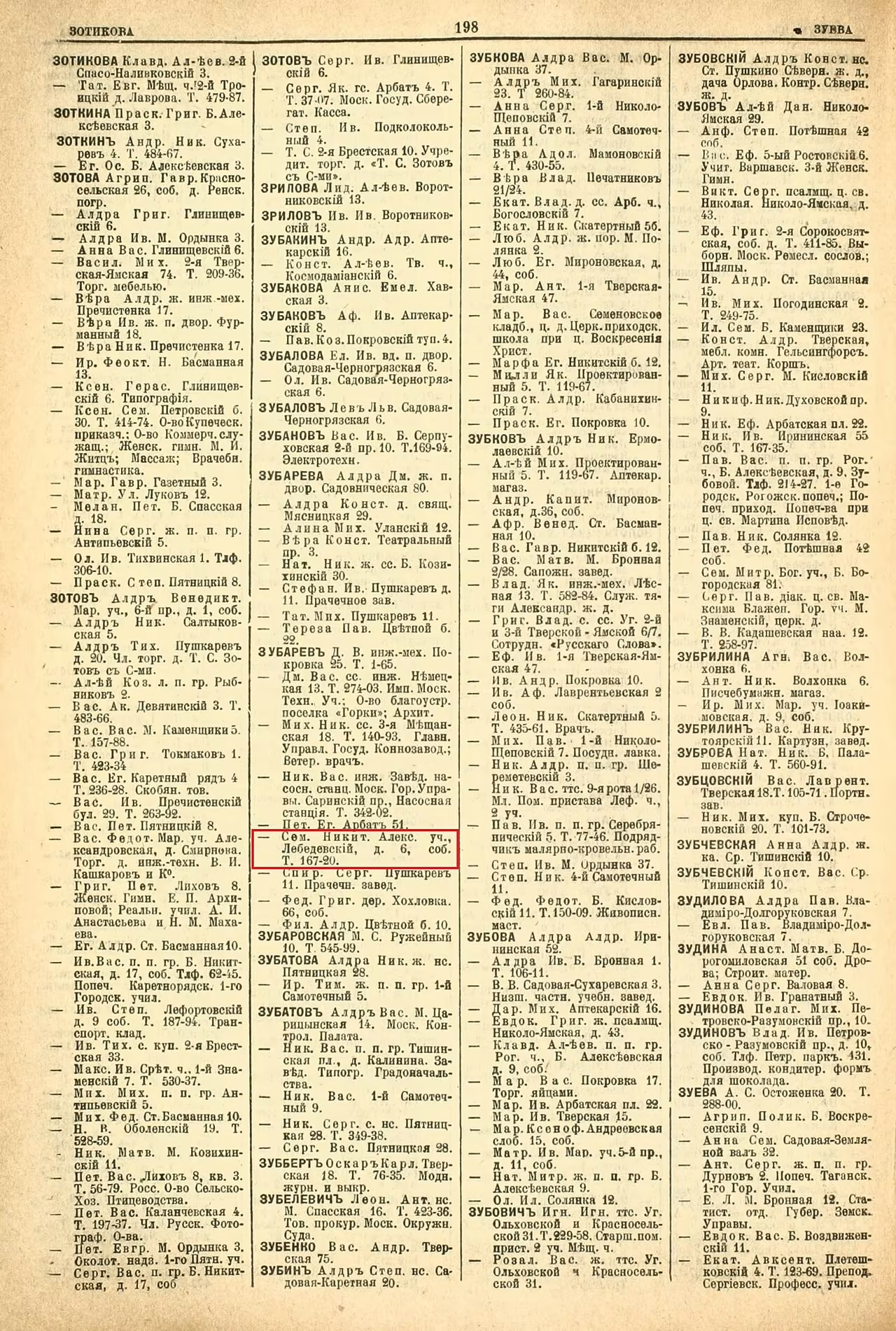
A page from a Moscow address directory, with an alphabetical list of residents, occupations and addresses. The page itself is numbered 198, but the year of publication is not printed. Wikimedia Commons, Moscow Address Book.jpg, author: A. S. Suvorin Partnership "Novoye Vremya", licence: CC BY-SA 4.0 source, license
The signboard shaped expectations of an establishment’s style
Contemporaries associated the word ‘tavern’ with an old urban tradition, Russian cuisine, tea and waiters in white shirts. ‘Restaurant’ and its earlier Russian form, ‘restoratsiya’, evoked European fashion, French cuisine, tail-coated waiters, hotel service and evening entertainment. These words shaped expectations, although they guaranteed neither the menu nor the price.
In 1868, Ivan Testov opened the Grand Patrikeyevsky Tavern in Patrikeyev’s building, specialising in prestigious Russian cuisine. According to Vladimir Gilyarovsky’s memoirs, it attracted merchants and aristocrats; theatregoers arrived after performances, and members of the St Petersburg nobility were among its guests. In the early twentieth century, Testov’s establishment changed its signboard while retaining its cuisine, established clientele and accumulated reputation.
Gilyarovsky wrote that the fashion for the new name turned yesterday’s taverns into restaurants, although Muscovites continued to use the old term. At the same time, the word could appear on the sign of a cheap, unpretentious establishment. Renaming might signal refurbishment or the proprietor’s desire to enhance its prestige, but sometimes it remained no more than an advertising gesture.
At Testov’s, the new name was accompanied by a substantial remodelling of the dining rooms. Gilyarovsky recalled that the old furniture survived in only two or three rooms. Moscow’s old gourmets stopped visiting Testov’s, while merchants arriving from elsewhere no longer recognised the former tavern. The proprietor had indeed modernised the interior, but some patrons associated the establishment’s reputation with its pre-refurbishment setting and style of service.
Advertisements and customers’ bills told different stories about prices
During the New Year holidays of 1825–1826, Moskovskiye Vedomosti announced that a restaurant owned by the French merchant Tranquille Yard would open on 1 January in Chavan’s building on Kuznetsky Most. The advertisement promised lunch and dinner, grape wines, liqueurs, pâtés and pastries at ‘very moderate’ prices. The proprietor promoted the cuisine, its foreign gastronomic vocabulary and an affordable respectability all at once.
A study published on the mos.ru portal compares this advertisement with a recollection by Alexander Herzen. He visited Yar with Nikolai Ogarev and ordered fish soup made with champagne, Rhine wine and small game; the bill was high, yet the young guests left hungry. The two accounts describe different orders and expectations, but clearly demonstrate that the word ‘moderate’ was not a measurable price category.
By the end of the nineteenth century, taverns still covered a broad price range. Cheap service in a communal dining room, an elaborate meal for a regular at Testov’s and a sealed carafe of expensive cognac at the Slaviansky Bazaar catered to different budgets. Converting an isolated pre-revolutionary price into modern roubles is meaningless without information about incomes, product quality and portion size. The contents of the order, the establishment’s standing and several independent accounts provide a more reliable basis for comparison.

The Yar restaurant in Petrovsky Park on a 1900 postcard, showing the building as it appeared in 1898–1900. Wikimedia Commons, Moscow. 'Yar' Restaurant in Petrovsky Park 1898~1900 903117 e1t3.jpg, author: P. von Girgensohn, licence: Public domain source
Russian and French culinary traditions intermingled
Taverns were associated with Russian dishes, while restaurants evoked French names and elaborate presentation. In practice, their menus overlapped. Prestigious taverns competed through the quality of their ingredients and the skill of their kitchens, while restaurants served dishes that patrons regarded as Muscovite or Russian.
Testov built his reputation on sumptuous Russian cuisine. In the chapter ‘Taverns’, Gilyarovsky lists sturgeon and beluga with horseradish, caviar, crayfish soup, fish and kidney solyanka, rasstegai pies, suckling pig, botvinya with fish and Guryev porridge. The writer describes a meal ordered by a wealthy regular, not the lunch of an average customer. The list confirms the establishment’s high standing: expensive ingredients, silverware, porcelain and professional service.
The Slaviansky Bazaar hotel restaurant on Nikolskaya Street offered breakfasts, private rooms, wines, champagne, coffee and liqueurs. European décor was combined with Russian tastes, while taverns also maintained wine lists. Proprietors of both types adapted their menus to the habits of regular patrons, seasonal produce and changing fashions.
The manner in which a meal was ordered revealed more about an establishment’s standing than the origin of any individual dish. At a working-class tavern, the main offerings might be inexpensive tea, hot water, ring-shaped bread rolls and hearty hot food. At an expensive establishment, an order extended over several courses accompanied by appetisers and wines, while the chef or a well-known waiter remembered a regular patron’s tastes. The standard of the cuisine was determined by purchasing, the team’s skill and the clientele’s spending power.
The carefully staged ‘Russian style’ of a prestigious tavern
At his tavern on Varvarka Street, Lopashov transformed traditional cuisine into a carefully staged vision of respectable Moscow. Gilyarovsky described a separate ‘Russian izba’, where small dinners were held for distinguished foreign guests: no French dishes were served, but French wines were decanted into vessels from bygone eras and presented as Fryazhian, Falernian or Greek wine.
Historical names, antique vessels, wooden spoons and the chosen menu formed a unified ritual. The proprietor retained the French wine but renamed the drink and served it differently. An expensive tavern consciously constructed a national image for a discerning clientele, so the simple division between ‘Russian tavern cuisine’ and ‘European restaurant cuisine’ does not withstand scrutiny.
Gilyarovsky dated a dinner held by Siberian gold-mine owners at Lopashov’s to the 1880s. A specially invited chef prepared 2,500 pelmeni for twelve guests—filled with meat, fish, or fruit in rosé champagne. This episode from his memoirs describes an exceptional display of status, not an ordinary serving, and shows how a tavern tailored its menu to the guests’ origins and sense of identity.
The leading merchants had their favourite tables at Lopashov’s. When meeting provincial wholesalers, they first ordered tea and discussed terms, then moved on to breakfast or lunch in private rooms. According to Gilyarovsky, a serving of tea cost fifteen kopecks, while the deals were worth tens or hundreds of thousands of roubles. A familiar table, a private room and the customary style of service had a value of their own during negotiations.

Boris Kustodiev. ‘Moscow Tavern’, 1916. Wikimedia Commons, Moscow Tavern (Kustodiev).jpg, author: Boris Kustodiev, licence: Public domain source
Tavern waiters and restaurant waiters: different uniforms, shared skills
A Moscow tavern employed waiters who usually wore white shirts and light-coloured trousers; in a restaurant, guests were greeted by waiters in tailcoats. In practice, the distinction was fluid. Gilyarovsky recalled that at the Slaviansky Bazaar, staff in tailcoats were already called restaurant waiters, while the best tavern waiters donned tailcoats for large orders.
A tavern waiter was expected to know the cuisine, serve guests, settle bills and maintain relationships with regular patrons. Training began with menial work; the boy then learnt the selection alongside the cooks before moving into the dining room under the supervision of senior staff. Guests expected speed, a good memory for their habits and the ability to manage a large order. In a reputable establishment, the white shirt was both a professional uniform and part of a recognisable Moscow ritual.
Gilyarovsky recalled that tavern and restaurant waiters often received no wages, while the working day in some taverns lasted almost sixteen hours. This memoir account cannot be applied to every establishment in Moscow. It describes a model in which the staff’s income depended on payments made in addition to the bill and on their personal clientele.
The writer also describes the terms of this arrangement: a worker might pay the proprietor at least three roubles a month or surrender twenty per cent of the tips processed through the till. The precise rules varied between establishments, but the system itself transferred part of the business risk to the staff. A regular patron brought a tavern waiter not only tips but also a more predictable income.
The internal accounting system also required skill. According to Gilyarovsky, a waiter received twenty-five roubles’ worth of copper tokens in the morning and handed them to the buffet counter with each order, then exchanged them for money after the guest had paid. Tips were recorded and shared, although workers concealed some of their takings. The tavern waiter took the order, transferred the money and was liable for any mistake.
The uniforms differed, but the professional duties were the same: knowledge of the cuisine, settling accounts with the buffet counter, remembering regular patrons, speed and tact were required in both types of establishment. ‘European’ service changed the outward conventions while preserving Moscow’s system of personal relationships between patrons and staff.

A Russian Empire-style samovar from the early nineteenth century, used in traditional tea service. Wikimedia Commons, Empire samovar.jpg, author: user:shakko, licence: CC BY-SA 3.0 source, license
A tavern’s clientele depended on its location and prices
Nineteenth-century Moscow taverns served different groups of city dwellers: their clientele was determined by the district, prices and specialisation of the establishment. Near markets and cab stands were taverns offering inexpensive tea and simple food; the commercial centre had establishments for major merchants; and expensive dining rooms attracted nobles, literary figures and members of the theatrical world. Different floors of the same establishment sometimes catered to different clienteles.
Gilyarovsky describes the traktir as a dining room for the solitary man, a place to relax and hold business meetings, and an informal merchants’ exchange. In such a setting, having a regular table meant almost as much as having an office at one’s firm: it signalled status, made one readily recognisable and allowed meetings to take place without official ceremony. At Testov’s, particular places were reserved for prominent merchants at set hours and remained unoccupied by other patrons until they arrived.
Traktirs catering to cab drivers and ordinary working people operated on a different business model. Several guests might share a cheap serving of tea, repeatedly ask for more boiling water and economise on every place setting. Such a dining room was closely tied to street work and short breaks, whereas a regular at Testov’s expected an elaborate meal and a familiar waiter.
The expression ‘merchants’ traktir’ also needs qualification. The category encompassed the owner of a large firm, a merchant from Gostiny Dvor, a young heir and a small shopkeeper. Their budgets differed, and their choice depended on the company, the time of day, the business at hand and the desired degree of visibility.
Restaurants welcomed hotel guests, office workers and theatregoers
Restaurants at hotels, theatres and out-of-town pleasure gardens combined dining with public entertainment. Expensive establishments attracted officials, noblemen, industrialists, performers, writers and affluent visitors. A tailcoated waiter, a wine list, music, a winter garden or a hotel room all shaped how guests spent their evening and made an appearance in society.
The word ‘restaurant’ did not in itself guarantee high prices. Gilyarovsky recalled the small Venice on Kuznetsky Most: by day, it fed passers-by of moderate means and office workers, while the more smartly dressed clientele chose the neighbouring confectioners’ shops. He also mentioned cheap little restaurants whose quality he judged harshly. These observations provide a counterpoint to the grand stories of Yar and the Hermitage.
An expensive restaurant could also attract a diverse clientele. At the Slavyansky Bazar hotel restaurant, ministers rubbed shoulders with gold-mine owners, landowners from the steppes, merchants and people of dubious reputation. People travelled to out-of-town restaurants to dine, listen to choirs, stroll through the gardens and continue their evening after the theatre. The common requirement was wealth, not membership of a single social estate.

Nikolskaya Street and the façade of the Slavyansky Bazar Hotel on a historic postcard. Wikimedia Commons, Nikolskaya Slavyansky Bazar2.jpg, author: Unknown authorUnknown author, licence: Public domain source
The traktir served as an informal office
A merchant could meet a partner at a well-known traktir, request his usual table, have a meal and discuss a deal away from the office. The waiters recognised their customers, patrons could see who was speaking to whom, and the proprietor maintained the order essential for conducting business. In this way, the traktir combined the functions of a dining room, club and meeting room.
A private room offered privacy without any formal procedure. Such rooms were used for negotiations, family meals and lengthy social gatherings, so their mere presence tells us nothing about respectability or revelry. Their character depended on the establishment, the floor and the company. Grand dining rooms and a cheap lower section could coexist in the same building.
The business function was particularly evident at the Slavyansky Bazar. According to Gilyarovsky’s recollections, the fashionable time for breakfast was between noon and three: groups of merchants came here after trading at the exchange and concluded major deals over their meals. Proprietors offered a communal dining room, a reserved table or a private room, each providing a different degree of visibility. The choice of venue became part of the negotiating strategy.
Establishments near theatres and newspaper offices
Traktirs and restaurants formed part of the city’s cultural infrastructure through their proximity to theatres, newspaper offices, shopping arcades and hotels. They remained open after performances and provided private rooms for lengthy conversations. Writers and actors went there to dine, read newspapers and discuss their work; the historical significance of each such episode requires reliable evidence.
The best-known example is the meeting between Konstantin Stanislavsky and Vladimir Nemirovich-Danchenko on 22 June 1897 at the Slavyansky Bazar restaurant. The official history of the Moscow Art Theatre records that their conversation lasted eighteen hours: they discussed artistic principles, stage ethics, the organisation of the company and its future repertoire. This meeting laid the foundations for the Moscow Art Theatre, whose first production opened on 14 October 1898 according to the Old Style calendar, or 26 October according to the New Style.
The episode involving Stanislavsky and Nemirovich-Danchenko demonstrates the practical role of a hotel restaurant in central Moscow: it provided the two men with a neutral, serviced space where they could work for many hours. Such establishments were well suited to discussing publishing plans and meeting after performances, but individual stories from one address cannot be applied to restaurant culture as a whole.

Anton Chekhov reads The Seagull to members of the Moscow Art Theatre company. Staged photograph. Wikimedia Commons, Anton Chekhov reads The Seagull.jpg, author: Pyotr Pavlov (1860-1925) [3][4], licence: Public domain source
The clientele changed with the time of day
A single establishment could attract a different clientele over the course of the day. In the morning, a traktir fed workers finishing the night shift; during the day, it served office workers and merchants; in the evening, theatre parties; and at night, those returning from entertainment outside the city. Listing its patrons without specifying the time creates the false impression that they all sat at neighbouring tables.
For a business breakfast, people chose a convenient central location, prompt service from familiar staff and the opportunity to talk; for a family meal, they sought reliable cuisine and a good reputation. A late-night theatre party looked for somewhere that stayed open long hours, while a cab driver needed a yard for his horses, cheap tea and filling food. The sign above the door conveyed none of these requirements.
Prestige, too, took different forms. Testov’s Russian cuisine could cost more than the menu at an unremarkable restaurant with a foreign name. The out-of-town Yar attracted guests with music and late-night entertainment, the Slavyansky Bazar with its hotel and business breakfasts, and the neighbourhood traktir with familiar company and affordable prices. A Muscovite chose a setting for the day’s activities, not an abstract category of establishment.
Women’s access depended on the individual establishment
Merchants’ private rooms, cab drivers’ dining rooms and cheap drinking rooms often revolved around male commerce, labour and convivial drinking; some spaces effectively or explicitly excluded women. Sources, however, record different rules even at neighbouring establishments.
Gilyarovsky describes Bubnov’s ‘Hole’ as a place where women were not admitted, whereas at another traktir their presence formed part of the rowdy revelry. Testov’s welcomed families when landowners brought their children to Moscow for schooling, and women were also among the theatregoing public. A restaurant at a hotel or pleasure garden offered a different visiting experience from a merchants’ traktir beside the shopping arcades, while each establishment’s reputation determined how safe and respectable it was.
The sources present women in various roles: as patrons, kitchen workers, stage performers and people whose access was restricted. Such cases need to be examined separately. The rules were determined by the proprietor, the layout of the premises, the programme, the time and the conventions of a particular social circle.
A single traktir served several different clientele groups
Social distinctions could run quite literally up the stairs within a single establishment. Gilyarovsky described Krasovsky’s traktir at the corner of Ostozhenka Street and 1st Zachatievsky Lane, known to Muscovites as the Dovecote. After reconstruction, the three-storey stone building acquired so-called noblemen’s rooms with private dining rooms on the first floor, while above them was a low-ceilinged dining room for ordinary people, with more than a hundred tables and still enough space for dancing.
The Dovecote hosted weddings and balls; in the mornings, footmen gathered there after completing their commissions, while trade intermediaries settled their accounts. The private rooms were used for closed meetings. Later, according to Gilyarovsky, revolutionaries gathered there, and in 1905 the building hosted political rallies. This single address served as a dining room, a celebration venue, an informal office and a political refuge.
Bubnov’s traktir in the Kazansky Metochion building on Vetoshny Lane was divided even more starkly. Its upper section occupied two floors and a mezzanine, with richly decorated dining rooms and private rooms; below was a cheap, cramped and noisy cellar known as Bubnov’s ‘Hole’. Merchants ate breakfast and conducted business upstairs, while the lower dining room offered large portions and inexpensive drink.
The floor, the room and the time of a visit revealed more about the clientele than the name applied to the establishment as a whole. This arrangement allowed the proprietor to serve several groups, retaining both high-value orders and mass custom. Two contemporaries might describe the same traktir as luxurious and filthy if they knew different parts of it.
A private room did not necessarily signify exclusivity, nor did a communal dining room necessarily indicate poverty. Its meaning depended on the décor, prices, admission rules and purpose of the meeting. By allocating patrons to different rooms, the proprietor reproduced the city’s social hierarchy within a single building.

Vetoshny Lane, viewed from Nikolskaya Street, 29 June 2014. Wikimedia Commons, Vetoshny Lane, 29.06.2014.JPG, author: Brateevsky, licence: CC BY-SA 3.0 source, license
Khitrovka as a distinct part of Moscow’s traktir culture
Khitrovskaya Square was an area of dosshouses, cheap labour and traktirs with grim reputations. Gilyarovsky knew this milieu and described it with a reporter’s vividness. Later retellings often treat his accounts as a general portrait of Moscow’s drinking culture, although Khitrovka was a distinctive district.
The Katorga traktir and neighbouring establishments served people connected with the casual labour market, dosshouses and the street economy. Their food, prices, rules and risks differed from those at Testov’s, the merchants’ dining rooms of Kitay-Gorod or a hotel restaurant. Even within Khitrovka, different floors and rooms had distinct characters. In later retellings, the label ‘den of vice’ erased these distinctions, leaving only a colourful criminal backdrop.
Gilyarovsky’s description of Khitrovka relates to a distinctive area. The law placed its local traktirs in the same line of business as respectable establishments, but their addresses, proximity to dosshouses and links to the casual labour market changed their everyday operation. Comparison with Testov’s or the Slavyansky Bazar reveals the limits of legal classification: establishments in the same category did not provide guests with the same conditions.

People at Khitrov Market in Moscow in the 1900s. Wikimedia Commons, Khitrov Market folk, 1900s.jpg, author: Unknown authorUnknown author, licence: Public domain source
Nikolskaya: a hotel restaurant in the commercial centre
Nikolskaya Street formed part of the commercial centre, with its shopping arcades, offices, hotels and constant flow of visitors. The Slavyansky Bazar restaurant welcomed hotel guests, merchants and the participants in the celebrated theatrical meeting. Its location in Kitay-Gorod connected services for travellers with the district’s commercial life: people came here for breakfast, negotiations and after completing their business in the city.
Gilyarovsky described a route from the hotel rooms to the restaurant through a corridor of private rooms. The layout brought together a public dining room, private conversation and accommodation for travellers. A state historical and cultural assessment records the Slavyansky Bazar hotel and restaurant complex at 17 Nikolskaya Street as a cultural heritage site. The document confirms the building’s location and protected status, but not that its historic interiors are freely accessible.
Further east, around Khokhlovka and Khitrovskaya Square, narrow lanes, residential buildings, the labour market and a network of small establishments predominated. Nikolskaya catered to the hotel trade and large-scale commerce; Khitrovka encompassed neighbourhood, inexpensive and marginalised spaces. This comparison is more illuminating than a general debate over which type of establishment was ‘better’.

The Zaikonospassky Monastery tenement building, constructed in 1899–1900 on Nikolskaya Street. Present-day view. Wikimedia Commons, 7071. Moscow. Nikolskaya Street, 7-9.jpg, author: GAlexandrova, licence: CC BY-SA 4.0 source, license
How to read laws, directories and memoirs together
The 1893 Regulations explain what the authorities considered to be the tavern trade, but do not tell us how the waiter in a particular proprietor’s establishment was dressed or who occupied a table at a given hour. A directory records the name, proprietor or address, but not the quality of the food or the atmosphere in the dining room. Memoirs preserve details of everyday practice while also selecting the most striking episodes.
The article’s main narrative source is Vladimir Gilyarovsky’s chapter ‘Taverns’. The State Public Historical Library dates the first edition of Moscow and Muscovites to 1926, while the electronic publication of the text states that it was written between 1917 and 1926. The author was recalling turn-of-the-century establishments many years later. His observations are valuable for menus, speech and everyday routines, but precise sums, records and anecdotal episodes require careful attribution.
The story of the 2,500 dumplings remains Gilyarovsky’s testimony rather than a verified kitchen record. The legal classification of 8 June 1893 can be checked against the Digest of Laws. The 1900 edition of All Moscow helps establish the establishment’s contemporary spelling and commercial presence. This kind of comparison separates its statutory category from its urban reputation.
The same principle applies to Slavyansky Bazar. The Moscow Art Theatre’s webpage confirms the date of the meeting between Stanislavsky and Nemirovich-Danchenko and draws on Stanislavsky’s memoirs; the historical and cultural assessment report confirms the address and status of the complex on Nikolskaya Street. The first source describes the event and the second the building. Neither proves what was on the menu, the social profile of the entire clientele or whether the interiors were accessible.
The reliability of a conclusion depends on how roles are assigned to the sources. The law confirms the rule; the directory, the establishment’s existence and location; memoirs, observed practice and the author’s recollections; theatre history, a specific meeting; and the heritage-protection document, information about the building. Keeping these roles separate prevents a vivid episode from being mistaken for the workings of an entire urban trade.

The four-volume collected works of Vladimir Gilyarovsky, published in Moscow in 1989. Wikimedia Commons, Sobranie sochinenii Gilarovskogo v 4 tomah.jpg, author: Bekbal, licence: CC BY-SA 4.0 source, license
Four criteria for an accurate comparison
Begin by establishing the establishment’s place within the legal and urban system: the year, address, proprietor, connection with a hotel, permitted forms of trade and character of the district. The meaning of the same signboard in the 1830s and the 1900s depended on the establishment’s business model.
Next, compare the menu and prices. Russian dishes could be expensive, while a French name was no guarantee of quality. An advertising claim must be distinguished from an account of an actual order, and a single lavish meal from the everyday fare of most guests.
The third criterion is service and space. The staff’s attire, tipping practices, tables reserved for regulars, the main dining room, private rooms, music, the hotel corridor and the yard for horses all influenced the purpose of a visit. These details turned an eating establishment into a place for negotiations, a family dining room, somewhere to relax after the theatre or an inexpensive stop during the working day.
Finally, consider the clientele and the time of day. Terms such as ‘merchants’, ‘nobles’ and ‘the common people’ are too broad without qualification. It is more reliable to establish which patrons came in the morning, afternoon and at night, why they met and which room they occupied.
Conclusion: how a tavern differed from a restaurant
In the late nineteenth and early twentieth centuries, these two types of Moscow establishment differed in their cultural codes and organisation of service. The tavern retained its association with Russian cuisine, tea, waiters in white shirts and a regular merchant clientele; the restaurant was associated with European fashions, waiters in tailcoats, hotels, wines and entertainment. Expensive cuisine, private rooms and distinguished guests could be found in both.
In law, these establishments belonged to the same category, while proprietors borrowed successful practices from one another. Renaming in the early twentieth century blurred the distinction still further. Muscovites chose an establishment according to their means, its reputation and district, the time of day and the occasion: a wealthy merchant conducted business in both taverns and restaurants; a clerk ate lunch in an inexpensive little restaurant; and theatregoers went to Testov’s after a performance.

The junction of Khokhlovsky Lane and Maly Ivanovsky Lane. Present-day view. Wikimedia Commons, Moscow, Khokhlovsky Lane and Maly Ivanovsky Lane — 7022.jpg, author: Roman Balabin, licence: CC BY-SA 3.0 source, license
This historical comparison can be continued through the city’s topography. The ‘Notorious Haunts’ tour links Nikolskaya Street and Slavyansky Bazar with Khokhlovka and Khitrovskaya Square. These locations reveal differing conditions of trade, hotel service, work and everyday social interaction. The programme explores the surviving city from the street and does not promise access to historic interiors.
Sources
- Code of Laws of the Russian Empire. Volume XII, Part 2: Regulations on the Tavern Trade, 1893
- All Moscow: Address and Reference Book for 1900
- Vladimir Gilyarovsky. Moscow and Muscovites
- Vladimir Gilyarovsky. Moscow and Muscovites. Chapter: Taverns
- Chekhov Moscow Art Theatre: the Meeting at the Slavyansky Bazar and the Theatre’s Formation
- State Historical and Cultural Expert Assessment Report on the Development of Nikolskaya Street, including the Slavyansky Bazar Hotel and Restaurant
- A Taste of Moscow: Three Centuries of Moscow Restaurants
- Moscow Heritage Magazine: Memories of Food
- Culture.ru: Five Famous Restaurants of Pre-Revolutionary Moscow
- State Public Historical Library: V. A. Gilyarovsky, Moscow and Muscovites, 1926 edition
- Moscow Code: Materials on V. A. Gilyarovsky’s Book Moscow and Muscovites
We took a tour of Taganka designed for 12-year-old children. It was an excellent programme. We covered a great deal of ground and learnt so much. We discovered the story of Dryanaya Street and discussed the Vladimir Highway, the surrounding monasteries and churches, and the Old Believers. We now know where Korovin was born, where Stanislavsky was born and raised, where the Morozov merchant children lived, and why Arseny Morozov was considered such an outrageous figure in his day. We also discussed Solzhenitsyn, discovered where Stalin Avenue was supposed to be built, saw the bunker, walked to the Russian metochion of the Mount Athos Monastery, and learnt why the Illuzion cinema made Taganka famous. Of course, no tour would have been complete without Vysotsky and Lyubimov. We also touched briefly on Taganka Prison, although naturally we did not go there. All in all, it was an exceptionally rich and informative tour! Our guide Alexander was superb!
Our thanks to our guide Alexander for a magnificent sightseeing tour. Alexander’s love for Moscow and its history, his wide-ranging knowledge, elegant and engaging delivery, and personal charm make the tour not merely interesting and informative, but truly delightful! Thank you, Alexander! Tatiana and Tatiana, St Petersburg
On July 18th, we participated in the "Soul of Moscow" group tour led by Alexander. Kitay-gorod and its surroundings revealed a new side to us, and everyone thoroughly enjoyed it. Some of us began intensively studying related materials to broaden our horizons. We'll be back, and we highly recommend it! You won't regret it.
Good afternoon, on June 23rd we had a tour called " The Soul of Moscow ," led by Alexander. He's a very pleasant young man. We visited such lovely courtyards and alleys with him that we never even knew existed, and we learned so much. We really enjoyed everything, and we hope to continue our acquaintance. Alexander! Thank you! We had a great time with you, and we thoroughly enjoyed it. See you there!
This isn't my first time with Radius. This time, I took the Moscow metro . The goal was not only to admire the underground palaces but also to learn how to navigate the metro. As a resident of a region without a metro, I was a bit apprehensive and didn't understand how to navigate the metro. Of course, the internet helps, but live communication is much better. Tour guide Yulia handled this task perfectly. The information was accessible and interesting, the presentation was calm, and the communication style was very friendly. Thank you very much for the tour and the practical experience.
Good afternoon! I gave the "Soul of Moscow" tour to some of the capital's guests. We were thrilled to hear our guide, Anton. It was so informative and engaging, and very warm. To say we were absolutely delighted is an understatement. It turned out to be a truly family-friendly excursion. We learned so many interesting facts. The material was presented professionally, all our questions were answered, and we saw so much. It was simply WOW! Thank you so much, Anton, he's the best!!!!! From now on, I'll only come to you, the Radius team. I highly recommend it. I promise we'll see each other again soon on other tours.
Overall, the tour left a positive impression! Thanks to Alexander for the walk through the courtyards and atmospheric spots of Kitay-Gorod; we certainly wouldn't have done it on our own. The tour was comfortable, and the guide spoke confidently and calmly. One thing we personally missed: we would have liked more of the historical part, relating to ancient Moscow and the history of Kitay-Gorod. There were quite a few stories about the Soviet period and the bar scene, but for our group, this wasn't particularly relevant. We think the program could be a little more tailored to the age and interests of the group. It would also have been interesting to add more historical facts, monuments, and details about old Moscow and the area itself. That said, the tour was still interesting, and some places and churches were truly memorable. These aren't really "cons," but rather suggestions for an even more comprehensive program.
Hello! We had a corporate group of 10 people. Our guide was Anton, and we had a tour of Bulgakov. I would like to point out the excellent organization; everything went smoothly. The managers were very accommodating to our changes in the number of participants. The bus was very comfortable. Anton is a super-engaged and motivated guide. He lives this history and is delighted to share his knowledge and create an unforgettable experience. Everything went well. I highly recommend it!
Thank you for a fascinating tour! It gave me so much food for thought to explore! Note: Review of the "Zamoskvorechye" tour with guide Maria.
I'd like to express my gratitude on behalf of our team! Thank you for keeping to our scheduled schedule despite our lack of organization. Our colleagues appreciated your preparation for the tour! It was informative. Note: Review of the "Modern Residential Complexes, Factory Past, and Avant-Garde" tour of the ZILART residential complex with guide Maria. Maria prepared and conducted a customized tour for employees of the Samolet Group of Companies development company.
Thank you! You have great talent. Good luck! ☺️ You're a wonderful guide! Thank you again! Note: This is a review of the corporate tour "The Heart of the Capital" with guide Maria.
Thank you for a wonderful day today!!)) Note: review of the excursion "The Soul of Moscow" with guide Maria
On behalf of the whole family, I want to thank you for a very informative and interesting tour! Note: This is a review of the "Palace Dungeons" tour with guide Maria.
Good afternoon! I'd like to express my gratitude and that of my guide for organizing the tour! We were very pleased. We'd like to do it again in October, but on a different route — ZIL. Note: This refers to the tour for Samolet Group developers, led by guide Maria.
Thanks to Alexander for the bar tour of Baumanka ! It was fun, exciting, and we discovered so many new places! Awesome! May we reach new heights!
Good afternoon! I was on a tour of Sukharevskaya Square — we went all the way to Tsvetnoy Boulevard. I didn't expect it to be so interesting! For those wondering whether to go — go for it! It truly became one of my most memorable summer memories!
Anastasia, good morning! Thank you and Masha for yesterday! The speakers are happy. The connection through the headphones was often lost, especially at the checkpoint, but that's just our current situation. You could hear if you were standing close, no more than 1.5 meters away. Colleagues have already asked for your contact information. I'd be happy to share it and look forward to another opportunity to work with you. Special thanks to the Director for the Bureau . Note: " Heart of the Capital " tour for participants of the 2025 Moscow Oncology Forum. Guides: Anastasia and Maria.
We'd like to thank Anton and Alexander for leading the tour! It was fascinating to hear how the Krasnaya Presnya district developed and how Prokhorov's influence on our city's development. It was a pleasant immersion into a quiet, previously unexplored area!
Good afternoon, thank you so much, Anastasia. The " Uncle Gilyai " tour was fantastic. Even though we're Muscovites and know a lot about Moscow, the experience was amazing, so much new and interesting happened. We'll definitely be back.
Thank you for the " Heart of Moscow " and " Khamovniki " tours. Anton, a knowledgeable and passionate Moscow guide, gave me the tour. He's a great storyteller, intelligent, well-read, and captivating. You've truly opened up my Moscow to me! I'll definitely be back next summer to explore Moscow with you. I'll recommend your wonderful tour program to all my friends!
Excursions with the Radius travel agency are always a positive experience if you choose them. We planned a tour of Zamoskvorechye on our next visit. We've worked with our guide, Anton, before. We'll definitely recommend him to everyone we know. The tour is informative, not overloaded with dates, and the information is comprehensive yet easy to understand, as it's presented in a light, narrative manner, not like a history textbook, dry and academic. Thank you for this approach. We'll definitely use the Radius agency again on our next visit to Moscow.
Thank you so much for the tour of Zamoskvorechye . Despite the weather, it was very interesting and informative! Note: this refers to the tour with guide Anton.
A huge thank you to Anastasia. We had a fantastic tour of the Patriki district. We learned so much. Anastasia is a true master of her craft. The tour was captivating, not at all boring, lively and interesting. Everyone was delighted. We were full of new impressions. I definitely recommend it. You won't be disappointed!
We explored the Soul of Moscow with my family and Radius on my birthday. Everyone thoroughly enjoyed the walk! Anton shared so many interesting facts about the capital and its history, taking us into spiritual depths no one else had even suspected. Most of us were either born or longtime Moscow residents who spent a lot of time walking around. It was educational, heartwarming, and unforgettable. 🙂 Overall, this wasn't my first time walking around Moscow with Anton, and each time was a real adventure!