The excursion leaflet of the 1920s served as a practical guide for following a route independently. In the ‘Self-Education Excursions’ series, published by the Cultural and Educational Department of the Moscow Provincial Council of Trade Unions, each slim publication set out a subject for study and linked it to movement through a real place. It helped participants formulate a research question and gather observations with which to answer it.
The sources place limits on this conclusion. The online catalogue of the Russian State Library provides the title, publisher, length and subject of each issue, but not the contents of every page. The catalogue data must be distinguished from the methodological principles described by contemporaries Nikolai Geinike and Boris Raikov. In the methodology of Geinike and Raikov, structured observation became the central technique: participants were encouraged to observe, compare, record and discuss what they saw.
The ‘Self-Education Excursions’ Series
A series of short thematic publications appeared under this title from 1925 onwards. The Russian State Library catalogue names the Cultural and Educational Department of the Moscow Provincial Council of Trade Unions as the publisher. Their pocket-sized format—18 centimetres—made the booklets convenient to use on the move; individual issues ranged from five to twenty pages.
Issue No. 14 appeared in 1926 under the full title ‘Leaflet for a Walking Local-History Excursion around the Outskirts of Moscow: “To a Village near Moscow” (Market-Gardening and Fruit-Growing District)’. It ran to 15 pages. The bibliographic record identifies the Moscow Provincial Council of Trade Unions’ Trud i Kniga printing house, while the MARC record gives a print run of 5,000 copies. This last figure indicates the scale of publication, but does not in itself establish how many people used the leaflet or precisely how they followed its route.
The compilers linked the text to a walking local-history excursion. The title combines a mode of travel, a geographical area, a field of study and an economic theme. The words ‘market-gardening and fruit-growing district’ point to the observable organisation of labour and space. A single catalogue record cannot reveal the precise sequence of stops or the publication’s assignments.
The Leaflet within the Series
The list of titles reveals the series’ self-education concept more clearly than any individual catalogue record. Country estates, museums, nature, urban history, agriculture and contemporary art all appear side by side. The term ‘excursion’ denoted a transferable method for studying a variety of subjects.
The compilers of the first booklets proposed a trip to Kuskovo, observations of nature and a visit to Ostankino. A later list includes the Moscow Municipal Museum; the issue ‘At the Estate of the Tsar of Moscow’, complete with a plan; the leaflet ‘Through Old Moscow’; the guide ‘How and Where to Observe Animals in Moscow and the Moscow Region’; and material for the eighth exhibition of the Association of Artists of Revolutionary Russia, ‘The Life and Everyday Culture of the Peoples of the USSR’. Their length also varied, from five pages for the Kuskovo and Ostankino publications to 23 pages for the Association’s edition.
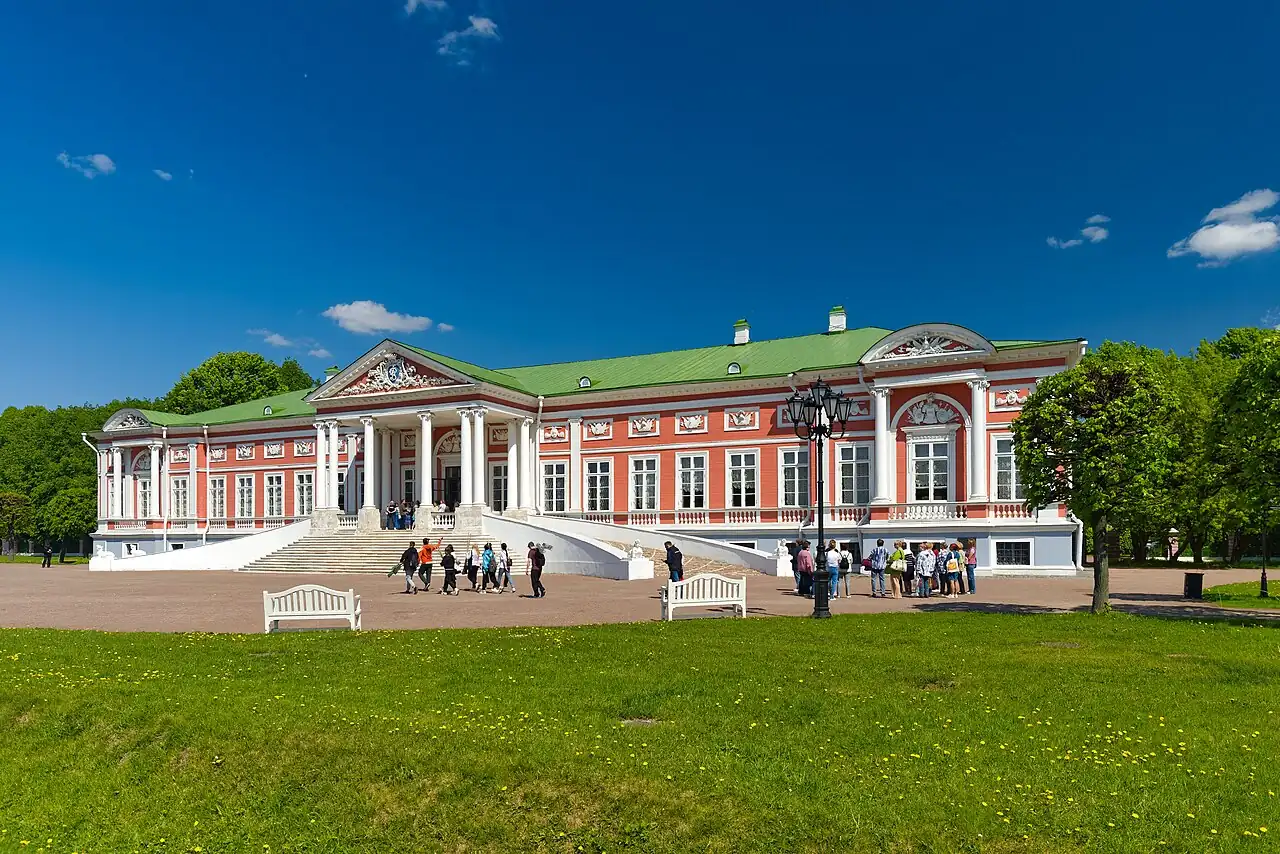
A present-day view of the Main Palace at the Kuskovo Estate from the formal façade. Wikimedia Commons, Moscow. Kuskovo Estate. Palace P5172739 2600.jpg, author: Alexxx1979, licence: CC BY-SA 4.0 source, license
The list of issues allows us to reconstruct the general principle behind this approach to learning: identify a subject, select an environment in which it could be observed and provide the participant with printed guidance. Estate architecture required one kind of route, animals a different mode of attention and an exhibition a different viewing sequence. The series incorporated each individual walk into a programme of self-education.
The institutional attributions within the series also changed. According to the Russian State Library catalogue, Issues Nos. 1–4 were introduced by the Cultural and Educational Department of the Moscow Provincial Council of Trade Unions; Nos. 11–17 by its Self-Education Advisory Service; and No. 18 by the Self-Education Bureau. These attributions connect the leaflets to an institutional educational programme, although they do not allow the history of the entire organisation to be reconstructed.
Printed Form as Part of the Method
The supporting material varied according to the issue’s subject. Catalogue descriptions record a bibliography, a plan and illustrations in different booklets. The printed format formed part of the method: the compilers selected a different tool for each type of observation, although the purpose of a particular element can sometimes be inferred only tentatively.
Leaflet No. 1, ‘An Excursion to Kuskovo’, ran to just five pages, and the Russian State Library record specifically notes a bibliography on page 5. The established fact is the presence of a reading list; the editorial interpretation is that it enabled readers to continue their studies after completing the short route. Even if the main text was extremely concise, the final page took participants beyond this single publication.
For Booklet No. 12, ‘At the Estate of the Tsar of Moscow’, the catalogue notes the inclusion of a plan. Issue No. 13, about observing animals in Moscow and the Moscow Region, had 13 pages and illustrations. For Issue No. 16, which accompanied the eighth exhibition of the Association of Artists of Revolutionary Russia, ‘The Life and Everyday Culture of the Peoples of the USSR’, the bibliographic description distinguishes four pages numbered with Roman numerals, 23 pages of main pagination and one further unnumbered page. For a spatial subject the compilers chose a plan, for natural history an image and for an exhibition a more extensive text.
Different media invite different actions. A plan helps relate a stop to the overall configuration of the route; an illustration helps identify an object; a bibliography extends observation into further reading. This interpretation of the publications’ physical features remains an editorial one. It accords with Raikov’s requirement to connect preparation, direct observation and subsequent analysis, but there is no direct evidence that all the compilers followed a single set of instructions.

An aerial view of the Ostankino Estate: the palace complex, forecourt and road, 1997. Wikimedia Commons, Ostankino Palace (1997-01-01).jpg, author: Viktor Chernov / RIA Novosti, licence: CC BY 4.0 source, license
In 1915, Russian Excursionist reviewed Ivan Lelkov’s book Our Saratov Province, or How Petya Travelled around the City of Saratov and What He Learnt about Saratov Province. The reviewers criticised its narrative style, the absence of a map of Saratov and the excessive amount of statistics. Their comments reveal the practical criteria by which contemporaries assessed a publication for travellers: readers needed a spatial guide and a selection of information they could work with along the way. The review does not relate directly to the series published by the Moscow Provincial Council of Trade Unions, so it provides historical context rather than commentary on Leaflet No. 14.
The catalogue record for Issue No. 14 establishes another boundary. The Russian State Library classifies it under cultural and educational work, the promotion of agricultural knowledge and reference guides for excursions; geographically, the document is classified under Moscow’s natural features. These subject headings were assigned by the library at a later date and cannot substitute for the authors’ preface of 1926. They do, however, precisely identify the leaflet’s dual focus: a method of study and an agricultural and natural environment.
Every issue retained a portable format of 17–18 centimetres. The pocket-sized booklet allowed participants to consult a question, plan or bibliography while following the route. Its physical format supported the independent study of a place.
The Excursionist as Researcher
Pre-revolutionary educational practice already combined travel, observation and the recording of material. The journal Russian Excursionist was published in Yaroslavl from 1914 to 1917; the National Library of Russia lists 26 issues devoted to the theory and practice of excursions. Professional discussion of the purpose, organisation and educational benefits of excursions began before the Soviet self-education campaign.
Materials from the Russian State Library on school expeditions in the early twentieth century reveal this practice in detail. Participants were advised to bring sketchbooks and pencils, take notes, and make sketches and photographs. In 1913, a group of 22 children covered 650 versts in 42 days; the organisers recorded their pace, rest periods, meals, expenses and division of responsibilities. Both the journey and the participants’ collective work were documented.
The first 1914 issue of Russian Excursionist published two different types of account. A group of 30 grammar-school pupils led by their headmaster described a journey to the Solovetsky Islands and included photographs of the monastery and its surroundings. In the same issue, Yevgeny Shaposhnikov, a fourth-year pupil at the Kaluga Realschule, recounted a journey to Nizhny Novgorod, Kostroma and Yaroslavl. The group report and the pupil’s account preserved their observations after their return and turned a private itinerary into material for other readers.

A present-day view of the Solovetsky Monastery ensemble from the water. Wikimedia Commons, Historical and cultural complex of the Solovetsky Islands.jpg, author: Alexander Baidukov, licence: CC BY-SA 4.0 source, license
The 1913 expedition and the urban leaflet of the 1920s differed in scale, institutional context and subject matter. What they shared was a demonstrable emphasis on the participant’s active involvement. A route acquires educational meaning when participants identify features for themselves, make notes and subsequently analyse the material they have collected. In the 1920s, educational theorists formulated this principle more precisely.
Excursion Methodology in the 1920s
During the 1920s, disparate observation techniques developed into a methodology. Comparing the Moscow and St Petersburg schools of the 1910s and 1920s, researcher Elena Romanicheva identifies movement through space, thematic unity, immersion in the atmosphere of a place, the authenticity of the object, collective perception and independent study. A peer-reviewed article published in 2026 describes this process as a transition from visual demonstration to methodology and, by the turn of the 1930s, to the establishment of excursion studies as a discipline.
In 1923, Nikolai Geinike edited the collection Cultural and Historical Excursions. Its sections covered Moscow, Moscow’s museums and the Moscow Region. Romanicheva emphasises Geinike’s integration of visual, physical and emotional perception, historical sequence, active group participation and the exchange of observations. Participants interpreted their surroundings together, while a specialist directed their attention.
These principles explain the title of the ‘Self-Education Excursions’ series. Self-education required a prepared framework: a defined subject, objects available for direct study, an ordered sequence of stops and a set of questions. A leaflet could structure this kind of work in the city.
Raikov argued against using a house or street merely to illustrate a proposition presented in advance. The object’s characteristics became part of the reasoning process, while participants compared what they saw with their historical knowledge and formulated a conclusion.
Four Elements of the Excursion Method
Raikov assigned the theme, object, route and analysis of the results to different stages of the work. Together, they form a system: the question focuses attention, the subject provides the material, the sequence of stops structures the reasoning, and the written record allows the conclusion to be verified after returning.
- Topic
- A boundary for the investigation, narrower than a broad field such as ‘old Moscow’. Raikov required the parts to be logically connected and warned that attempting to show everything at once created a chaotic medley. The theme determines which phenomena come to the fore and which remain outside the scope of the walk.
- The Excursion Object
- An object that can be observed directly in its own setting: a building, monument, plant or industrial process. Background information about the object supports its presentation but does not replace it. If a key piece of evidence cannot be seen on site, it should be moved to the preparatory or follow-up work.
- Plan and route
- The plan divides the subject into related questions, while the route arranges encounters with objects in space and time. The shortest path is not always the best: the sequence should allow each new observation to refine the previous one. The pattern of movement is therefore part of the argument, not merely a matter of logistics.
- Post-tour follow-up
- The consolidation of notes, sketches and collected materials into a verifiable result. Raikov listed a collective account, a practical session, a report, an essay, an exhibition and combinations of these forms. The precise outcome depended on the subject, but without one, impressions did not become a complete piece of educational work.
The tour as a method of studying the city is formed by the interplay of these four operations. Tour leaflets from the 1920s are of interest as a possible vehicle for this system: they brought together a narrowly defined subject, portable text and a real territory. Only a complete copy of a particular issue can reveal where it drew the line between a prompt and a ready-made conclusion.
The authentic setting and the image
Boris Raikov assessed a tour object by its form and its position within its own setting. In his book Methods and Techniques of Guided Tours, he insisted that movement through space was essential, yet did not in itself constitute a tour. Participants had to study the object in its natural relationship with its surroundings.
Raikov examined the difference between an image of a monument and encountering it on site. A photograph or reproduction conveys its form, but not its true scale, position, approaches or relationship with neighbouring objects. His example of the Bronze Horseman shows that the urban setting is not a decorative backdrop: the monument’s location forms part of what is observed.

The Bronze Horseman in Senate Square: an overall view of the monument together with its granite boulder pedestal. Openverse, Wikimedia, Bronze Horseman, author: Florstein (Telegram:WikiPhoto.Space), licence: by-sa 4.0 source, license
This principle is particularly important in architecture. On the street, the form of a façade is complemented by the width of the plot, the building line, the building’s setback, shifts in perspective, the juxtaposition of different eras and the direction in which the viewer moves. The participant sees the object as evidence of a particular urban-planning decision. The walking format of issue No. 14 established the conditions for observation: the commercial district was to be understood through distances, boundaries and the sequence of properties.
Direct observation also has its limits: a person’s attention depends on the question posed and their preparation. A methodological leaflet selects features in advance, helping the participant while also narrowing the field of observation. The resulting understanding does not encompass the whole of reality.
The route as an argument
A route becomes an argument when the order of its objects addresses a single question. Raikov allowed for a complex subject but required its parts to be organically and logically connected. A random accumulation of notable places undermines the investigation: participants remember individual stories but fail to understand the relationships between them.
Thematic unity does not mean uniformity. An architectural tour may compare a manor house, a tenement building and a public building if their differences help reveal changes in the urban fabric. A natural-history tour may examine several species and habitats if the stops test a shared hypothesis. In the issue about a village near Moscow, the economic theme, judging by its precise title, was intended to bind the journey and the study of local history together, although the author’s narrative structure cannot be reconstructed without the full text.
The sequence serves three purposes. Its spatial function ensures a manageable transition without breaking the participants’ concentration. Its evidential function adds a feature that refines or disproves the initial impression. Its temporal function presents participants with material in an order that allows them to formulate a conclusion. Each stop must add an essential link to the chain of reasoning; the object’s fame alone does not guarantee this.
This logic explains the brevity of the printed guide. A pocket-sized publication did not need to provide an exhaustive history of every place. It could keep the question and the sequence of work in view while participants examined the objects themselves. The leaflet’s small size therefore cannot be regarded as a sign of superficiality without analysing its function.

Plan of Greater Moscow — Appendix I to S. S. Shestakov’s book Greater Moscow, published in 1925. Wikimedia Commons, 1925 moscow-shestacov.jpg, author: S. S. Shestakov, licence: Public domain source
The debate over the ‘open-air lecture’
A tour loses its distinctive character if the guide delivers an ordinary lecture and the street serves merely as scenery. Raikov explicitly criticised this format and proposed speaking primarily about what could be observed under the given conditions. Theoretical material was to be provided sparingly, while objects that could not be seen were to be excluded from the plan or moved to another form of study.
Historical background is needed to understand a structure’s purpose or the reason why a landscape has changed. It directs observation and explains what is seen. If participants could have the same experience in a classroom without losing any of the content, the route has been poorly designed.
Raikov’s methodology required facts to be connected with visible evidence while leaving room for participants to draw their own conclusions. Brevity was the result of editorial selection. The compiler needed to know the subject and understand at what point along the route the reader would need a question, explanation or point of reference.
In a ‘street lecture’, the guide imparts ready-made knowledge; on an investigative route, the guide organises its acquisition. The quality of the method depends on the objects’ role in the argument and is not determined simply by the number of dates and names.
Participants’ independent work
Raikov instructed organisers to define the subject in advance, draw up a plan and route, select relevant literature, conduct a reconnaissance visit and prepare the group. Before setting out, participants could be given questions they were expected to answer. The guide directed their observation without providing a ready-made conclusion.
Raikov described the team, or group, method in detail. Small teams were assigned different sections or aspects of a common subject, studied them and then presented their findings to the others. After completing the route, they were expected to process the material collectively. The guide provided the necessary information and allocated the research tasks.
Raikov made note-taking part of the method itself: he encouraged participants to record observations along the way, preserve them in a diary and review them after returning. This practice links the methodological literature of the 1920s with earlier pupils’ albums, drawings and photographs. Different media preserved material for subsequent work.
The series title, its association with the Self-Education Advisory Service and its choice of narrowly defined subjects suggest that the leaflets were printed tools for directing attention. Catalogue records do not confirm that every issue contained identical questionnaires or assignments. Such guides defined the scope of participants’ independent work.
New and inherited elements in the methodology of the 1920s
Educational tours, specialist periodicals and the practice of note-taking all existed before the Revolution. In the 1920s, institutions expanded the scale of this work, while methodologists turned individual techniques into a reproducible method of self-education.
The MGSPS series placed museums, country estates, nature, agriculture and art exhibitions side by side. This juxtaposition demonstrated that the method could be transferred from one subject to another, provided that the question and the observable features were redefined. In this sense, the leaflet formed part of a technology of cultural education: compact, reproducible and intended for use outside the classroom.

The parterre of Kuskovo Estate’s formal garden: lawns, flower beds, an obelisk and park sculpture. Wikimedia Commons, Moscow Kuskovo ParkParterre.JPG, author: Ludvig14, licence: CC BY-SA 3.0 source, license
There is no direct line from the 1920s to the modern author-led tour: the institutions, language, participants and social objectives were different. The Soviet educational programme determined its own selection of subjects and interpretations; even an ostensibly neutral route reflected its compilers’ view of what constituted valuable knowledge. The authorial framework placed limits on the investigative method.
The compiler designed the participant’s independent work: selecting the area, formulating questions and establishing the sequence. Within this framework, participants could compare sources and notice what the plan had not anticipated. The historical leaflet helps us understand how such work was organised; there is no need to replicate the old format literally today.
The editorial layers of Raikov’s book
Methods and Techniques of Guided Tours preserves several layers of revision. The Russian State Library catalogue describes the 1930 book as revised and expanded: the main text comprises 114 pages plus two unnumbered pages, while the bibliography, Tour Literature, occupies eight pages. In the full text, the first preface is dated 1921, the preface to the third edition 1927, and the author’s date for the fourth edition is 20 August 1929.
Raikov revised the book over almost a decade. According to his prefaces, he expanded the sections on psychology and extracurricular tours for the third edition, then revised the text again and added a systematised bibliography for the fourth. By 1929–1930, the book recorded an established professional vocabulary. The sources do not confirm that the compiler of issue No. 14 had any specific connection with the fourth edition.
Tour practice in 1920s Moscow must be considered on three levels: methodological principles, the printed programme and the group’s actual activities. No single document in the body of sources consulted reconstructs all three at once.
| Source | What can be established | What it does not prove |
|---|---|---|
| The RSL or National Electronic Library catalogue | The title, year, length, publisher, series, physical characteristics and library subject headings | The text's full argument, the exact order of stops and the reader's experience |
| Tour leaflet | The question posed, the selection of sites, the instructions and the route's printed structure | What the participants actually noticed, did and remembered |
| Methodological guide | Normative concepts, the recommended sequence of preparation and professional debates | The automatic application of the norm in every publication and to every group |
| Modern historical and pedagogical research | A comparison of schools of thought, a chronology of concepts and an interpretation of the body of sources | A neutral picture free from authorial selection and the researcher's perspective |
A researcher reaches a reliable conclusion by comparing sources. The catalogue confirms the existence and physical make-up of the copy; the primary text reveals what was prescribed; the methodological book explains the profession's vocabulary; and the scholarly article verifies the chronology and the differences between schools of thought. A diary, report or leaflet with readers' annotations would provide evidence of its practical use, but the body of sources consulted contains no such evidence for leaflet No. 14.
For issue No. 14, the catalogue confirms the title, year, length, publisher, printing house, print run and place within the series. The author's exact wording, the stops, the duration of the walk, the group's response and its actual reach can be established only from additional documents. The leaflet reveals its compilers' intention: participants were expected to study the place attentively, follow the logic of the theme and continue their work after completing the route.
A contemporary occasion: ‘Superguide. Local History Laboratory’
From 1 to 24 September 2026, the Museum of Moscow is running the in-person programme ‘Superguide. Local History Laboratory’. As of 14 September, the programme is still under way; the museum describes it as a 40-hour practical intensive course for aspiring and experienced guides, as well as for those who study urban areas.
The schedule includes separate sessions on researching a neighbourhood, reading architecture, creating a route, tour structure and timing, and working with one's voice and a group. The field sessions venture beyond the familiar monumental city centre, taking in Izmailovo, Zelenograd, Solomennaya Storozhka, Butovo, Kuryanovo and Shabolovka. The organisers invite participants to seek out stories not found in ready-made guidebooks.

The Shukhov television tower on Shabolovka in 1963. Wikimedia Commons, Shukhov Tower in 1963.jpg, author: G. Korabelnikov, licence: CC BY 4.0 source, license
The programme addresses the same professional tasks that preoccupied methodologists in the 1920s: choosing an area, reading its environment and turning observations into a coherent route. The official page does not link the laboratory to the MGSPS series, so no direct genealogy can be established between them. In a new context, specialists are once again discussing the principles for selecting facts to include in a route.
In 2020, the Museum of Moscow included a section entitled ‘Current Urban Studies: the Tour as a Method’ in the programme of its international conference on 10–12 December. Its description mentioned Pyotr Sytin, who in 1947 brought Moscow historians together to establish the city's first tour bureau, timed to open for Moscow's 800th anniversary. Institutional interest in this way of producing and disseminating local knowledge continued beyond the 1920s.

The Provision Stores complex on Zubovsky Boulevard, home to the Museum of Moscow. View from 2019. Wikimedia Commons, Moscow 033.jpg, author: Moscow Government, licence: CC BY 4.0 source, license
How to apply the method today
A modern route can be built around four elements: a question, an observable feature, a meaningful sequence and a subsequent record. They apply equally to an independent walk and to a tour with a guide; there is no need to recreate the style of 1926.
The first step is to pose a question that cannot be answered with a single paragraph of background information. For an architectural route, a suitable question would be: ‘How did different periods integrate a large building into an established street?’ A visible feature is then selected for each stop: scale, material, the line of the façade, the entrance, the courtyard or the relationship with an intersection. The sites are arranged so that each observation alters or refines the one before it.

The Volkov–Yusupov Chambers in Bolshoy Kharitonyevsky Lane: the garden façade. Wikimedia Commons, Moscow Volkov-YusupovPalace 009 2696.jpg, author: Ludvig14, licence: CC BY-SA 4.0 source, license
It is useful to distinguish what can be seen on site from what is known from documents. A plaque on the façade, an archival plan and the building's present condition are different kinds of evidence; one cannot be quietly substituted for another. If a site has been rebuilt or is closed, the researcher incorporates this break into the analysis and explains it precisely.
After the final stop, the participant processes the material. A few written comparisons, a diagram of the route between stops or a brief conclusion make it possible to assess whether the route answered the original question. Post-route work distinguishes research from the mere accumulation of impressions. In the 1920s, diaries and group discussions served this purpose; today, the record may take a digital form.
Conclusion: the leaflet as a research tool
Leaflet No. 14 linked an institution, methodological thinking and a real place. Its fifteen printed pages were intended to accompany readers as they explored a particular commercial district on foot, while the series as a whole extended this approach to estates, museums, nature, old Moscow and a contemporary exhibition. The catalogue record does not make it possible to assess the appearance of a complete copy.
In the 1920s, methodologists described a tour as a sequence of observations, a search for an answer and subsequent analysis. Grevs linked the route with active collective perception; Raikov insisted on thematic unity, questions prepared in advance, direct engagement with the site and written notes. The catalogues of the Russian State Library and the National Library of Russia confirm the existence of a substantial print culture surrounding these ideas.
In a self-education leaflet, the route served as a form of argument. The compiler narrowed the subject, selected the evidence and determined the order in which participants encountered it; participants compared what they saw and noted the limitations of the sources.
Тот же принцип можно проследить на современной экскурсии «Архитектура по-московски»: путь от Красных ворот к Яузским связывает палаты Волковых-Юсуповых и усадьбу Барышникова с конструктивизмом, сталинской высоткой и архитектурой XXI века, так что последовательность объектов работает как рассказ о развитии города. Если важно подобрать специалиста, который выстроит подобное чтение пространства под интересы группы, на сайте собрана отдельная страница о гидах по Москве.

Высотное здание у Красных Ворот замыкает перспективу Садовой-Черногрязской улицы. Wikimedia Commons, Moscow, Sadovaya-Chernogryazskaya Street to Red Gate building (43265306262).jpg, автор: Andrey Filippov 安德烈 from Moscow, Russia, лицензия: CC BY 2.0 source, license
Sources
- Self-Education Tours: Bibliographic Record of the Series
- ‘A Tour of Kuskovo’ leaflet, 1925
- A Tour of the Eighth AKhRR Exhibition, ‘The Life and Everyday Life of the Peoples of the USSR’, 1925
- Leaflet for the local-history walking tour ‘To a Village near Moscow’, 1926
- How and Where to Observe Animals in and around Moscow, 1926
- Cultural and Historical Tours, edited by N. A. Geinike, 1923
- Educational Tour Practices of the 1910s–1920s: From Visual Learning to Methodology
- B. E. Raikov. Methods and Techniques of Guided Tours: Catalogue Card for the Fourth Edition, 1930
- B. E. Raikov. Methods and Techniques of Guided Tours
- Russian Excursionist magazine, 1914–1917
- ‘Every Journey Has a Beginning, but the Journey Never Ends’: School Excursions in the Early 20th Century
- The Urban Literary Tour as a Means of Inspiring Readers’ Creativity
- Superguide. Local History Laboratory
- 5th International Research and Practice Conference of the Museum of Moscow
We took a tour of Taganka designed for 12-year-old children. It was an excellent programme. We covered a great deal of ground and learnt so much. We discovered the story of Dryanaya Street and discussed the Vladimir Highway, the surrounding monasteries and churches, and the Old Believers. We now know where Korovin was born, where Stanislavsky was born and raised, where the Morozov merchant children lived, and why Arseny Morozov was considered such an outrageous figure in his day. We also discussed Solzhenitsyn, discovered where Stalin Avenue was supposed to be built, saw the bunker, walked to the Russian metochion of the Mount Athos Monastery, and learnt why the Illuzion cinema made Taganka famous. Of course, no tour would have been complete without Vysotsky and Lyubimov. We also touched briefly on Taganka Prison, although naturally we did not go there. All in all, it was an exceptionally rich and informative tour! Our guide Alexander was superb!
Our thanks to our guide Alexander for a magnificent sightseeing tour. Alexander’s love for Moscow and its history, his wide-ranging knowledge, elegant and engaging delivery, and personal charm make the tour not merely interesting and informative, but truly delightful! Thank you, Alexander! Tatiana and Tatiana, St Petersburg
On July 18th, we participated in the "Soul of Moscow" group tour led by Alexander. Kitay-gorod and its surroundings revealed a new side to us, and everyone thoroughly enjoyed it. Some of us began intensively studying related materials to broaden our horizons. We'll be back, and we highly recommend it! You won't regret it.
Good afternoon, on June 23rd we had a tour called " The Soul of Moscow ," led by Alexander. He's a very pleasant young man. We visited such lovely courtyards and alleys with him that we never even knew existed, and we learned so much. We really enjoyed everything, and we hope to continue our acquaintance. Alexander! Thank you! We had a great time with you, and we thoroughly enjoyed it. See you there!
This isn't my first time with Radius. This time, I took the Moscow metro . The goal was not only to admire the underground palaces but also to learn how to navigate the metro. As a resident of a region without a metro, I was a bit apprehensive and didn't understand how to navigate the metro. Of course, the internet helps, but live communication is much better. Tour guide Yulia handled this task perfectly. The information was accessible and interesting, the presentation was calm, and the communication style was very friendly. Thank you very much for the tour and the practical experience.
Good afternoon! I gave the "Soul of Moscow" tour to some of the capital's guests. We were thrilled to hear our guide, Anton. It was so informative and engaging, and very warm. To say we were absolutely delighted is an understatement. It turned out to be a truly family-friendly excursion. We learned so many interesting facts. The material was presented professionally, all our questions were answered, and we saw so much. It was simply WOW! Thank you so much, Anton, he's the best!!!!! From now on, I'll only come to you, the Radius team. I highly recommend it. I promise we'll see each other again soon on other tours.
Overall, the tour left a positive impression! Thanks to Alexander for the walk through the courtyards and atmospheric spots of Kitay-Gorod; we certainly wouldn't have done it on our own. The tour was comfortable, and the guide spoke confidently and calmly. One thing we personally missed: we would have liked more of the historical part, relating to ancient Moscow and the history of Kitay-Gorod. There were quite a few stories about the Soviet period and the bar scene, but for our group, this wasn't particularly relevant. We think the program could be a little more tailored to the age and interests of the group. It would also have been interesting to add more historical facts, monuments, and details about old Moscow and the area itself. That said, the tour was still interesting, and some places and churches were truly memorable. These aren't really "cons," but rather suggestions for an even more comprehensive program.
Hello! We had a corporate group of 10 people. Our guide was Anton, and we had a tour of Bulgakov. I would like to point out the excellent organization; everything went smoothly. The managers were very accommodating to our changes in the number of participants. The bus was very comfortable. Anton is a super-engaged and motivated guide. He lives this history and is delighted to share his knowledge and create an unforgettable experience. Everything went well. I highly recommend it!
Thank you for a fascinating tour! It gave me so much food for thought to explore! Note: Review of the "Zamoskvorechye" tour with guide Maria.
I'd like to express my gratitude on behalf of our team! Thank you for keeping to our scheduled schedule despite our lack of organization. Our colleagues appreciated your preparation for the tour! It was informative. Note: Review of the "Modern Residential Complexes, Factory Past, and Avant-Garde" tour of the ZILART residential complex with guide Maria. Maria prepared and conducted a customized tour for employees of the Samolet Group of Companies development company.
Thank you! You have great talent. Good luck! ☺️ You're a wonderful guide! Thank you again! Note: This is a review of the corporate tour "The Heart of the Capital" with guide Maria.
Thank you for a wonderful day today!!)) Note: review of the excursion "The Soul of Moscow" with guide Maria
On behalf of the whole family, I want to thank you for a very informative and interesting tour! Note: This is a review of the "Palace Dungeons" tour with guide Maria.
Good afternoon! I'd like to express my gratitude and that of my guide for organizing the tour! We were very pleased. We'd like to do it again in October, but on a different route — ZIL. Note: This refers to the tour for Samolet Group developers, led by guide Maria.
Thanks to Alexander for the bar tour of Baumanka ! It was fun, exciting, and we discovered so many new places! Awesome! May we reach new heights!
Good afternoon! I was on a tour of Sukharevskaya Square — we went all the way to Tsvetnoy Boulevard. I didn't expect it to be so interesting! For those wondering whether to go — go for it! It truly became one of my most memorable summer memories!
Anastasia, good morning! Thank you and Masha for yesterday! The speakers are happy. The connection through the headphones was often lost, especially at the checkpoint, but that's just our current situation. You could hear if you were standing close, no more than 1.5 meters away. Colleagues have already asked for your contact information. I'd be happy to share it and look forward to another opportunity to work with you. Special thanks to the Director for the Bureau . Note: " Heart of the Capital " tour for participants of the 2025 Moscow Oncology Forum. Guides: Anastasia and Maria.
We'd like to thank Anton and Alexander for leading the tour! It was fascinating to hear how the Krasnaya Presnya district developed and how Prokhorov's influence on our city's development. It was a pleasant immersion into a quiet, previously unexplored area!
Good afternoon, thank you so much, Anastasia. The " Uncle Gilyai " tour was fantastic. Even though we're Muscovites and know a lot about Moscow, the experience was amazing, so much new and interesting happened. We'll definitely be back.
Thank you for the " Heart of Moscow " and " Khamovniki " tours. Anton, a knowledgeable and passionate Moscow guide, gave me the tour. He's a great storyteller, intelligent, well-read, and captivating. You've truly opened up my Moscow to me! I'll definitely be back next summer to explore Moscow with you. I'll recommend your wonderful tour program to all my friends!
Excursions with the Radius travel agency are always a positive experience if you choose them. We planned a tour of Zamoskvorechye on our next visit. We've worked with our guide, Anton, before. We'll definitely recommend him to everyone we know. The tour is informative, not overloaded with dates, and the information is comprehensive yet easy to understand, as it's presented in a light, narrative manner, not like a history textbook, dry and academic. Thank you for this approach. We'll definitely use the Radius agency again on our next visit to Moscow.
Thank you so much for the tour of Zamoskvorechye . Despite the weather, it was very interesting and informative! Note: this refers to the tour with guide Anton.
A huge thank you to Anastasia. We had a fantastic tour of the Patriki district. We learned so much. Anastasia is a true master of her craft. The tour was captivating, not at all boring, lively and interesting. Everyone was delighted. We were full of new impressions. I definitely recommend it. You won't be disappointed!
We explored the Soul of Moscow with my family and Radius on my birthday. Everyone thoroughly enjoyed the walk! Anton shared so many interesting facts about the capital and its history, taking us into spiritual depths no one else had even suspected. Most of us were either born or longtime Moscow residents who spent a lot of time walking around. It was educational, heartwarming, and unforgettable. 🙂 Overall, this wasn't my first time walking around Moscow with Anton, and each time was a real adventure!