The theatricality of academic painting is evident in the arrangement of the figures: the artist selects a moment in the action and directs the viewer’s attention through gestures and gazes. The painting therefore resembles a scene frozen in time. From the characters’ poses and the distances between them, the viewer can reconstruct the conflict even without knowing the full story. A canvas captures a single moment, while a theatrical performance unfolds the action over time; this distinction defines the limits of the comparison.
The exhibition ‘Art of the Stage. Academic Painting’ opened on 10 September 2026 in Pavilion No. 1, Central, at VDNKh and runs until 17 January 2027. The project brings together around 200 exhibits from 32 participating museums in 12 Russian cities. In Russian painting, visual drama is created through pose, gesture, the direction of the gaze and the distance between figures, as the works in the exhibition demonstrate.
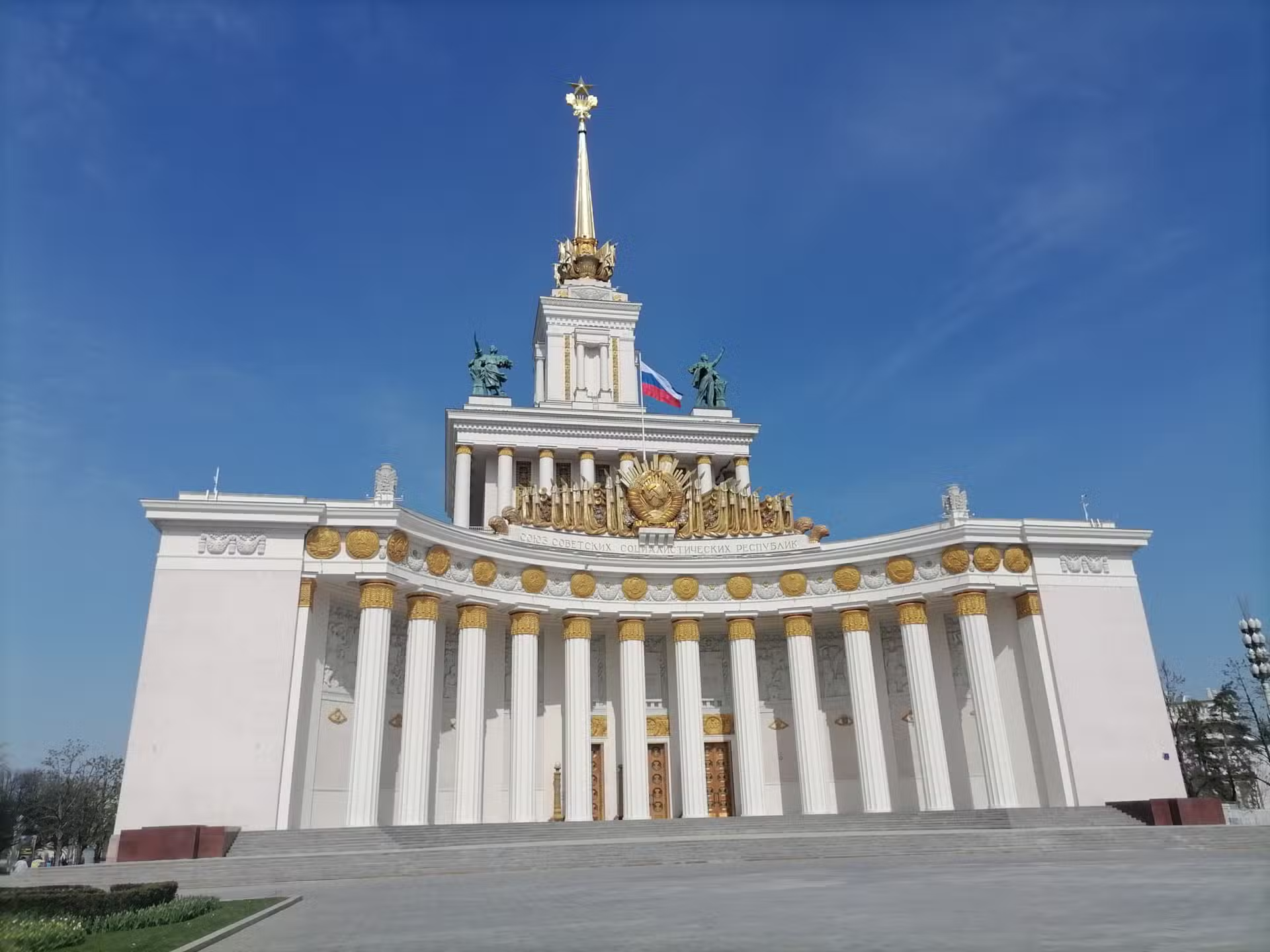
The ceremonial façade of the Central Pavilion at VDNKh, with its colonnade, USSR coat of arms and spire.
What exactly can be called mise-en-scène in a painting
Mise-en-scène is the arrangement of actors on stage at different moments in a performance. Gesture and mise-en-scène operate on different levels in an academic painting: the former clarifies the action of an individual figure, while the latter determines the arrangement of the entire group. As a working analogy, this principle helps us assess who occupies the centre, which figures are brought together or kept apart, and how objects alter the relationships between the characters.
The artist uses the frame as the boundary of the visible scene, giving meaning to the distances within it. A frontal figure most often faces the viewer directly, a figure in profile connects the character with a neighbouring figure, while a figure shown from behind may conceal a reaction or direct attention into the depth of the painting. The meaning of a pose is determined by its relationship to the other figures.
A theatrical scene unfolds over time: an actor arrives at a particular spot, pauses there, and then moves away. A painter, by contrast, has only a single visible state at their disposal. Yet a painting allows that moment to be held for as long as one wishes and every part of the composition to be considered simultaneously. The artist must make the chosen instant sufficiently rich in meaning for the viewer to imagine both what came before and what might follow.
Academic painting and theatre drew on shared cultural codes: classical and biblical subjects, rhetorical gestures, and a hierarchy of genres. As a result, their compositional schemes could be similar. Any claim that a particular theatrical production directly influenced a painting requires separate evidence; formal similarity alone is not sufficient to support such a conclusion.
Where the historical limits of the comparison lie
Academic painters of the eighteenth and nineteenth centuries cannot literally be described as directors. The Culture.RF portal associates the transformation of mise-en-scène into a means of artistic expression with the development of director-led theatre in the nineteenth century. Previously, the playwright and actors were regarded as the principal participants in the staging process, while the director’s duties remained primarily administrative.
Theatre historian Olga Kuptsova demonstrates that, in Classicist theatre, a character’s position depended on their place in the hierarchy: the principal characters appeared on the forestage, while the dramatic chorus occupied the rear stage. However, she emphasises that the surviving evidence does not allow us to determine how closely the actors were grouped. Any similarity between a painting and a stage scene should therefore be considered in terms of the visible spatial arrangement, without attempting to reconstruct the lost production.
In another research seminar, Kuptsova describes the transition from the statuesque physicality of Classicism to Romanticism’s expressive profusion of gestures. Classicist theatre employed codified gestures; models from antiquity helped to shape this vocabulary, which subsequently influenced painting and sculpture. Similarities in expressive means could arise from the shared conventions of the period, whereas direct borrowing can be established only through documentary evidence of a specific connection.
Kuptsova interprets the final silent scene in Gogol’s The Government Inspector as a tableau vivant and cites paintings by Karl Bryullov and Alexander Ivanov as possible, though unproven, models. Painting may therefore have influenced theatre, but this conclusion cannot be applied to every superficial resemblance.

The tiers of boxes, proscenium arch and painted auditorium ceiling of the Alexandrinsky Theatre. Wikimedia Commons, Alexandrinsky theatre-2.jpg, licence: CC BY-SA 2.5 source, license
When assessing a possible connection, it is useful to distinguish between three levels of evidence:
- Formal similarity
- The frontal arrangement, diagonal, grouping of figures or type of gesture may coincide. This is an observation about form, not proof of influence.
- The shared language of the era
- Painting and theatre employ recognisable narratives, costume, rhetorical poses and a hierarchy of genres. Here it is appropriate to speak of a shared cultural context.
- Documented influence
- The connection is substantiated by letters, diaries, sketches, evidence that the artist attended a production, or an identified source for the composition. Only material of this kind allows us to move from analogy to a historical assertion.
Why the Academy taught artists to stage the human figure
At the Imperial Academy of Arts, drawing the human figure formed the foundation of the curriculum, teaching students how to convey action, character and the meaning of a pose. On 6 November 1757 under the Old Style calendar, or 17 November under the New Style calendar, the Senate issued a decree establishing the ‘Academy of the Three Noblest Arts’. In 1764, the institution gained autonomy, a charter, privileges and its own school.
The Research Museum of the Russian Academy of Arts traces the sequence of artistic training in the eighteenth and nineteenth centuries. Students began by copying drawings by masters and engravings, then progressed to plaster casts of ancient sculptures, studied anatomy and drew from a live model. After completing the life classes, a student would undertake a finished diploma painting, for which they could be awarded the title of artist.
Students constructed an academic pose according to the structure of the body, taking into account the shift of weight, the turn of the torso, the rotation of the shoulder girdle and the position of the limbs. Casts of ancient sculptures provided a model for proportion, anatomy revealed the body's internal structure, and working from life developed powers of observation. What they observed then had to be reconciled with the demands of the subject.
The studio exercise already contained an element of the future painting. The student worked with the model in a prescribed pose, sought the right viewpoint and selected the essential lines. The model, however, was not yet a character. Only at the next stage did the model become a historical hero, saint or mythological being, as the artist combined the studied body with the subject, costume, attributes and relationships with other figures.

The Imperial Academy of Arts building on Universitetskaya Embankment, viewed from the Neva. Openverse, Wikimedia, Imperial Academy of Arts building, author: The Cosmonaut, licence: by-sa 2.5 source, license
A diploma painting required a pose that could be read from a distance. The artist amplified the gesture and maintained a clear outline for each figure within the group. Everyday naturalness therefore cannot be the sole criterion for judging the work: the artist was addressing the challenge of presenting a complex subject to a public audience.
Why history painting required a clear dramatic structure
History painting occupied the highest rank in the academic hierarchy, as artists were expected to combine mastery of the human figure, knowledge of source material, complex composition and a morally significant subject. This category encompassed events from the nation's past, myths of classical antiquity and biblical themes. Still life, by contrast, stood at the bottom of the hierarchy, showing that the academy ranked genres according to the scale of the challenge it believed they presented to the artist.
Viewers of a history painting were expected to recognise its protagonists and understand the decision they were making. The painter therefore chose a pivotal episode—a moment after which their relationships would never be the same. Too early a stage would not yet reveal the conflict; too late would show only its consequences. The most fruitful moment was one in which the intention was already apparent, while the outcome still had to be imagined.
The exhibition’s official page lists among its exhibits Orest Kiprensky’s ‘Dmitry Donskoy at the Battle of Kulikovo’, Dmitry Ivanov’s ‘Marfa Posadnitsa’ and Alexander Kotzebue’s ‘The Heroic Deed of Peter I during a Storm’. Together, these works demonstrate the range of narrative challenges faced by an academic painter: a ruler’s decision, a social conflict and a physical ordeal.
A history painting functions like a play in condensed form. Secondary figures support the main action: a witness can convey the magnitude of the event, an adversary can indicate the direction of the conflict, and a crowd can reveal the social cost of a decision. Architecture, weapons, fabrics, furniture and the natural setting establish the location and status of the participants more precisely. Yet an object becomes part of the drama only when it shapes how the action is understood, rather than merely displaying the artist’s erudition.
Compositional clarity does not in itself confirm the accuracy of what is depicted. An artist might study historical costume meticulously while simultaneously subordinating the facts to a didactic agenda. A history painting can also reveal the values of the period in which it was created: which qualities were considered heroic, how duty was understood and which events were chosen for public depiction. Such conclusions should be distinguished from evidence about the past itself.

The equestrian monument to Dmitry Donskoy near the junction of Nikoloyamskaya and Yauzskaya Streets in Moscow.
How gesture turns the body into a line of dialogue
The viewer reads a gesture as the character’s response to what is happening. The position of a hand may point, halt or protect; a tilt of the head may signal attention or a refusal to engage. The face, the turn of the body, the surrounding figures and the narrative clarify its meaning, so no gesture has a single definitive interpretation.
A verb helps to identify the action. Rather than vaguely saying that ‘the figure looks majestic’, it is more precise to ask: is he holding the other person back, blocking the way or retreating? Then consider the position of his feet, the angle of his shoulders and his distance from the other figure. Inconsistent movements may indicate the figure’s hesitation or an error in interpreting the pose.
The artist amplified academic gestures for multi-figure compositions. A hand had to be legible within the overall silhouette, while the turn of a body had to link one group to another. This use of the body is akin to the theatrical gestures of periods when acting styles likewise relied on recognisable poses.
The viewer can easily mistake an expressive movement for an unambiguous sign. The same raised elbow may convey an authoritative command, an attempt to stop another person or a defensive reaction. Any interpretation should be tested against the direction of the movement, the person to whom it is addressed and the behaviour of those around them, and then checked against the narrative. Without these points of reference, any psychological diagnosis remains merely the viewer’s invention.
Stillness can also make a figure stand out. A figure who does not share the group’s collective momentum becomes conspicuous through this pause. Folded arms, a lowered gaze or the body’s rigid vertical stance arrest the movement of the composition. A single motionless figure that disrupts the rhythm may become the composition’s focal point.
How the direction of a gaze creates invisible connections
The artist connects the figures through the direction of their gaze. Several figures looking towards the same point draw attention to an object or character; diverging gazes suggest a rift or parallel strands of action. A figure turned towards the space beyond the frame points to an event that remains unseen.
Begin by identifying the figure at whom the others are looking. This does not necessarily mean that they are the main character, but it provides a testable hypothesis. Then trace the opposing lines of sight: does the figure return their gaze, look above or below them, or notice the observers? A figure’s size is only one indication of hierarchy. A character can control the scene while remaining at the side if faces, hands and diagonals all converge on them.
A direct gaze towards the viewer draws the audience into the depicted scene. In portraiture, this is a conventional form of engagement; in a narrative painting, such a figure can act as an intermediary between the event and the audience. The device is particularly striking when the other figures are absorbed in one another and only one person addresses the viewer.
A figure’s gaze can also point to an unseen part of the action. If a character is looking at a small, barely discernible object, the viewer understands its significance from the character’s reaction. A cause that remains beyond the frame prompts the audience to imagine how the scene continues. In the theatre, the wings serve a similar purpose: they conceal part of the action, while a line or a turn of the head confirms that it is continuing.

A 1972 USSR postage stamp reproducing Portrait of the Actor F. G. Volkov; on the stamp, the work is attributed to A. P. Losenko and dated 1763. Wikimedia Commons, 1972 Fyodor-Volkov-(stamp) Losenko portrait.png, author: USSR Post, licence: Public domain source
How the distance between figures and their relative height convey power
The artist conveys social and emotional relationships through the placement of the figures. Height, proximity to the centre and the amount of open space around a figure establish a visual hierarchy. These elements must be considered together: a figure in an elevated position may possess authority, be exposed to judgement or be in danger.
Figures placed close together may appear to form a single group or to be people under pressure. A gap between the figures emphasises alienation, ceremonial distance, or a moment of choice. If the central figure reaches across the empty space with a gesture or a step, the artist is showing an attempt to draw closer.
The foreground brings a figure physically closer to the viewer, but the centre of the action sometimes lies deeper within the scene. In such cases, the artist uses openings between groups, lines of perspective, patches of light and the angles of bodies to lead the eye inwards. This visual path does not always follow the left-to-right order in which text is read. It may begin with a vivid detail at the edge, return to the centre and end on an almost imperceptible witness.
Head height alone does not determine hierarchy: a seated figure may occupy a throne, while a standing figure bows before them. A more reliable guide is to observe whose decisions shape the actions of the others. The visual focus is the figure around whom the composition is organised and who influences the behaviour of the others.
How the artist directs attention through light and colour
The artist uses light to guide the viewer’s attention: separating a figure from the background, unifying a group, or concealing part of the action. The brightest area often catches the eye first, although the composition’s focal point may lie elsewhere. The line of an arm, a fold of fabric, or an architectural detail leads the gaze towards a less conspicuous face.
The lighting within the depicted world and the tonal organisation of the canvas serve different purposes. A window, candle, or open sky explains the source of the light, while the distribution of light and dark masses preserves the clarity of the composition. Verisimilitude alone does not create an expressive structure; the artist may make contrast serve the meaning of the scene.
Similar hues in costumes or drapery connect figures who are far apart, while a single colour accent marks out an exception. Automatic symbolism is unreliable here. Red does not in itself signify passion or danger: its function must be assessed in relation to the overall palette, lighting and the material of the object.
On stage, the director and lighting designer can alter the lighting over time. A painter captures a single state and controls every transition within it. The dimming of a secondary group or the light falling on the protagonist’s hand remains a constant condition for interpreting the work, whereas in a performance the lighting may change in the next second. The viewer can return to the same lighting accent and examine its role in the composition.
Why a genre scene is also staged
In a painting of everyday life, the artist likewise selects the moment, viewpoint and relationships between the figures. Genre painting relocates conflict to a familiar setting and reduces the scale of the event while retaining careful compositional planning. A door, table or narrow passage separates people, provides an entrance for a new participant or restricts movement.
The official exhibition plan at VDNKh places genre scenes in a separate section after biblical, mythological and historical works. This juxtaposition shows viewers different ways of constructing conflict. The grand manner is characterised by large-scale, elevated poses that lend grandeur to the event. In scenes of everyday life, conflict is revealed through awkwardness, a breach of personal space, or a detail that one character has already noticed while another has yet to see it.
A specific example is Firs Zhuravlyov’s 1874 painting Before the Wedding Ceremony. The Russian Museum describes the moment when the daughter is blessed before her wedding: her father holds an icon, her mother stands motionless with the ceremonial loaf, and the bride weeps. Zhuravlyov was awarded the title of Academician for this painting; it became so popular that the artist produced several replica versions.

Firs Zhuravlev. A genre scene with two children appealing to a passer-by: gestures and gazes unite the figures in a single action. Wikimedia Commons, Zhuravlev 09.jpg, author: Firs Zhuravlev, licence: Public domain source
By a ‘staged’ scene, we mean a process of selection. The artist frames the event, removes extraneous details and brings the chosen relationships into view. Even a work drawn from real-life impressions undergoes this process of compositional selection.
Viewers should take note of thresholds and boundaries: a doorway, the edge of a rug, the line of a piece of furniture, a step. The artist uses these barriers to separate the characters and show who can enter, leave or remain an outsider. In a genre scene, objects determine the characters’ access to one another.
What portraiture borrows from the stage
In portraiture, the artist creates an encounter between the individual and the viewer through pose, attire and objects. Clothing, an armchair, a book, an element of uniform or an empty background reveal the capacity in which the sitter is presented to the public. The artist may affirm the sitter’s official status or reveal the tension between their role and individual appearance.
A frontal pose creates an impression of open presentation; a profile suggests distance or concentration, while a turn over the shoulder implies unfinished movement. The hands often reveal more than stylised facial expressions: they hold an object, gather fabric or rest on a piece of furniture. The harmony between pose and props creates a coherent public image.
The exhibition's Portraits section brings together works by Academy-trained artists from the eighteenth to the twentieth centuries and depictions of theatre figures. The official description names Dmitry Levitsky, Orest Kiprensky, Karl Bryullov, Ilya Repin, Mikhail Vrubel and Boris Kustodiev, while the sitters include Fyodor Volkov, Yakov Shumsky, Ekaterina Semyonova and Feodor Chaliapin. The comparison between the actor's profession and the role performed in a portrait is thus embedded in the curatorial structure itself.

Boris Kustodiev. Portrait of F. I. Chaliapin, 1922. The singer is depicted full-length against the backdrop of a winter fair. Wikimedia Commons, Kustodiyev Shalyapin.JPG, licence: Public domain source
The painter, the patron and the sitter jointly shape a public image that later viewers interpret from the perspective of another era. The pose may suggest confidence, restraint or tension. Any conclusion about the sitter's actual psychological state would require letters, memoirs or other sources.
Why an artist needs costume and objects when the figure is what matters most
Costume and props define the role, but their meaning is determined by the action. A helmet held in the hand differs from one worn on the head; a letter being read differs from one left on a table. The material and the way an object is used tell us what has happened and how far the character controls the situation.
In history painting, the artist had to evoke the period through costume while preserving a clear silhouette. An excess of archaeological detail could disrupt the composition, while overly generic drapery could erase the distinctions between the protagonists. The artist selected details that supported the action.
A theatre designer uses clothing to indicate a character's role, social standing and physical bearing. Original costumes from the museums of the Bolshoi, Mariinsky and Alexandrinsky Theatres and the Moscow Art Theatre allow us to compare how fabric works on stage and in painting. In both cases, cut, colour and texture alter the figure's silhouette.
First establish what a particular person is doing with an object, and only then look for symbolic meaning. An artist may connect two figures through a letter, indicate a profession with a tool, or use an abandoned object to mark a turning point. If an object does not alter the action, the character's status or the path of the viewer's gaze, any symbolic interpretation requires particular caution.
How the exhibition constructs a history of theatricality
Semyon Mikhailovsky, the originator and curator of the exhibition, arranged it chronologically: from the history of the Academy and its building, through biblical, mythological, historical and genre scenes, to portraits. The route concludes with contemporary images of the auditorium, backstage areas and dressing rooms, where the theatre itself becomes the direct subject of painting.
The project includes around 200 exhibits from 32 participating museums in 12 cities; the Russian Museum contributed 72 works. The artists represented include Karl Bryullov, Orest Kiprensky, Dmitry Levitsky and Boris Kustodiev. Paintings are displayed alongside drawings, prints, sculpture, rare books and theatrical costumes, allowing visitors to compare finished images with the materials used in their preparation and stage presentation.

Karl Bryullov. Portrait of F. A. Bruni, 1827–1828. Wikimedia Commons, Karl Brullov 50.jpg, author: Karl Bryullov, licence: Public domain source
What Bryullov's sketch reveals
The Russian Museum brought the sketch for The Last Day of Pompeii to VDNKh, rather than the principal canvas of 1833. The idea for the painting arose after the artist visited the excavations of the city destroyed by the eruption of Mount Vesuvius in AD 79; he worked on the concept for about six years. This preparatory work should be viewed as a record of artistic choices: Bryullov could alter the groupings, directions of movement and balance between episodes.
When examining the sketch, it is useful first to identify the major masses and empty spaces, then compare them with a reproduction of the completed painting. This comparison reveals how the groupings, directions of movement and balance between episodes changed. The sketch belongs to a six-year creative process, so it cannot reveal the full sequence of Bryullov's decisions.
The curators placed works from the eighteenth and nineteenth centuries, Art Deco-era graduation pieces, Socialist Realist art and contemporary scenes of theatrical spaces along a single route, while preserving them as distinct stages. Comparing them allows us to examine how artists turn the human figure into a vehicle for action and direct the viewer's attention.

Nikolai Efimov. Karl Bryullov at Work on a Group Portrait of the Davydov Family in Their Home in Rome, 1834–1835. Wikimedia Commons, K.Brullov painting Davydovs' by N.E.Efimov (1834-5, GIM).jpg, author: drawing by architect Nikolai Efimovich Efimov (1799–1851), licence: Public domain source
Six questions to begin with when examining a painting
A practical analysis is best conducted by moving from what is visible to interpretation. The following questions require no prior knowledge of the entire narrative and help distinguish observation from conjecture.
- Where does your eye go first? Identify the specific reason: scale, contrast, light, colour or the position of the figure. Then trace where your attention moves next.
- Who is acting, and who is reacting? Describe the poses using verbs and identify whom each gesture is directed towards. The reaction of a secondary figure often reveals the cost of an action more clearly than the central figure does.
- How are the figures separated in space? Note the groups, empty spaces, barriers and levels. Decide whether they express intimacy, subordination, conflict or ceremonial order.
- Which moment has the artist chosen? Describe what might have happened immediately beforehand and what is likely to follow. If neither can be imagined, action may not be the painting’s principal organising principle.
- What do the costume and objects reveal? Consider what the object is, where it is placed and how it is used. An attribute becomes evidence only through its relationship with the figure.
- Where does fact end and interpretation begin? The visible position of a hand is an observed fact; a conclusion about fear, arrogance or remorse is an interpretation that must be supported by other elements and knowledge of the subject.
The answers may yield several well-founded interpretations. On looking again, the initial hierarchy sometimes shifts when the viewer notices a second line of sight or a figure at the edge of a group. This method disciplines the eye and prevents attempts to guess the ‘correct meaning’.
Where the comparison between a painting and a theatrical performance breaks down
A painting captures a single visible moment, while a performance unfolds through time: the actor changes intonation and position, and the audience encounters the scenes in a set sequence. Viewers standing before a canvas determine for themselves how long, from what distance and in what order they examine it. They can take in the entire group at once, return to a detail and compare distant parts of the composition.
The nature of presence also differs. On stage, a living performer stands before the audience, their body belonging simultaneously to the actor and the character. In a painting, the viewer sees the material traces of the artist’s work—colour, line and texture—from which the figure is formed. The model took part in creating the image but does not continue to perform the role before us.
A study drawing explores the structure of the body, a portrait conveys an enduring presence, and a landscape examines the organisation of space. The theatrical lens is particularly useful for multi-figure narrative painting but is less effective in explaining works without action. The comparison remains useful only while it provides a more precise explanation than the alternatives.
| Criterion | Academic painting | Theatrical performance |
|---|---|---|
| Time | The viewer is presented with a single visible moment and reconstructs the preceding and subsequent action from the clues. | The action unfolds through a sequence of scenes, and the meaning of a pose depends on how the actor moves into and out of it. |
| Performer | The figure is created through line, colour and texture; the model is not present before the viewer. | The role is performed by a living actor, so the gesture is complemented by movement, voice, pauses and intonation. |
| Order of perception | Viewers decide for themselves how long to look and can return to any detail. | The pace and sequence of events are determined by the performance, although the viewpoint depends on where one sits in the auditorium. |
| Spatial boundary | The frame defines the pictorial field; everything significant must be arranged within it or indicated indirectly. | The stage is connected to the wings and the offstage space, from which a character may enter and into which they may exit. |
| Testing the interpretation | The conclusion is based on the composition, the material surface, the subject and the work’s history. | The development of the action and the specific performance, which varies from one show to the next, are added to these same relationships. |
The similarity helps us analyse how attention is distributed and how the figures relate to one another. Conclusions about pace, voice, movement or variations in performance require evidence from the production; they cannot be drawn from a painting alone.
Standards of plausibility have changed from one era to another. An expressive pose is no measure of the quality of acting, while a restrained composition may likewise be the result of a carefully conceived design. First establish the work’s purpose and the context in which it was created, then assess the means chosen to achieve it.

The auditorium of the State Academic Bolshoi Theatre of the USSR. Moscow, April 1959. Wikimedia Commons, Moscow locations by mos.ru 03.jpg, author: Glavarkhiv Moskvy, license: CC BY 4.0 source, license
What changes after reading a painting in this way
After this kind of analysis, an academic painting can be read as a system of relationships. The viewer identifies whom a gesture is directed towards, notices the distance between the figures and understands how the artist guides attention through light and objects. Artistic convention makes a complex narrative legible and emphasises its pivotal moment.
At the Art of the Stage exhibition, these criteria can be explored through works in various genres until 17 January 2027. The dates and contents of the project are correct as of 19 September 2026; before travelling, it is worth checking the visiting arrangements on the project page, as they may change.

The spiral staircase on the second level of VDNKh’s Central Pavilion. Wikimedia Commons, Moscow, VDNKh, Central Pavilion — spiral stairs inside (10656520916).jpg, author: Gennady Grachev from Moscow, Russia, licence: CC BY 2.0 source, license
The itinerary VDNKh tour ‘VDNKh and Space’ includes the Central Entrance arch and the Friendship of Peoples Fountain; VDNKh’s official website places the fountain square beside Pavilion No. 1, the Central Pavilion. After examining the mise-en-scène of academic painting, the pavilion can be seen both as part of the architectural ensemble and as an active exhibition venue. A visit to the temporary exhibition is part of a separate museum programme and is not included in the tour description.
Sources
- The exhibition ‘The Art of the Stage: Academic Painting’ in Pavilion No. 1, Central
- The Russian Museum presented masterpieces from its collection at VDNKh
- The ‘Great Karl’ exhibition — ‘The Last Day of Pompeii’ section
- The Human Figure. Principles of Construction. Drawing from Originals, Plaster Casts and Life
- History of the Academy
- ‘Mise-en-scène’: the Origin and Meaning of the Term
- Olga Kuptsova. ‘Compose a Group...’: Mise-en-scène and Staging in Pre-directorial Theatre
- Olga Kuptsova. Theatrical Gesture in Russian Stage Practice from the Late 18th Century to the First Third of the 19th Century
- Seminar ‘The Historical Genre in Russian Painting’ at the Research Institute of the Russian Academy of Arts
- Still Life! — Russian Museum
- Firs Zhuravlev. ‘Before the Wedding’ — Virtual Russian Museum
- Around 200 works from 32 museums have been brought together for an exhibition at VDNKh’s Central Pavilion
- Friendship of Peoples Fountain Square — VDNKh
- Official VDNKh channel: opening of the ‘Art of the Stage’ exhibition
- ‘VDNKh and Space’ Tour — Radius Tour Bureau
We took a tour of Taganka designed for 12-year-old children. It was an excellent programme. We covered a great deal of ground and learnt so much. We discovered the story of Dryanaya Street and discussed the Vladimir Highway, the surrounding monasteries and churches, and the Old Believers. We now know where Korovin was born, where Stanislavsky was born and raised, where the Morozov merchant children lived, and why Arseny Morozov was considered such an outrageous figure in his day. We also discussed Solzhenitsyn, discovered where Stalin Avenue was supposed to be built, saw the bunker, walked to the Russian metochion of the Mount Athos Monastery, and learnt why the Illuzion cinema made Taganka famous. Of course, no tour would have been complete without Vysotsky and Lyubimov. We also touched briefly on Taganka Prison, although naturally we did not go there. All in all, it was an exceptionally rich and informative tour! Our guide Alexander was superb!
Our thanks to our guide Alexander for a magnificent sightseeing tour. Alexander’s love for Moscow and its history, his wide-ranging knowledge, elegant and engaging delivery, and personal charm make the tour not merely interesting and informative, but truly delightful! Thank you, Alexander! Tatiana and Tatiana, St Petersburg
On July 18th, we participated in the "Soul of Moscow" group tour led by Alexander. Kitay-gorod and its surroundings revealed a new side to us, and everyone thoroughly enjoyed it. Some of us began intensively studying related materials to broaden our horizons. We'll be back, and we highly recommend it! You won't regret it.
Good afternoon, on June 23rd we had a tour called " The Soul of Moscow ," led by Alexander. He's a very pleasant young man. We visited such lovely courtyards and alleys with him that we never even knew existed, and we learned so much. We really enjoyed everything, and we hope to continue our acquaintance. Alexander! Thank you! We had a great time with you, and we thoroughly enjoyed it. See you there!
This isn't my first time with Radius. This time, I took the Moscow metro . The goal was not only to admire the underground palaces but also to learn how to navigate the metro. As a resident of a region without a metro, I was a bit apprehensive and didn't understand how to navigate the metro. Of course, the internet helps, but live communication is much better. Tour guide Yulia handled this task perfectly. The information was accessible and interesting, the presentation was calm, and the communication style was very friendly. Thank you very much for the tour and the practical experience.
Good afternoon! I gave the "Soul of Moscow" tour to some of the capital's guests. We were thrilled to hear our guide, Anton. It was so informative and engaging, and very warm. To say we were absolutely delighted is an understatement. It turned out to be a truly family-friendly excursion. We learned so many interesting facts. The material was presented professionally, all our questions were answered, and we saw so much. It was simply WOW! Thank you so much, Anton, he's the best!!!!! From now on, I'll only come to you, the Radius team. I highly recommend it. I promise we'll see each other again soon on other tours.
Overall, the tour left a positive impression! Thanks to Alexander for the walk through the courtyards and atmospheric spots of Kitay-Gorod; we certainly wouldn't have done it on our own. The tour was comfortable, and the guide spoke confidently and calmly. One thing we personally missed: we would have liked more of the historical part, relating to ancient Moscow and the history of Kitay-Gorod. There were quite a few stories about the Soviet period and the bar scene, but for our group, this wasn't particularly relevant. We think the program could be a little more tailored to the age and interests of the group. It would also have been interesting to add more historical facts, monuments, and details about old Moscow and the area itself. That said, the tour was still interesting, and some places and churches were truly memorable. These aren't really "cons," but rather suggestions for an even more comprehensive program.
Hello! We had a corporate group of 10 people. Our guide was Anton, and we had a tour of Bulgakov. I would like to point out the excellent organization; everything went smoothly. The managers were very accommodating to our changes in the number of participants. The bus was very comfortable. Anton is a super-engaged and motivated guide. He lives this history and is delighted to share his knowledge and create an unforgettable experience. Everything went well. I highly recommend it!
Thank you for a fascinating tour! It gave me so much food for thought to explore! Note: Review of the "Zamoskvorechye" tour with guide Maria.
I'd like to express my gratitude on behalf of our team! Thank you for keeping to our scheduled schedule despite our lack of organization. Our colleagues appreciated your preparation for the tour! It was informative. Note: Review of the "Modern Residential Complexes, Factory Past, and Avant-Garde" tour of the ZILART residential complex with guide Maria. Maria prepared and conducted a customized tour for employees of the Samolet Group of Companies development company.
Thank you! You have great talent. Good luck! ☺️ You're a wonderful guide! Thank you again! Note: This is a review of the corporate tour "The Heart of the Capital" with guide Maria.
Thank you for a wonderful day today!!)) Note: review of the excursion "The Soul of Moscow" with guide Maria
On behalf of the whole family, I want to thank you for a very informative and interesting tour! Note: This is a review of the "Palace Dungeons" tour with guide Maria.
Good afternoon! I'd like to express my gratitude and that of my guide for organizing the tour! We were very pleased. We'd like to do it again in October, but on a different route — ZIL. Note: This refers to the tour for Samolet Group developers, led by guide Maria.
Thanks to Alexander for the bar tour of Baumanka ! It was fun, exciting, and we discovered so many new places! Awesome! May we reach new heights!
Good afternoon! I was on a tour of Sukharevskaya Square — we went all the way to Tsvetnoy Boulevard. I didn't expect it to be so interesting! For those wondering whether to go — go for it! It truly became one of my most memorable summer memories!
Anastasia, good morning! Thank you and Masha for yesterday! The speakers are happy. The connection through the headphones was often lost, especially at the checkpoint, but that's just our current situation. You could hear if you were standing close, no more than 1.5 meters away. Colleagues have already asked for your contact information. I'd be happy to share it and look forward to another opportunity to work with you. Special thanks to the Director for the Bureau . Note: " Heart of the Capital " tour for participants of the 2025 Moscow Oncology Forum. Guides: Anastasia and Maria.
We'd like to thank Anton and Alexander for leading the tour! It was fascinating to hear how the Krasnaya Presnya district developed and how Prokhorov's influence on our city's development. It was a pleasant immersion into a quiet, previously unexplored area!
Good afternoon, thank you so much, Anastasia. The " Uncle Gilyai " tour was fantastic. Even though we're Muscovites and know a lot about Moscow, the experience was amazing, so much new and interesting happened. We'll definitely be back.
Thank you for the " Heart of Moscow " and " Khamovniki " tours. Anton, a knowledgeable and passionate Moscow guide, gave me the tour. He's a great storyteller, intelligent, well-read, and captivating. You've truly opened up my Moscow to me! I'll definitely be back next summer to explore Moscow with you. I'll recommend your wonderful tour program to all my friends!
Excursions with the Radius travel agency are always a positive experience if you choose them. We planned a tour of Zamoskvorechye on our next visit. We've worked with our guide, Anton, before. We'll definitely recommend him to everyone we know. The tour is informative, not overloaded with dates, and the information is comprehensive yet easy to understand, as it's presented in a light, narrative manner, not like a history textbook, dry and academic. Thank you for this approach. We'll definitely use the Radius agency again on our next visit to Moscow.
Thank you so much for the tour of Zamoskvorechye . Despite the weather, it was very interesting and informative! Note: this refers to the tour with guide Anton.
A huge thank you to Anastasia. We had a fantastic tour of the Patriki district. We learned so much. Anastasia is a true master of her craft. The tour was captivating, not at all boring, lively and interesting. Everyone was delighted. We were full of new impressions. I definitely recommend it. You won't be disappointed!
We explored the Soul of Moscow with my family and Radius on my birthday. Everyone thoroughly enjoyed the walk! Anton shared so many interesting facts about the capital and its history, taking us into spiritual depths no one else had even suspected. Most of us were either born or longtime Moscow residents who spent a lot of time walking around. It was educational, heartwarming, and unforgettable. 🙂 Overall, this wasn't my first time walking around Moscow with Anton, and each time was a real adventure!