In The Master and Margarita, money takes the form of specific historical objects: silver tetradrachms, Soviet chervonets banknotes, foreign currency, gold and Torgsin commodity vouchers. Each has its own function: the silver records the price of betrayal, the winnings free up the hero’s time for work, audience members check the banknotes for authenticity, the dollars that are found become evidence, and the trading network’s documents provide access to scarce goods.
Comparing these objects links the Yershalaim and Moscow narratives and shows why the notion of universal greed is too crude. In both parts of the novel, money records the consequences of a decision. The weight of a coin, the watermark on a banknote, the dollars in the ventilation duct and the commodity voucher distinguish the price of betrayal, temporary freedom, a piece of evidence and a pass to scarce goods.
Why the theme of money runs through both strands of the novel
In both narratives, money binds the individual to power and institutions. In Yershalaim, Judas enters Caiaphas’s palace and soon afterwards tells the assassins about the thirty tetradrachms he has just received; after his death, the purse is thrown into the high priest’s palace, whose representatives deny making the payment. In Moscow, roubles, chervonets banknotes, foreign currency and commodity vouchers determine access to housing, free time and scarce goods, and sometimes provide grounds for interrogation.
Bulgakov began the novel in 1928 and continued revising it until February 1940. During those years, the New Economic Policy came to an end, foreign-exchange controls were tightened, Torgsin opened and closed, and the first Soviet chervonets banknotes became rarities. The final text therefore brings together monetary realities from different years rather than presenting an economic snapshot of a single, precisely dated day in Moscow.
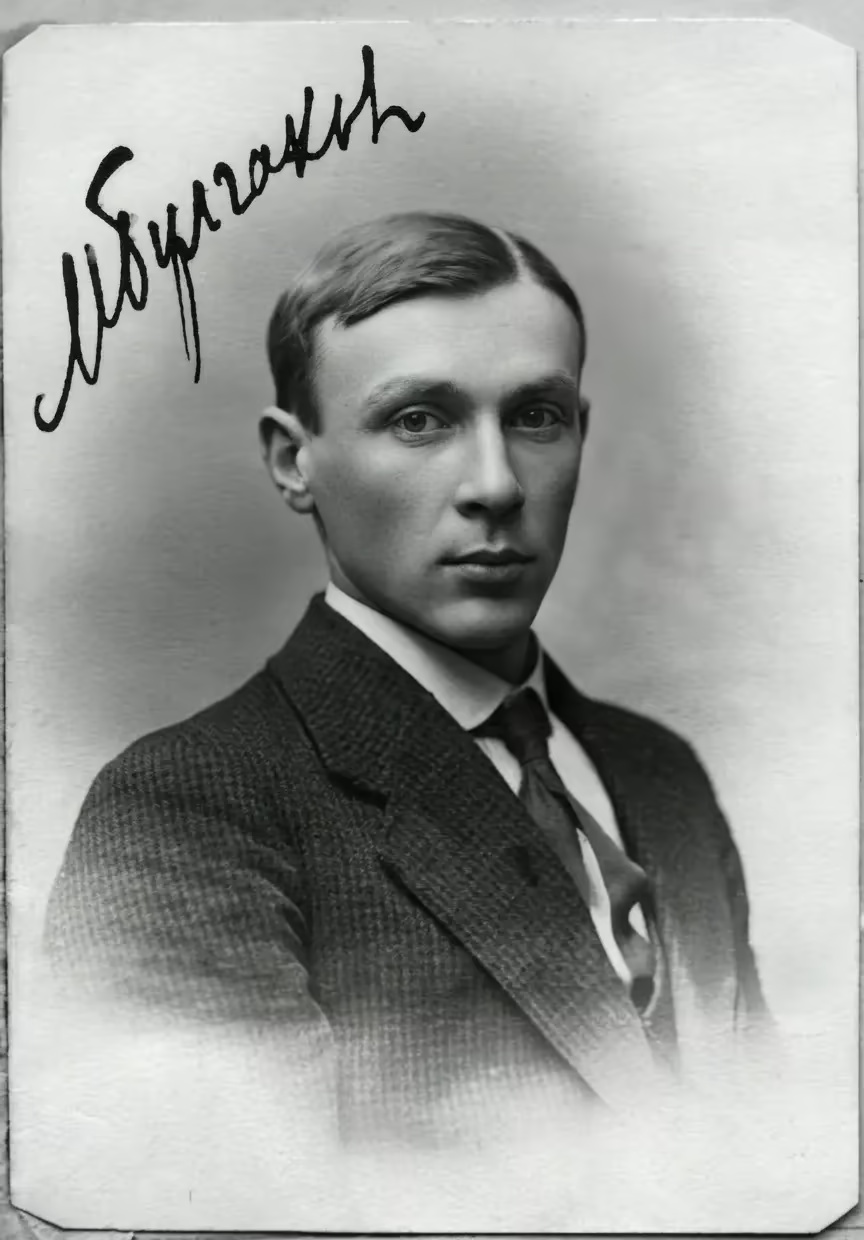
Mikhail Bulgakov in 1916, while studying at Saint Vladimir Imperial University of Kyiv. Wikimedia Commons, Mikhail Bulgakov, 1916, restored.jpg, author: Unknown author, licence: Public domain source
In the Yershalaim narrative, Bulgakov replaces the general term ‘pieces of silver’ with a precise name: tetradrachms. Aphranius states the sum, the assassins take the purse from Judas, and after the killing the silver is returned to Caiaphas’s palace. A single object links the agreement, the murder, the evidence and the warning to the high priest.
In the Moscow chapters, roubles, chervonets banknotes and foreign currency coexist, but the state and the city’s residents value them according to different rules. For a banknote, the issuer and security features matter; for dollars, the legality of possession; and for a voucher, whether it can be used to pay within a particular retail network. Woland’s retinue alters one of these conditions and observes the consequences.
What Judas's thirty tetradrachms were like
Judas’s thirty tetradrachms in The Master and Margarita can be identified with Tyrian silver coins that circulated in first-century Judaea. The State Historical Museum describes this identification as the accepted historical interpretation. The sources allow us to establish the probable type of coin, but not the contents of the particular purse.
A Tyrian tetradrachm weighed approximately 14–14.5 grams. The obverse bore the head of the god Melqart, while the reverse featured an eagle standing on the prow of a ship, the date of minting and a Greek inscription proclaiming Tyre sacred and inviolable. Sources differ on when minting ended: the State Historical Museum’s exhibition newspaper gives a broad period from 126 BC to AD 70, while the catalogue of KU Leuven’s archaeological collection dates the Tyrian shekel from 126 BC to AD 65. The Bank of Israel notes that the rebels began minting their own silver coins in AD 66. The year AD 70 may therefore be used as the boundary of the historical context, but not as the undisputed date when minting in Tyre ceased. The coin’s name requires some explanation: in the local monetary and weight system, the principal unit was the shekel, which was close in weight to the Attic tetradrachm; hence the two names for the same coin.
The association between Tyrian silver and Temple payments is confirmed by the State Historical Museum and the Bank of Israel, the latter noting that such coins were used for the half-shekel contribution. However, the claim that they were the only coins accepted is disputed. After comparing tax documents from the Judaean Desert, historian Michael Girardin concludes that the idea of a single ‘Temple coin’ rests on shaky foundations and that, under certain conditions, denarii were accepted at the Temple in Jerusalem. It is therefore accurate to describe Tyrian silver as the accepted standard, but not as the only permitted means of payment.
The word ‘tetradrachm’ alone is insufficient for identification: four-drachma silver coins were minted by different states, and their weight and imagery varied. The Tyrian identification is supported by the place and period of circulation, weight, iconography and documented use of such silver for Temple contributions. The calculation provides a well-founded estimate of the weight of Judas’s purse; its precise contents cannot be determined from the text.

A Tyrian shekel from AD 49/50: the head of Heracles-Melqart on the obverse and an eagle on the prow of a ship on the reverse. This is an example of the coin type, not an attribution of the contents of Judas's purse. Wikimedia Commons, Huseifa hoard — Tyrian shekel (2).JPG, author: Hanay, licence: CC BY-SA 3.0 source, license
Thirty tetradrachms weighed approximately 420–435 grams. It was a noticeably heavy purse, but its value cannot meaningfully be converted into modern roubles: purchasing power, taxation and the role of silver in the economy of Judaea have no direct modern equivalents.
Naming the exact coin makes the scene of Judas’s murder tangible. The protagonist is carrying a recognisable form of currency with a specific weight and imagery. The killers ask how much money he has and take the purse; later, it is planted in Caiaphas’s palace. Thus, the secret arrangement leaves behind physical evidence.
Why the precise sum does not measure the cost of betrayal
The number thirty tells us the terms of the bargain, but does not define the moral magnitude of the act. When Pilate hears the amount from Afranius, he calls it small. His reaction diminishes the price of the bargain: the recipient’s life has been staked for a reward that the procurator considers modest.
Judas is carrying thirty tetradrachms after visiting Caiaphas’s palace, but the high priest’s household subsequently denies making the payment. Afranius presents the bloodstained purse to Pilate as evidence of the murder; the coins planted after the killing become a political warning. The same set of silver discs serves in turn as payment, spoils, evidence and a means of exerting pressure.
The precise denomination underscores the disparity between the price and the deed. The tetradrachms establish the terms of the bargain, but do not explain the fear, loyalty or responsibility of those involved. After the murder, the purse remains as physical evidence, while the consequences of the decision can no longer be undone.
The Moscow chapters likewise set money circulating, changing its owners and functions. In these episodes, a banknote may turn out to be a magic trick, become a label or change currency. Tyrian silver retains its weight, whereas the Moscow token retains its value only for as long as people and institutions recognise it as genuine.
Why the Master needs his winnings of one hundred thousand roubles
The Master's winnings on a government bond give money a creative purpose. The hundred thousand roubles allow him to leave his museum job, rent basement rooms and devote his time to a novel about Pontius Pilate. It is a legitimate windfall, which the Master uses to fund his independent work.
The government loan combined public debt with a lottery mechanism. The Bank of Russia Museum notes that bonds were the only securities available to Soviet citizens; prize bonds were entered into draws, with the terms printed on the reverse. The state could also pay part of a person's salary in this form. Thus, the newspaper announcement of the draw and the matching number in the Master's story are grounded in a financial practice familiar to readers.
The Bank of Russia Museum distinguishes between loans issued in kind, interest-bearing loans, housing loans and bond issues with prize draws. The Master specifically refers to a prize bond: the outcome was determined by a draw, while the terms were printed on the reverse of the bond. Such an instrument both formalised the state's debt to its holder and served as a lottery ticket, which is why the Master checks its number against the newspaper.

A four-per-cent State Treasury bond for 50 roubles, 1914; the coupon on the left, maturing on 1 August 1916, has survived. Wikimedia Commons, Russian treasury bond — 1914.jpg, author: Bogunilia, licence: Public domain source
The novel does not specify the bond issue or the date of the draw. It is therefore impossible to calculate the odds of winning, compare the hundred thousand roubles with a specific salary or convert the sum into present-day roubles. The practical scale of the change is evident in the Master's decision to leave his job and move to different accommodation.
Having received a hundred thousand roubles, the Master buys books, rents basement rooms with a private entrance, sets up a desk and gains months in which to work on his manuscript. The money frees him from the constraints of his work schedule, although the idea and the text itself still depend on the author. In this episode, the winnings pay for the time he needs to write.
Yet money does not protect the outcome. The editors reject the manuscript; after the newspaper articles, the Master loses confidence, while his acquaintance with Aloisy Mogarych leads to the loss of his home. Bulgakov shows both the practical benefit of the winnings and the limits of this freedom: they give him time to write, but do not guarantee recognition or security.
Margarita lives in comfort, yet her home and familiar comforts are no substitute for the Master and the lost manuscript. Her story further clarifies the limits of material prosperity: it solves practical everyday problems but cannot restore a relationship or a sense of purpose in one’s work.
What kind of chervonets banknotes fell from the Variety Theatre's ceiling
The chervonets banknotes in The Master and Margarita bear the hallmarks of real banknotes issued in 1922. Researchers at the State Historical Museum compared the description of the shower of money with the design of the notes and highlighted two details: the white paper and clearly visible watermarks.
The first banknotes in denominations of 1, 3, 5, 10 and 25 chervonets entered circulation in late November 1922. The law stipulated that the new currency be backed by commodities and that its value be linked to precious metals, with gold accounting for one quarter of its backing. Within the country, holders of paper notes could not exchange them for gold coins: the Bank of Russia Museum notes that gold chervonets coins were not supplied to State Bank branches for this purpose. From 1924, one chervonets was set equal to ten roubles.
On the front of the banknote, the State Bank printed a promise to redeem the note for gold following the adoption of a separate government act. No such act was ever adopted, and the coins intended for redemption were never supplied to bank branches. The gulf between the inscription and actual convertibility is important to the Variety Theatre scene: the audience can examine the paper, printing and watermark, but not the issuer’s obligations.
The first-issue banknotes were printed on one side only. They featured a watermark, a coloured guilloche border and between four and six facsimile signatures of State Bank board members and its chief accountant; these notes were commonly known as ‘white notes’. Later issues were printed on both sides and generally no longer featured a design visible when held to the light; the State Historical Museum specifically notes two exceptions: the 3-chervonets note of 1924 and the 5-chervonets note of 1928. It is precisely the combination of white paper, diamond shapes visible when held to the light and numerous signatures that has led museum specialists to suggest that Bulgakov described a 1922 specimen.

The Moscow Academic Satire Theatre on Triumfalnaya Square. Night view, 2015. Wikimedia Commons, 2015 night in Moscow — Satire Theatre 02.jpg, by Andrey Korzun, license: CC BY-SA 4.0 source, license
This identification explains why the trick convinces the audience. Koroviev hands out banknotes bearing the familiar hallmarks of the State Bank. The spectators hold them up to the light, inspect the printing and smell the scent of fresh banknotes; only after checking them in this way do they begin catching the chervonets.
Why the Variety Theatre trick works on cautious spectators
The Variety Theatre audience is convinced by a series of checks. The spectators make out the watermarks, count the notes and compare them with familiar banknotes. The retinue reproduces the hallmarks of authenticity, so the audience’s caution merely reinforces their mistaken conclusion.
The packed auditorium heightens the effect. People see others getting lucky and fear missing out, while those around them also accept the banknotes as genuine. The security features and the consensus of the crowd combine to convince the audience.
Later, some of the ten-rouble notes turn into scraps of paper and labels. The buffet manager, Andrei Fokich Sokov, accepted these notes and gave customers change in real money, leaving him to bear the loss. The audience enjoyed a brief windfall, while the cashier and accounting department are left to make sense of an impossible outcome.
The shower of money accompanies the opening of a fashion salon on stage. According to materials from the State Historical Museum, stockings, shoes and imported clothing commanded specific prices in the 1920s and 1930s and served as signs of affluence. The female visitors are drawn to items whose availability was restricted by shortages and special distribution channels. Koroviev offers them the chance to obtain rare goods without the usual payment, thereby heightening the effect of the money trick.
Why Nikanor Bosoy's roubles turn into foreign currency
The transformation of a rouble-denominated bribe into foreign currency changes the legal significance of the money discovered. Koroviev leaves the chairman of the housing association a payment in Soviet banknotes, but the authorities find dollars hidden in the ventilation shaft. Following the search, investigators view the cache as evidence of a foreign-exchange offence, rather than merely a bribe.
By the early 1930s, transactions involving gold and foreign currency were a state monopoly. The State Historical Museum links this system to the search for funds for industrialisation and to repressive measures against those suspected of concealing valuables. By replacing the roubles with dollars, Koroviev adds the hallmarks of a foreign-exchange offence to the bribe; the discovery of foreign currency opened the way to a separate set of charges and interrogations.
Nikanor Ivanovich’s dream develops the same theme in the form of theatrical coercion. People on stage are forced to confess where their money is hidden, while the audience joins in the moral pressure. Bulgakov does not present this grotesque scene as a documentary record. The writer gathers the recognisable fears of the era into a nightmare in which the stage, the investigation and the auditorium become indistinguishable.
The purchasing power of the dollars found is barely discussed. The investigators are interested in the origin of the foreign currency, the hiding place, and the state's right to demand an explanation. At the Variety Theatre, spectators check the ten-rouble note's watermark; the discovery of foreign cash makes Bosoy himself a suspect.

A one-dollar US silver certificate from the 1928 series—the first issue of small-size American banknotes. Wikimedia Commons, First Small Size Silver Certificate (face, 1928).jpg, author: National Museum of American History, licence: Public domain source
How Torgsin operated and why it matters to the novel
In The Master and Margarita, Torgsin is a state-run channel for exchanging personal valuables for access to goods. The shop at Smolensky Market accepts foreign currency, gold, silver and precious stones; ordinary Soviet roubles do not give shoppers the same freedom of choice.
The Special Office for Trade with Foreigners was established in 1930. Initially, only foreign visitors were admitted. In the summer of 1931, Soviet citizens were permitted to exchange gold coins minted under the tsars and later to receive foreign-currency transfers from abroad; at the end of that year, Torgsin began accepting household gold, including jewellery and domestic utensils. The range of valuables accepted was subsequently expanded. The system remained in operation until 1936.
Once the valuables had been authenticated and appraised, the person handing them in received Torgsin's internal means of payment. At first, the shops issued purchase vouchers denominated in roubles and kopecks, but later switched to commodity booklets with control sheets. Ordinary currency gave way to a document valid only within this special retail network. The state received precious metals and foreign means of payment, while the customer gained the right to collect food or manufactured goods.
In Bulgakov's scene, the doorman tries to stop two visitors, citing the shop's special payment rules. Koroviev objects that one cannot judge the contents of a person's pockets by their clothes, while Behemoth adds a quip about having ‘a Primus stove full of foreign currency’. The comedy draws on the way the shop actually operated, where the origin of the means of payment mattered more than the number of ordinary roubles a customer had.

A Moscow Torgsin shop in 1931: the sign above the entrance, customers and cars outside the commercial building. Wikimedia Commons, 1931. TORGSIN.jpg, author: Branson DeCou, licence: Public domain source
Behemoth consumes goods before paying, while Koroviev causes an uproar among the customers and shop assistants, until the entire trading system collapses. Bulgakov turns the procedure of exchanging family gold, coins or money transferred from abroad for food into a grotesque spectacle. The newspaper accompanying the State Historical Museum exhibition describes the mandatory examination and valuation of valuables being tendered. It is this very procedure that provides the factual basis for Bulgakov’s scene.
Why the money scenes cannot be reduced to a satire on greed
The notion that everyone is driven by greed is too crude an interpretation of these scenes. Judas accepts payment for his betrayal, the Master spends his winnings on his work, the Variety Theatre audience scrambles for banknotes that appear out of nowhere, Bosoy conceals an illicit payment, and a customer at Torgsin exchanges a valuable possession for goods. Each character has different motives and faces different consequences.
The effect over time also differs. The tetradrachms conclude a deal agreed in advance; the hundred thousand roubles give the Master months in which to work; and the Variety Theatre’s ten-rouble notes exist long enough to provoke an action and shift the loss onto someone else. The foreign currency hidden away links the present to a future investigation, while the Torgsin voucher requires the valuable item to be exchanged immediately for goods from the available range.
The satire arises when a familiar rule breaks down. A spectator trusts a watermark, the chairman of the residents’ committee is certain that he has hidden roubles, and the doorman judges whether a visitor has foreign currency by their clothes. Woland’s retinue changes a single condition and takes the flawed rule to its predictable conclusion.
What the comparison of money reveals about Yershalaim and Moscow
In both narrative strands, a personal decision is linked to an institution. Judas is summoned to Caiaphas's palace; after leaving, he tells the killers about the thirty tetradrachms he has just received. Afranius reports the murder and the planted purse to Pilate. In Moscow, the banknotes and warrants are backed by the State Bank, the housing association, the investigative authorities and the state retail network.
In Yershalaim, people alter the route taken by a purse of silver, while the coins themselves retain their weight. In Moscow, the form of value also changes: a banknote gains or loses credibility, roubles turn into dollars, and gold is exchanged for an internal purchase order. Through these monetary transactions, Bulgakov compares different forms of control.
In both strands, a coin or banknote makes another person's actions visible. In Yershalaim, the killers take Judas's purse and plant it in Caiaphas's palace, turning a secret payment into a warning; Woland changes the properties of money and watches as the spectators, the building manager and the shop staff follow familiar rules. It is the individual who names the price, accepts payment, checks a banknote or conceals something of value: the weight of the silver and the watermark cannot make the decision for them.
Five monetary systems in the novel compared
The table distinguishes the historical basis from the function within the plot. Bulgakov takes specific properties of real money—weight, security features, legal status and rules of exchange—and uses them in different scenes.
| Monetary object | Historical basis | Role in the plot | Literary function |
|---|---|---|---|
| Tyrian tetradrachms | High-purity silver, weighing about 14–14.5 grams, circulated in the eastern Mediterranean | The thirty tetradrachms received by Judas and the return of the purse to Caiaphas's palace | The price of an action becomes evidence and a political message |
| One hundred thousand roubles | Soviet money won by the Master through a state-loan bond | Leaving his job, securing a home of his own and working on the manuscript | Money buys time, but does not protect the work or its author |
| White chervonets banknotes | Probably issued in 1922, with watermarks and several signatures | A shower of money at the Variety Theatre | The counterfeit reproduces the hallmarks of trust and sets off a collective chase |
| Foreign currency | The state monopoly on foreign-exchange transactions and prosecution for concealment | Dollars are discovered in Nikanor Bosoy’s hiding place | The change in the form of money heightens the legal danger posed by the discovery |
| Valuables and Torgsin vouchers | Exchange of foreign currency, gold, silver and precious stones for the store’s internal vouchers | Koroviev and Behemoth disrupt the store’s order at Smolensky Market | The system governing access to goods is revealed through the grotesque rituals of admission and appraisal |
Each system requires its own basis for trust. The tetradrachm is accepted because of its metal and consistent weight; the chervonets because of its seal and watermark; foreign currency because of its scarcity and legal status; and the voucher under the rules of a particular retail network.

A 10-rouble coin from 1899: a portrait of Nicholas II on one side and the state coat of arms, denomination and year on the other. Wikimedia Commons, 10 roubles 1899.jpg, author: Elif68, licence: CC BY-SA 4.0 source, license
Four foundations of trust in money
- Weight and fineness of the metal
- The Tyrian tetradrachm retains its value as a standardised quantity of silver. Its recipient can assess the coin by its weight and the quality of its metal, although the design also indicates its origin.
- The issuer’s obligation
- Instead of being made from precious material itself, the paper chervonets bears a seal, signatures and a watermark. The State Bank promises that it is backed by reserves, while the holder places trust in the institution and in the banknote’s protection against counterfeiting.
- Legal regime
- The foreign currency in the story of Nikanor Bosoy is dangerous not because of its design. The state restricts its possession and exchange, so the discovery of dollars alters the suspect’s position far more dramatically than hidden roubles would.
- Closed-loop payment system
- A Torgsin voucher is valid within a single retail network. The customer first hands over foreign currency or another valuable, receives an internal voucher and only then exchanges it for goods.
Can the Moscow chapters be dated from their currency?
The monetary details belong to different years: the white chervonets banknotes to the beginning of the 1922–1924 reform, Torgsin to the 1930s, while the manuscript was revised from 1928 until February 1940. A particular banknote issue can help identify the source of a specific scene, but it cannot date the entire Moscow narrative.
The lower limit is set by the beginning of the Soviet monetary reform. Banknotes with denominations of 1, 3, 5, 10 and 25 chervonets entered circulation in late November 1922; from 1924, one chervonets was made equivalent to ten roubles. Banknotes from the first issue remained in circulation as they were gradually superseded by notes issued in 1924, 1926, 1928 and 1932. The white, single-sided banknote with a diamond-pattern watermark could therefore have remained familiar to readers in later years.
Torgsin provides another chronological boundary. Its stores opened to Soviet citizens in 1931, and the organisation ceased operating in 1936. The scene at Smolensky Market draws on an institution that existed for a far shorter period than the chervonets. Banknotes bearing Lenin’s portrait, issued in 1937, are not mentioned in the novel, but this omission cannot be used to establish an upper limit for the story’s setting.
In 1937, Goznak artist Ivan Dubasov designed a series featuring Lenin’s portrait in denominations of 1, 3, 5 and 10 chervonets. The banknotes were printed on both sides and had no watermarks. This issue differs markedly from the white, single-sided note that the Variety Theatre audience holds up to the light, yet the absence of the later design from the scene still does not indicate the precise period in which it is set.

Mikhail Bulgakov in a 1930 photograph bearing his autograph and the date ‘1.XI.37’ — 1 November 1937. Wikimedia Commons, Mikhail Bulgakov 1937.jpg, author: Mikhail Bulgakov, licence: public domain source
The history of the manuscript explains why these dates overlap. According to the Mikhail Bulgakov Museum, the writer completed the epilogue in the spring of 1939, resumed revising the novel on 4 October, and Elena Sergeevna dated the final changes to 13 February 1940. In the final text, early chervonets banknotes appear alongside Torgsin and revisions from the late 1930s. It is more reasonable to associate these details with different stages of the author’s experience than to treat them as a code pointing to a single year.
Each scene must be dated separately. The likely prototype for the Variety Theatre chervonets links that episode to the 1922 issue, while Torgsin places its scene in the years 1931–1936. Nor does the date of the novel’s final revision shift every monetary detail to 1940: first the source of the object is established, then its function in the finished composition.
What museum objects add to our reading of the novel
An authentic coin or banknote illuminates a scene better than the generic word ‘money’. A Tyrian tetradrachm makes it possible to estimate the weight of Judas’s purse. A 1922 chervonets explains why the Variety Theatre audience holds the pieces of paper up to the light. A merchandise voucher shows that Torgsin created its own closed-loop payment system.
The State Historical Museum exhibition ‘People Are Just People. They Love Money’ features first-century Judaean coins, Soviet chervonets banknotes from 1922–1937 and rare Torgsin merchandise vouchers. As of 21 September 2026, the museum lists the exhibition as running from 18 March 2026 to 18 January 2027. A lecture on the novel’s monetary themes by curator E. S. Semiletnikova is scheduled for 2 October 2026.
At the centre of the ancient-world section, the curators have placed a display case containing thirty Tyrian tetradrachms, traditionally associated with the payment for the betrayal. The Soviet section presents the principal types of chervonets issued between 1922 and 1937, as well as rare Torgsin merchandise vouchers. Their juxtaposition allows visitors to compare the tangible materials, security features and rules of circulation of the two eras.

The State Historical Museum on Red Square in Moscow. Wikimedia Commons, Moscow — Moscow State Historical Museum (Red Square).jpg, author: Voytek S, licence: CC BY-SA 2.5 source, license
The exhibition concludes with the ‘Writer’s Room’, featuring Bulgakov’s personal belongings and a 1966 issue of the magazine Moskva, in which the novel’s first publication began. This transition from monetary artefacts to the history of the manuscript is a reminder of the method’s limitations: a coin or banknote can clarify a scene, but it cannot explain the author’s entire conception.
How to distinguish established fact from literary interpretation
To analyse a monetary detail, three questions must be answered separately: what the novel states explicitly, which historical object matches the description, and whether the manuscripts confirm the author’s intention. A single match provides a hypothesis. Several independent correspondences support the identification of a likely prototype, but the author’s intention requires separate evidence.
First, examining the text
The researcher first records the denomination, number of objects, material, visible features and the character’s actions. In the Variety Theatre scene, the audience members check the watermarks; in the Yershalaim narrative, Afranius names thirty tetradrachms; at Torgsin, the right to make purchases depends on possessing foreign currency or valuables. This approach distinguishes observable details from assumptions about the author’s intentions.
Next, identifying the object
The researcher then consults the museum catalogue to check the date of issue, weight, images, security features and area of circulation. The Tyrian coin matches the Yershalaim context in several respects, while the white 1922 chervonets matches the description of the banknote when held up to the light. Specialists at the State Historical Museum word their conclusion cautiously: Tyrian silver is traditionally associated with the thirty pieces of silver, while the early banknote is regarded as a likely prototype for the theatre money.
The author’s intention requires separate evidence
The similarities between the objects support the identification of a likely prototype, but establishing the author’s intention requires a draft, note, letter or account of how the episode was created. The Mikhail Bulgakov Museum dates his work on the novel to 1928–1940; over that period, the writer repeatedly altered its structure. A detail may have passed from an early version into a later one and acquired new meaning alongside the revised scenes.
Defining the limits of a conclusion is also part of the analysis
The sources impose clear limitations. The absence of a particular issue of banknote does not date the events, while the weight of the silver cannot provide a meaningful exchange rate against the modern rouble. A historian can establish the weight of the purse, the banknote’s design and Torgsin’s rules; literary analysis explains how Bulgakov used these characteristics. The conclusion should therefore distinguish between established fact, a hypothesis supported by sources and an editorial interpretation.

Detail of the façade of I. D. Pigit’s apartment building at 10 Bolshaya Sadovaya Street: bay windows and a blue ceramic band above the windows. Wikimedia Commons, I. D. Pigit Apartment Building, 10 Bolshaya Sadovaya Street, Moscow, 2026 01.jpg, author: Nikoniko962, licence: CC BY-SA 4.0 source, license
What conclusion unites the monetary episodes?
In the Yershalaim narrative, the silver fixes the price of betrayal and returns to Caiaphas’s palace as evidence and a warning. In the Moscow chapters, the winnings give the Master time to work on his manuscript, the audience members check whether the chervonets notes are genuine, foreign currency becomes grounds for interrogation, and Torgsin converts gold and precious stones into internal purchase vouchers. A common monetary motif links the narratives, but the objects continue to serve different purposes.
For Bulgakov, what matters is how people handle things of value. Judas accepts payment, the Master buys time to work, visitors to the Variety Theatre trust the security features, Bosoy hides his reward, and Torgsin employees appraise metal and precious stones. The denomination states the amount; responsibility for the decision remains with the individual.
After an analysis like this, on the Master and Margarita tour the monetary scenes can be matched to their Moscow settings: the Variety Theatre, the ‘Bad Apartment’, Patriarch’s Ponds, Nikitsky Gates and MASSOLIT. The route reveals the urban setting in which Bulgakov placed his stories of ten-rouble notes, foreign currency, housing and literary status.
Sources
- The exhibition ‘People Are Just People. They Love Money’. Money in Mikhail Bulgakov’s novel The Master and Margarita — State Historical Museum
- Newspaper for the exhibition ‘People Are Just People. They Love Money’ — State Historical Museum
- Part 3 — Currency Exhibition — Bank of Israel
- Coins — Luc Dequeker Archaeological Collection, KU Leuven Libraries
- Lecture ‘Surrender Your Foreign Currency!’: Money in M. A. Bulgakov’s novel The Master and Margarita — State Historical Museum
- The Journey of the Chervonets: Leafing Through the Pages of History — Bank of Russia Museum
- The intimate exhibition ‘The Novel Will Bring You More Surprises’ — Mikhail Bulgakov Museum
- Exhibition ‘A Novel About the Master: The Final Revisions’ — Mikhail Bulgakov Museum
- ‘Better Death Than Dishonour’ — a special project on Mikhail Bulgakov by the National Electronic Library
- M. A. Bulgakov. The Master and Margarita — electronic text of the novel
- The Master and Margarita Tour — Radius Tour Bureau
- Michaël Girardin. Monnaie du tribut, monnaie de l’offrande en Judée séleucide et romaine — Revue des Études Anciennes
- Bonds: Then and Now — Bank of Russia Museum
We took a tour of Taganka designed for 12-year-old children. It was an excellent programme. We covered a great deal of ground and learnt so much. We discovered the story of Dryanaya Street and discussed the Vladimir Highway, the surrounding monasteries and churches, and the Old Believers. We now know where Korovin was born, where Stanislavsky was born and raised, where the Morozov merchant children lived, and why Arseny Morozov was considered such an outrageous figure in his day. We also discussed Solzhenitsyn, discovered where Stalin Avenue was supposed to be built, saw the bunker, walked to the Russian metochion of the Mount Athos Monastery, and learnt why the Illuzion cinema made Taganka famous. Of course, no tour would have been complete without Vysotsky and Lyubimov. We also touched briefly on Taganka Prison, although naturally we did not go there. All in all, it was an exceptionally rich and informative tour! Our guide Alexander was superb!
Our thanks to our guide Alexander for a magnificent sightseeing tour. Alexander’s love for Moscow and its history, his wide-ranging knowledge, elegant and engaging delivery, and personal charm make the tour not merely interesting and informative, but truly delightful! Thank you, Alexander! Tatiana and Tatiana, St Petersburg
On July 18th, we participated in the "Soul of Moscow" group tour led by Alexander. Kitay-gorod and its surroundings revealed a new side to us, and everyone thoroughly enjoyed it. Some of us began intensively studying related materials to broaden our horizons. We'll be back, and we highly recommend it! You won't regret it.
Good afternoon, on June 23rd we had a tour called " The Soul of Moscow ," led by Alexander. He's a very pleasant young man. We visited such lovely courtyards and alleys with him that we never even knew existed, and we learned so much. We really enjoyed everything, and we hope to continue our acquaintance. Alexander! Thank you! We had a great time with you, and we thoroughly enjoyed it. See you there!
This isn't my first time with Radius. This time, I took the Moscow metro . The goal was not only to admire the underground palaces but also to learn how to navigate the metro. As a resident of a region without a metro, I was a bit apprehensive and didn't understand how to navigate the metro. Of course, the internet helps, but live communication is much better. Tour guide Yulia handled this task perfectly. The information was accessible and interesting, the presentation was calm, and the communication style was very friendly. Thank you very much for the tour and the practical experience.
Good afternoon! I gave the "Soul of Moscow" tour to some of the capital's guests. We were thrilled to hear our guide, Anton. It was so informative and engaging, and very warm. To say we were absolutely delighted is an understatement. It turned out to be a truly family-friendly excursion. We learned so many interesting facts. The material was presented professionally, all our questions were answered, and we saw so much. It was simply WOW! Thank you so much, Anton, he's the best!!!!! From now on, I'll only come to you, the Radius team. I highly recommend it. I promise we'll see each other again soon on other tours.
Overall, the tour left a positive impression! Thanks to Alexander for the walk through the courtyards and atmospheric spots of Kitay-Gorod; we certainly wouldn't have done it on our own. The tour was comfortable, and the guide spoke confidently and calmly. One thing we personally missed: we would have liked more of the historical part, relating to ancient Moscow and the history of Kitay-Gorod. There were quite a few stories about the Soviet period and the bar scene, but for our group, this wasn't particularly relevant. We think the program could be a little more tailored to the age and interests of the group. It would also have been interesting to add more historical facts, monuments, and details about old Moscow and the area itself. That said, the tour was still interesting, and some places and churches were truly memorable. These aren't really "cons," but rather suggestions for an even more comprehensive program.
Hello! We had a corporate group of 10 people. Our guide was Anton, and we had a tour of Bulgakov. I would like to point out the excellent organization; everything went smoothly. The managers were very accommodating to our changes in the number of participants. The bus was very comfortable. Anton is a super-engaged and motivated guide. He lives this history and is delighted to share his knowledge and create an unforgettable experience. Everything went well. I highly recommend it!
Thank you for a fascinating tour! It gave me so much food for thought to explore! Note: Review of the "Zamoskvorechye" tour with guide Maria.
I'd like to express my gratitude on behalf of our team! Thank you for keeping to our scheduled schedule despite our lack of organization. Our colleagues appreciated your preparation for the tour! It was informative. Note: Review of the "Modern Residential Complexes, Factory Past, and Avant-Garde" tour of the ZILART residential complex with guide Maria. Maria prepared and conducted a customized tour for employees of the Samolet Group of Companies development company.
Thank you! You have great talent. Good luck! ☺️ You're a wonderful guide! Thank you again! Note: This is a review of the corporate tour "The Heart of the Capital" with guide Maria.
Thank you for a wonderful day today!!)) Note: review of the excursion "The Soul of Moscow" with guide Maria
On behalf of the whole family, I want to thank you for a very informative and interesting tour! Note: This is a review of the "Palace Dungeons" tour with guide Maria.
Good afternoon! I'd like to express my gratitude and that of my guide for organizing the tour! We were very pleased. We'd like to do it again in October, but on a different route — ZIL. Note: This refers to the tour for Samolet Group developers, led by guide Maria.
Thanks to Alexander for the bar tour of Baumanka ! It was fun, exciting, and we discovered so many new places! Awesome! May we reach new heights!
Good afternoon! I was on a tour of Sukharevskaya Square — we went all the way to Tsvetnoy Boulevard. I didn't expect it to be so interesting! For those wondering whether to go — go for it! It truly became one of my most memorable summer memories!
Anastasia, good morning! Thank you and Masha for yesterday! The speakers are happy. The connection through the headphones was often lost, especially at the checkpoint, but that's just our current situation. You could hear if you were standing close, no more than 1.5 meters away. Colleagues have already asked for your contact information. I'd be happy to share it and look forward to another opportunity to work with you. Special thanks to the Director for the Bureau . Note: " Heart of the Capital " tour for participants of the 2025 Moscow Oncology Forum. Guides: Anastasia and Maria.
We'd like to thank Anton and Alexander for leading the tour! It was fascinating to hear how the Krasnaya Presnya district developed and how Prokhorov's influence on our city's development. It was a pleasant immersion into a quiet, previously unexplored area!
Good afternoon, thank you so much, Anastasia. The " Uncle Gilyai " tour was fantastic. Even though we're Muscovites and know a lot about Moscow, the experience was amazing, so much new and interesting happened. We'll definitely be back.
Thank you for the " Heart of Moscow " and " Khamovniki " tours. Anton, a knowledgeable and passionate Moscow guide, gave me the tour. He's a great storyteller, intelligent, well-read, and captivating. You've truly opened up my Moscow to me! I'll definitely be back next summer to explore Moscow with you. I'll recommend your wonderful tour program to all my friends!
Excursions with the Radius travel agency are always a positive experience if you choose them. We planned a tour of Zamoskvorechye on our next visit. We've worked with our guide, Anton, before. We'll definitely recommend him to everyone we know. The tour is informative, not overloaded with dates, and the information is comprehensive yet easy to understand, as it's presented in a light, narrative manner, not like a history textbook, dry and academic. Thank you for this approach. We'll definitely use the Radius agency again on our next visit to Moscow.
Thank you so much for the tour of Zamoskvorechye . Despite the weather, it was very interesting and informative! Note: this refers to the tour with guide Anton.
A huge thank you to Anastasia. We had a fantastic tour of the Patriki district. We learned so much. Anastasia is a true master of her craft. The tour was captivating, not at all boring, lively and interesting. Everyone was delighted. We were full of new impressions. I definitely recommend it. You won't be disappointed!
We explored the Soul of Moscow with my family and Radius on my birthday. Everyone thoroughly enjoyed the walk! Anton shared so many interesting facts about the capital and its history, taking us into spiritual depths no one else had even suspected. Most of us were either born or longtime Moscow residents who spent a lot of time walking around. It was educational, heartwarming, and unforgettable. 🙂 Overall, this wasn't my first time walking around Moscow with Anton, and each time was a real adventure!