Pavel Tretyakov transferred his collection and home to Moscow in 1892, bringing to fruition his vision of a public museum of Russian art, conceived at least three decades earlier. He sought to secure the gallery's future after his death and preserve the collection intact as a public treasure. The formal deed of gift placed an already functioning museum project on a legal footing.
The sequence of Tretyakov's decisions helps explain why he gave the collection to Moscow. His merchant wealth enabled him to purchase paintings, his business discipline brought a systematic approach to collecting, and his belief in the public value of art determined its ultimate owner: the city. The death of Sergei Mikhailovich in the summer of 1892 and the terms of his will hastened the transfer, but the idea itself had emerged earlier. As early as 1860, Pavel Tretyakov directed that a substantial sum be used to establish an art museum in Moscow.
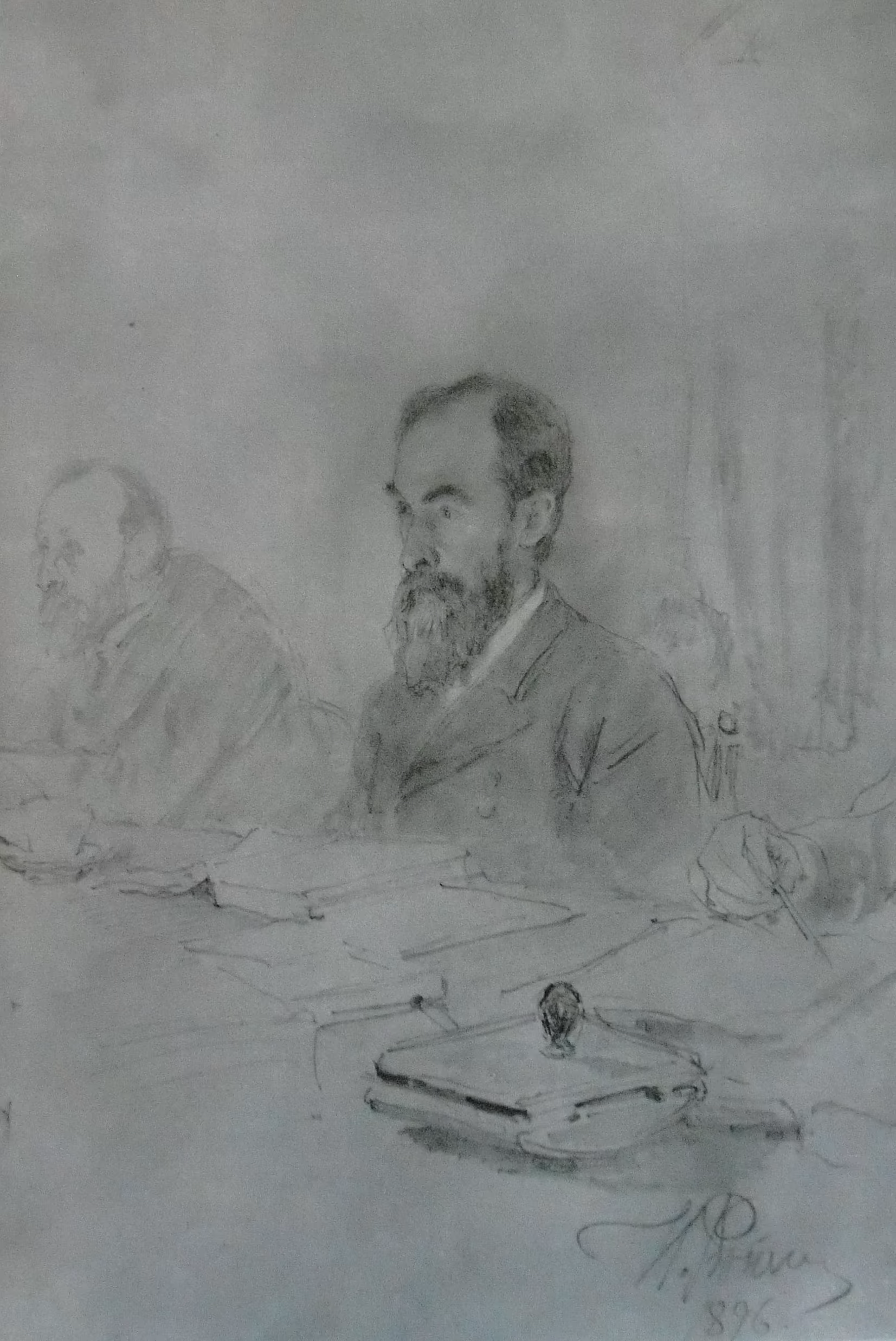
Pavel Tretyakov at a meeting of the Academy of Arts. Drawing by Ilya Repin, 1896. Wikimedia Commons, 1896P.M.Tretyakov at a meeting of the Academy of Arts.JPG, author: Ilya Repin, licence: Public domain source
The gift of 1892 had been decades in the making
The earliest documentary evidence of this intention dates from 1860. Before travelling abroad, the twenty-seven-year-old Tretyakov drew up his first testamentary letter. In it, he allocated 150,000 silver roubles to establish an art museum or public picture gallery in Moscow. His collection was still modest at the time, but his goal was already clear: he intended the works to be accessible to a broad public.
Tretyakov initially planned to make Fyodor Pryanishnikov's collection the foundation of the future institution and supplement it with his own paintings. He was unable to purchase the collection in its entirety: after its owner's death, it passed to the Moscow Public and Rumyantsev Museums in 1867. Following this setback, Tretyakov continued building the gallery on his own. Public accessibility became the standard by which he assessed acquisitions, premises and the collection's future.
Vasily Vereshchagin's Turkestan series occupies a special place in the history of Pavel Tretyakov's collection. Tretyakov acquired it in 1874 for 92,000 roubles, making it his most expensive purchase. He wanted to keep the series intact, house it in a purpose-built top-lit gallery and keep it permanently on public display. Tretyakov first offered the works to the Moscow School of Painting, Sculpture and Architecture, and then to the Moscow Society of Art Lovers. Neither plan came to fruition because the organisations lacked suitable premises or funds. Long before 1892, Tretyakov was seeking a public institution capable of accepting the art and opening it to visitors.
Sergei's death hastened the legal formalisation of the gift
The immediate impetus for formalising the gift was the death of Sergei Mikhailovich Tretyakov. Pavel's younger brother primarily collected nineteenth-century Western European art and bequeathed his share of the house and his art collection to Moscow, relying on Pavel's already known intention to transfer the gallery to the city as well. It was impossible to carry out these instructions literally while the house and the main collection remained privately owned.
On 31 August 1892 according to the Old Style calendar, or 12 September under the New Style, Pavel Tretyakov submitted a declaration to the Moscow City Duma. He offered the city his own collection, his younger brother's collection and the house in which the paintings were displayed. In September, the Duma accepted the gift and resolved to name the institution the Pavel and Sergei Mikhailovich Tretyakov City Art Gallery. A private initiative thus came under municipal ownership. Sergei's name was placed alongside Pavel's because his European collection became a distinct and significant part of the combined gallery.
His death determined the timing of the transaction; the objective had been established much earlier. This is confirmed by the preceding thirty years: the testamentary letter of 1860, attempts to make Vereshchagin's series available to the public, the construction of museum galleries and the opening of his private home to visitors. In 1892, Pavel Tretyakov combined the fulfilment of a mature plan with the execution of his brother's wishes.
Public access was a condition of the transfer
Pavel Tretyakov made public access a condition of transferring ownership. In his declaration to the Moscow City Duma, he required the gallery to be open free of charge to everyone for at least four days a week throughout the year. The established visiting arrangements thus became a binding obligation for the new owner. The city accepted the museum with a prescribed framework for public access.
The two dates encountered in the history of the gift refer to different legal acts. Tretyakov dated his declaration 31 August 1892 according to the Old Style calendar, corresponding to 12 September under the New Style; the Duma accepted Pavel's and Sergei's donations on 15 September Old Style, or 27 September New Style. The gallery's anniversary project uses the city authorities' decision as its point of reference, whereas biographical accounts often use the date on which the document was submitted. There is no contradiction between them.
The Duma's resolution instructed the city administration to take possession of the property and arrange the title deeds for the real estate at the city's expense. These formalities changed the legal basis of ownership: access to the paintings no longer depended on a personal invitation, a decision by an heir or the family's current expenditure. Moscow assumed responsibility for maintaining the building, while Tretyakov retained his position as trustee. The city acquired ownership, while the founder retained curatorial influence; this is why Tretyakov continued making acquisitions after the gift.

The Moscow City Duma building in a pre-revolutionary view of the city. Wikimedia Commons, Old city duma.jpg, author: AnonymousUnknown author, licence: Public domain source
What exactly did Moscow receive?
The city took ownership of an integrated museum complex: Pavel Tretyakov's collection, works from Sergei's collection, the house in Lavrushinsky Lane with its purpose-built galleries, and responsibility for its future upkeep. The inventory reveals the scale of Sergei's contribution, which is often overshadowed by his elder brother's name. According to research by the Tretyakov Gallery, this part of the gift comprised 101 works by 72 Russian and European artists, excluding terracotta figurines, classical sculpture and five tapestries. In April 1891, the collection was valued at 516,435 roubles.
Converting this valuation directly into modern currency would imply a false degree of precision: prices, incomes and the art market itself have all changed over the intervening century. A comparison within the period nevertheless clarifies the order of magnitude. In January 1893, the Duma granted the gallery an annual acquisition budget of 5,000 roubles, while Sergei's collection was valued at more than a hundred times that amount. The comparison serves only to illustrate the scale: one figure represents a collection of artistic treasures, the other an annual budget. It shows just how substantial a collection the city received at once.
The scale was also reflected in the depth of its sections devoted to particular artists and historical periods. By the time of the gift, the paintings from the first half of the nineteenth century alone numbered more than 250. The Alexander Ivanov collection contained 83 works, including numerous studies. Such groups of works made it possible to trace the creative process, the development of an artistic school and the relationships between individual pieces. The history of art was revealed through dozens of interconnected works rather than a handful of isolated masterpieces. Together with the house and its system of public access, they made the gift a fully established museum in need of a permanent owner.
Why was Moscow chosen as the recipient of the gift?
Moscow had been part of Tretyakov's vision from the outset. His first testamentary letter referred specifically to an institution in Moscow, and he later built a gallery adjoining the family home in Lavrushinsky Lane. Artists lived and worked in the city, visitors came to the galleries in his home, and it was here that the brothers developed their business and social connections. The transfer to the Moscow City Duma brought together the paintings, a purpose-adapted building and an established practice of public display.
The theory that Moscow was competing with imperial St Petersburg is not directly supported by the published documents. Tretyakov wanted to create a public repository of national art in his native city and had invested in this location for years. The municipal authorities were capable of accepting the property, maintaining the institution and securing its public status. In January 1893, the Duma resolved to allocate 5,000 roubles annually for acquisitions, supplementing the funds provided by Sergei Tretyakov with municipal expenditure.
This decision combined personal attachment with institutional foresight. A gallery in a private home depended on the health, heirs and finances of a single owner. A municipal museum could continue to operate beyond its founder's lifetime. Moscow received an assembled collection, a house with exhibition galleries and an established system of operation.

The Tretyakov Gallery display in a photograph by Karl Fischer, 1898. Wikimedia Commons, Tretyakov Gallery by Karl Fischer 1898.jpg, author: Karl Fischer, licence: Public domain source
Business practice and the organisation of the gallery
Pavel and Sergei came from a Moscow merchant family. After the death of their father, Mikhail Zakharovich, in 1850, the brothers inherited his property and continued the family business. Pavel managed shops and the Kostroma flax-spinning mill and served as a member of the Commercial Court. He ran his commercial and industrial affairs while simultaneously building the gallery, dividing his working hours between business obligations, exhibitions, visits to artists, correspondence, the construction of galleries and the compilation of catalogues.
His business experience is evident in the way the project was organised. Tretyakov planned expenditure years in advance, negotiated directly with artists, acquired substantial groups of works intact, expanded the building as the collection grew and documented his holdings. He acted simultaneously as purchaser, patron, curator, building client and future founder. After the transfer in 1892, Tretyakov retained a managerial role: he remained the gallery's trustee and continued expanding its collection with both municipal and personal funds.
Nineteenth-century Moscow merchants took different approaches to their private collections and charitable funds. Fyodor Pryanishnikov and Kozma Soldatyonkov collected works by Russian artists before, or at the same time as, the future founder of the gallery; their collections were later divided among several museums. Pavel Tretyakov's project was distinctive in combining three aims: to present a coherent account of the Russian school of art, make it accessible to the public and establish a sustainable form of ownership in advance.
The history of the Pryanishnikov and Soldatyonkov collections shows how much depended on the legal and museum model chosen. An album prepared by the Tretyakov Gallery and the Russian State Library for a 2026 exhibition traces the arrival of both collections at the Rumyantsev Museum following their owners' deaths. After that institution was dissolved in the 1920s, the main body of works entered the collection in Lavrushinsky Lane, while a significant number went to other museums in Moscow and elsewhere in Russia. Pavel Tretyakov chose a different course: during his lifetime, he transferred a functioning museum to Moscow and placed its ownership on a legal footing.

Apollinary Goravsky. Portrait of Kozma Terentyevich Soldatyonkov. 1857. Wikimedia Commons, Kozma Soldatyonkov.jpg, author: Apollinary Goravsky, licence: Public domain source
What kind of museum did Tretyakov want to create?
Tretyakov sought to present the development of the Russian school of art. The story of how the Tretyakov Gallery was created begins with his purchases of 1854–1855: works by the Dutch Old Masters. The museum itself, however, regards 1856 as its founding year, when Tretyakov acquired Vasily Khudyakov's “Skirmish with Finnish Smugglers”. Russian art subsequently became the heart of the collection: contemporary genre painting, landscapes, history paintings, portraits, earlier works from the eighteenth and first half of the nineteenth centuries, drawings and, later, Old Russian icons.
Tretyakov built his collection systematically and relied on his own judgement with growing confidence. In a letter to the artist Alexei Goravsky, he asked for truth and poetry even in an unremarkable subject, adding: “Give me even a muddy puddle.” This phrase connects his choices with truthful observation and the poetry of the everyday landscape. He valued an artist's ability to perceive significance in contemporary life, in a person's character or in an inconspicuous natural motif.
His support for Vasily Perov was unwavering: Tretyakov acquired his paintings, commissioned portraits from him and helped organise a posthumous exhibition of Perov's work. In the 1870s, the collector became a committed supporter of the Association of Travelling Art Exhibitions: he attended its exhibitions and purchased works both in the exhibition halls and directly from artists' studios before they opened. Alexei Savrasov's “The Rooks Have Returned”, Ivan Kramskoi's “Christ in the Wilderness”, and paintings by Ilya Repin, Vasily Surikov, Ivan Shishkin and Nikolai Ge formed a broad panorama of Russian art in the second half of the nineteenth century.

Ivan Kramskoi. “Christ in the Wilderness”. 1872. Wikimedia Commons, Christ in the Wilderness — Ivan Kramskoy — Google Cultural Institute.jpg, author: Ivan Kramskoi, licence: Public domain source
Tretyakov and the opinions of recognised connoisseurs
He valued the judgement of respected contemporaries, but reserved the final decision for himself. Tretyakov corresponded with artists and critics, examined exhibitions closely, and investigated the provenance and titles of works. By the late 1880s, however, he was buying paintings that even experienced audiences viewed with scepticism. This was how Valentin Serov’s “Girl in the Sunlight” entered the collection, followed by “The Hermit” and “The Vision to the Youth Bartholomew” by the young Mikhail Nesterov, and Isaac Levitan’s “After the Rain. Plyos”.
The idea of “Tretyakov’s taste” extended beyond Realism and the circle of the Peredvizhniki. What mattered to him was the persuasiveness of the artistic treatment. As new artists emerged, his selection criteria broadened. Socially charged genre scenes, historical canvases, intimate landscapes, Nikolai Ge’s religious explorations, and the fresh sensibilities of Serov and Nesterov all coexisted in the collection. Later, the collector turned his attention to icons, establishing a field that would become one of the foundations of the museum’s Old Russian art department.
Tretyakov sought to show each master’s artistic development, so he assembled substantial groups of works by Perov, Kramskoi, Repin, Levitan, Alexander Ivanov and other artists. By 1892, for example, the gallery held 83 works by this artist. In its rooms, visitors could compare a sketch with the finished composition, an artist’s early and late styles, and different genres by the same painter. The gallery had acquired scholarly value even before it became a municipal museum.
Acquiring Ge’s painting despite his personal reservations
The acquisition of Nikolai Ge’s painting “What Is Truth? Christ and Pilate” shows that Tretyakov distinguished between his personal response to a work and its importance to art history. In February 1890, the painting was presented at the eighteenth Peredvizhniki exhibition. Following an appeal by Konstantin Pobedonostsev, Alexander III ordered it to be removed from display and banned its exhibition in other cities; on 7 March, the organisers complied with the order and removed its reproduction from the catalogue.
Leo Tolstoy urged Tretyakov to acquire Ge’s work, but the collector did not share his high opinion of the artist’s treatment of the Gospel subject. Tretyakov nevertheless bought the canvas from the artist. On its page devoted to the work’s history, the museum cites Tretyakov’s practical reasoning: the painting had to be preserved for the sake of a comprehensive collection of Russian art and held until public display became possible. The decision involved additional expense, even though the owner did not regard the canvas as an undisputed masterpiece and could not yet exhibit it.
When selecting works, Tretyakov weighed his personal judgement against a painting’s historical significance. He considered a work’s place in the development of Russian painting, its connections with other works, and the risk of losing a record of an artistic debate. The collection therefore included paintings about which he had reservations but which he considered essential to presenting a complete picture of the period.

Nikolai Ge. “Peter the Great Interrogating the Tsarevich Alexei Petrovich at Peterhof”. 1871. Wikimedia Commons, Peter the Great Interrogating the Tsarevich Alexei Petrovich.jpg, author: Nikolai Ge, licence: Public domain source
A portrait gallery of Russian cultural figures
In the late 1860s, Tretyakov conceived the idea of a portrait gallery of writers, composers, artists and scholars. The collector commissioned new works and persuaded celebrated contemporaries to sit for portraits. At his request, Vasily Perov painted Alexander Ostrovsky, Fyodor Dostoevsky, Vladimir Dal, Ivan Turgenev and others, while Ivan Kramskoi portrayed Leo Tolstoy, Nikolai Nekrasov and Mikhail Saltykov-Shchedrin.
The portrait programme reveals the project’s public purpose particularly clearly. A family portrait preserves the memory of a lineage; Tretyakov was creating a visual record of Russian culture. He chose people whose books, music and research were already influencing their contemporaries. Perov and Kramskoi painted distinctive psychological portraits, allowing viewers to encounter individual faces and personalities rather than an official parade of titles and positions.
In Tretyakov’s view, a national museum helped society recognise itself. There, visitors could see the contemporary countryside and city, historical conflicts, the Russian landscape, and the faces of the authors they read. Supporting living artists was central to this programme: a purchase provided an artist with the means to continue working, while the painting gained a place in a publicly accessible collection where it could be viewed alongside other works.

Vasily Perov. “Portrait of the Writer Fyodor Mikhailovich Dostoevsky”. 1872. Wikimedia Commons, Dostoevsky (Perov, 1872) — Tretyakov Gallery.jpg, author: Perov, licence: Public domain source
How did a family home become a museum?
The Tretyakov family purchased the house in Lavrushinsky Lane in late 1851. At first, the paintings were kept in the living quarters, but the growing collection required purpose-built spaces. Construction of the first two museum rooms began in 1872; they were completed and connected to the house in 1874. After the acquisition of Vereshchagin’s Turkestan series, another six rooms were added in 1882, seven in 1885 and six more in 1892. The extensions were designed by the architect Alexander Kaminsky, the husband of the collector’s sister.
In 1902, after Tretyakov’s death, work began on the familiar façade designed by Viktor Vasnetsov. During the founder’s lifetime, the architect Alexander Kaminsky addressed the practical need to provide the works with sufficient space and light and to arrange them thoughtfully. Private and public spaces coexisted for many years, and the boundary between the family’s living quarters and the exhibition rooms shifted as the collection grew.
By the early 1880s, the gallery had already acquired the status of a museum open to the public regardless of social class or rank. The 1892 gift formally enshrined the public access that was already well established. Tretyakov was forced to close the gallery in 1891 because of thefts; after the city accepted the gift, the institution officially opened to visitors in August 1893. Its municipal status obliged the new owner to provide security, maintain the building, catalogue the holdings and expand the collection.

The main façade of the Tretyakov Gallery in Lavrushinsky Lane. Openverse, Wikimedia, File:Tretyakov Gallery, Moscow, main building .JPG, author: Wmpearl, licence: cc0 1.0 source, license
Municipal ownership and the founder’s management
Moscow became the owner, while Pavel Tretyakov retained responsibility for managing the gallery. He was appointed a trustee and, until his death in 1898, continued to acquire works, arrange their display and expand the premises. During the 1890s, the collection gained works by Nikolai Ge, Ilya Repin, Alexei Savrasov, Valentin Serov, Nikolai Kasatkin and Mikhail Nesterov. Tretyakov’s subsequent expenditure and activities disprove the suggestion that the gift was a way of escaping mounting costs.
Tretyakov also developed the museum’s work through its catalogues. From 1893 onwards, he published them annually, clarifying information, corresponding with artists and their relatives, and verifying titles. The last catalogue prepared by the founder was published after his death, in 1898, and included 1,634 works by Russian painters and 85 works by foreign masters from Sergei’s collection. The 1898 edition is not an exact inventory of the 1892 gift: over those six years, Tretyakov continued to make purchases and helped expand the municipal gallery.
Through the catalogue, the founder transformed his personal choices into verifiable museum scholarship. Visitors were given the artists’ names, the titles and the order of the works, while curators gained a basis for checking the collection’s holdings. A French version of the guide appeared in 1897, during Tretyakov’s lifetime. The inventory complemented the legal deed by documenting the composition of the collection and making it possible to distinguish the founders’ works from the city’s later acquisitions.
Tretyakov also made provisions for the period after his death. In his 1896 will, he allocated 150,000 roubles, the interest from which was to be spent on repairs to the gallery, and 125,000 roubles for acquiring paintings and sculpture. The neighbouring house and the icons kept in his apartment were specified separately. Through these provisions, Tretyakov supplemented the 1892 transfer: the city already owned the property, while interest from private capital was to support the building and collection.
How did the gallery survive the founder’s death?
Following Pavel Tretyakov’s death in December 1898, day-to-day management passed to the municipal authorities. The 1896 will contained procedural irregularities and did not take effect until August 1899, after the personal intervention of Nicholas II. In June of that year, the City Duma had approved regulations for managing the municipal gallery and entrusted its administration to a collegial Council.
With the founder gone, the collegial body acquired works and expanded the boundaries he had set for the collection. According to the museum chronicle, the holdings gained works from exhibitions by the World of Art, the Union of Russian Artists and the Blue Rose. The Council preserved the core of the gift and began collecting the art of the next generation.
The executors transferred Tretyakov’s personal collection of icons and part of his private library to the gallery. The Council established a small public art library on the ground floor. Visitors gained a place for viewing and study, where they could compare a work with a catalogue, a book or the artist’s biography. In this way, the Council continued the founder’s practice of clarifying attributions and titles through correspondence with artists and those close to them.
Sergei Tretyakov’s role in the combined gallery
Moscow named the municipal gallery after both brothers, although their artistic interests differed. Pavel collected primarily Russian art, while Sergei collected nineteenth-century Western European painting, especially French works. According to the 1891 inventory, his collection included works by masters from various countries; museum researchers particularly note his interest in the Barbizon School and his desire to show the evolution of the French school of painting.
Sergei’s European paintings allowed visitors to compare Russian artists with French and other Western European painters. After his brother’s death, Pavel had to combine the two collections and the house legally into a single gift. The phrase “Tretyakov donated his collection” oversimplifies the event: Moscow received a unified museum together with the founder’s continuing commitments.
The brothers’ story forms part of Moscow’s broader culture of collecting. Pryanishnikov sought to make his collection accessible, while Soldatenkov combined entrepreneurship, publishing and art collecting. Their collections developed differently and, after their owners’ deaths, passed through the Rumyantsev Museum and subsequent redistributions. Pavel Tretyakov decided the gallery’s fate during his lifetime: he transferred it to the city while retaining its management.

The first page of the inventory of paintings and sculptures in S. M. Tretyakov’s collection as of 29 May 1891. Wikimedia Commons, Inventory of the S. M. Tretyakov Collection.jpg, author: S. M. Tretyakov, licence: Public domain source
How did the composition of the gift change after 1918?
Municipal ownership ensured the museum’s continuity, while the composition of the gallery changed over time. After the Revolution, the Council of People’s Commissars nationalised the Tretyakov Gallery by a decree of 3 June 1918 and transferred it to the People’s Commissariat for Education. The new authorities preserved the institution’s public purpose but changed its ownership and acquisition principles. Nationalised private collections and works from the State Museum Fund entered the gallery.
A 1924 decree established the distribution of cultural assets according to each institution’s specialisation. The Tretyakov Gallery transferred its works by foreign artists to museums of Western art. The brothers’ unified collection thus ceased to exist in its 1892 configuration: a substantial part of Sergei’s European collection passed to other institutions. A published study of the collection’s history identifies around forty of his paintings in the Pushkin State Museum of Fine Arts, with the remaining works held by the Hermitage and museums across the former USSR.
In 1925, works also moved in the opposite direction: Russian paintings from the holdings of the dissolved Rumyantsev institution were transferred to Lavrushinsky Lane, including the core collections of Fyodor Pryanishnikov and Kozma Soldatenkov. The gallery survived as an independent institution, although its inventory changed. Tretyakov’s gift created a publicly accessible museum and the nucleus of a national collection; subsequent authorities and museum specialists altered its boundaries in accordance with the policies of their respective eras.
Why does 2026 bring Tretyakov’s choice back into focus?
The gallery traces its history back to 1856, when its first painting by a Russian artist was acquired, and therefore celebrates its 170th anniversary in 2026. The anniversary programme explores the founder’s life and the ways in which the collection was formed. As of 9 September 2026, the Engineering Building is hosting the exhibitions “Icons: The Collection of Pavel Tretyakov” and “Pavel Tretyakov’s Predecessors: Fyodor Pryanishnikov and Kozma Soldatenkov”, both scheduled to run until 11 October. In the historic building, “The Collectors’ Choice” continues until 21 March 2027, while “Pavel Tretyakov and Vasily Polenov” runs until 17 January 2027.
The anniversary programme reveals how the founder made contentious decisions. The icon exhibition traces the later expansion of his conception of national art. The project on Pryanishnikov and Soldatenkov compares different models of collecting in Moscow. The story of his relationship with Polenov reveals the collection as the product of dialogue—and, at times, tense negotiations—between artist and buyer.

A 2010 postal envelope from the ‘Patrons of Russia’ series dedicated to Pavel Tretyakov. Wikimedia Commons, Pavel Tretyakov PSE Russia 2010.jpg, author: Russian Post, Publishing and Trade Centre "Marka" (ITC Marka). Envelope design by A. Moskovets. Scanned by Dmitry Ivanov. Licence: Public domain source
What do the documents reveal about Tretyakov’s motives?
Tretyakov left no comprehensive manifesto setting out all the reasons for his gift. His motives can be reconstructed from documents created at different times and for different purposes. His testamentary letter of 1860 records an early intention to establish a public gallery in Moscow. His 1892 petition to the City Duma identifies what was to be transferred and to whom. Sergei’s will confirms that the younger brother knew of Pavel’s plan in advance, while Pavel’s instructions of 1896 link the museum’s future to capital set aside for repairs and acquisitions.
Biographical details carry less evidential weight. The gallery’s official history states that Tretyakov went abroad after the Duma reached its decision because he did not wish to take part in the celebrations or receive expressions of gratitude. His departure confirms his aversion to public ceremonies. The reasons behind decades of expenditure, the selection of works and the transfer of property are revealed by the collector’s documents and actions; attributing everything solely to personal modesty reduces a complex institutional decision to a character trait.
The sources and three decades of practice substantiate one motive: Tretyakov was consistently creating a public museum. He planned such an institution, sought public exhibitions of major acquisitions, built dedicated galleries, admitted visitors, transferred the property into municipal ownership and ensured that acquisitions would continue. Sergei’s death determined the timing of the legal step; the merchant milieu provided both the capital and models of philanthropy, while artistic taste supplied the content. Together, these factors explain why the city became the recipient and a functioning museum the object of the gift.
Conclusion: why Tretyakov gave the gallery to the city
Pavel Tretyakov transferred the gallery to Moscow to secure a permanent public owner for it and ensure the continuation of his museum project. The chronology supports this aim: in 1860, he set aside money for a public museum; in the 1870s, he sought a public exhibition of an entire series by Vereshchagin; in the early 1880s, he opened his own galleries; and in 1892, he transferred the collections and the house to the city. After making the gift, he remained a trustee, continued to acquire works, published catalogues and bequeathed capital for repairs and further acquisitions.
By transferring the property to Moscow, Tretyakov embedded his personal artistic choices within a municipal institution. Russian art gained a permanent public venue, artists gained a discerning buyer and a place in the collection’s history, and the city gained a museum with clearly defined responsibilities as its owner. The gallery’s holdings reflected its founder’s interest in contemporary everyday life, new artistic explorations, portraits of cultural figures and the development of the Russian school of art.
The urban setting of this story survives in Zamoskvorechye: merchants’ mansions stand alongside the Tretyakov family home and the museum extensions. The route of the Zamoskvorechye tour passes through Lavrushinsky Lane, the Kadashevskaya Sloboda, historic mansions and the area around the Tretyakov Gallery. The programme does not include admission to the museum galleries, so a separate museum visit is required to view the collection.
Sources
- Pavel Mikhailovich Tretyakov’s Collecting Activities
- Pavel Mikhailovich Tretyakov’s Donation of the Gallery to Moscow
- The Tretyakov Family
- The Building in Lavrushinsky Lane
- The Tretyakov Gallery Without Tretyakov
- How the Tretyakov Gallery Became a Public Museum
- The Tretyakov Gallery Turns 170
- Current Exhibitions at the Tretyakov Gallery
- Pavel and Sergei Tretyakov Museum
- P. M. Tretyakov’s Statement to the Moscow City Duma
- Pavel Tretyakov and His Gallery
- Sergei Tretyakov
- A collection of paintings from the first half of the 19th century
- From an inventory to a multi-volume catalogue
- Pavel Tretyakov’s predecessors: Fyodor Pryanishnikov and Kozma Soldatyonkov
- P. M. Tretyakov’s declaration and the resolution of the Moscow City Duma
- Nikolai Ge. ‘What Is Truth?’ Christ and Pilate
- Property of the Republic
We took a tour of Taganka designed for 12-year-old children. It was an excellent programme. We covered a great deal of ground and learnt so much. We discovered the story of Dryanaya Street and discussed the Vladimir Highway, the surrounding monasteries and churches, and the Old Believers. We now know where Korovin was born, where Stanislavsky was born and raised, where the Morozov merchant children lived, and why Arseny Morozov was considered such an outrageous figure in his day. We also discussed Solzhenitsyn, discovered where Stalin Avenue was supposed to be built, saw the bunker, walked to the Russian metochion of the Mount Athos Monastery, and learnt why the Illuzion cinema made Taganka famous. Of course, no tour would have been complete without Vysotsky and Lyubimov. We also touched briefly on Taganka Prison, although naturally we did not go there. All in all, it was an exceptionally rich and informative tour! Our guide Alexander was superb!
Our thanks to our guide Alexander for a magnificent sightseeing tour. Alexander’s love for Moscow and its history, his wide-ranging knowledge, elegant and engaging delivery, and personal charm make the tour not merely interesting and informative, but truly delightful! Thank you, Alexander! Tatiana and Tatiana, St Petersburg
On July 18th, we participated in the "Soul of Moscow" group tour led by Alexander. Kitay-gorod and its surroundings revealed a new side to us, and everyone thoroughly enjoyed it. Some of us began intensively studying related materials to broaden our horizons. We'll be back, and we highly recommend it! You won't regret it.
Good afternoon, on June 23rd we had a tour called " The Soul of Moscow ," led by Alexander. He's a very pleasant young man. We visited such lovely courtyards and alleys with him that we never even knew existed, and we learned so much. We really enjoyed everything, and we hope to continue our acquaintance. Alexander! Thank you! We had a great time with you, and we thoroughly enjoyed it. See you there!
This isn't my first time with Radius. This time, I took the Moscow metro . The goal was not only to admire the underground palaces but also to learn how to navigate the metro. As a resident of a region without a metro, I was a bit apprehensive and didn't understand how to navigate the metro. Of course, the internet helps, but live communication is much better. Tour guide Yulia handled this task perfectly. The information was accessible and interesting, the presentation was calm, and the communication style was very friendly. Thank you very much for the tour and the practical experience.
Good afternoon! I gave the "Soul of Moscow" tour to some of the capital's guests. We were thrilled to hear our guide, Anton. It was so informative and engaging, and very warm. To say we were absolutely delighted is an understatement. It turned out to be a truly family-friendly excursion. We learned so many interesting facts. The material was presented professionally, all our questions were answered, and we saw so much. It was simply WOW! Thank you so much, Anton, he's the best!!!!! From now on, I'll only come to you, the Radius team. I highly recommend it. I promise we'll see each other again soon on other tours.
Overall, the tour left a positive impression! Thanks to Alexander for the walk through the courtyards and atmospheric spots of Kitay-Gorod; we certainly wouldn't have done it on our own. The tour was comfortable, and the guide spoke confidently and calmly. One thing we personally missed: we would have liked more of the historical part, relating to ancient Moscow and the history of Kitay-Gorod. There were quite a few stories about the Soviet period and the bar scene, but for our group, this wasn't particularly relevant. We think the program could be a little more tailored to the age and interests of the group. It would also have been interesting to add more historical facts, monuments, and details about old Moscow and the area itself. That said, the tour was still interesting, and some places and churches were truly memorable. These aren't really "cons," but rather suggestions for an even more comprehensive program.
Hello! We had a corporate group of 10 people. Our guide was Anton, and we had a tour of Bulgakov. I would like to point out the excellent organization; everything went smoothly. The managers were very accommodating to our changes in the number of participants. The bus was very comfortable. Anton is a super-engaged and motivated guide. He lives this history and is delighted to share his knowledge and create an unforgettable experience. Everything went well. I highly recommend it!
Thank you for a fascinating tour! It gave me so much food for thought to explore! Note: Review of the "Zamoskvorechye" tour with guide Maria.
I'd like to express my gratitude on behalf of our team! Thank you for keeping to our scheduled schedule despite our lack of organization. Our colleagues appreciated your preparation for the tour! It was informative. Note: Review of the "Modern Residential Complexes, Factory Past, and Avant-Garde" tour of the ZILART residential complex with guide Maria. Maria prepared and conducted a customized tour for employees of the Samolet Group of Companies development company.
Thank you! You have great talent. Good luck! ☺️ You're a wonderful guide! Thank you again! Note: This is a review of the corporate tour "The Heart of the Capital" with guide Maria.
Thank you for a wonderful day today!!)) Note: review of the excursion "The Soul of Moscow" with guide Maria
On behalf of the whole family, I want to thank you for a very informative and interesting tour! Note: This is a review of the "Palace Dungeons" tour with guide Maria.
Good afternoon! I'd like to express my gratitude and that of my guide for organizing the tour! We were very pleased. We'd like to do it again in October, but on a different route — ZIL. Note: This refers to the tour for Samolet Group developers, led by guide Maria.
Thanks to Alexander for the bar tour of Baumanka ! It was fun, exciting, and we discovered so many new places! Awesome! May we reach new heights!
Good afternoon! I was on a tour of Sukharevskaya Square — we went all the way to Tsvetnoy Boulevard. I didn't expect it to be so interesting! For those wondering whether to go — go for it! It truly became one of my most memorable summer memories!
Anastasia, good morning! Thank you and Masha for yesterday! The speakers are happy. The connection through the headphones was often lost, especially at the checkpoint, but that's just our current situation. You could hear if you were standing close, no more than 1.5 meters away. Colleagues have already asked for your contact information. I'd be happy to share it and look forward to another opportunity to work with you. Special thanks to the Director for the Bureau . Note: " Heart of the Capital " tour for participants of the 2025 Moscow Oncology Forum. Guides: Anastasia and Maria.
We'd like to thank Anton and Alexander for leading the tour! It was fascinating to hear how the Krasnaya Presnya district developed and how Prokhorov's influence on our city's development. It was a pleasant immersion into a quiet, previously unexplored area!
Good afternoon, thank you so much, Anastasia. The " Uncle Gilyai " tour was fantastic. Even though we're Muscovites and know a lot about Moscow, the experience was amazing, so much new and interesting happened. We'll definitely be back.
Thank you for the " Heart of Moscow " and " Khamovniki " tours. Anton, a knowledgeable and passionate Moscow guide, gave me the tour. He's a great storyteller, intelligent, well-read, and captivating. You've truly opened up my Moscow to me! I'll definitely be back next summer to explore Moscow with you. I'll recommend your wonderful tour program to all my friends!
Excursions with the Radius travel agency are always a positive experience if you choose them. We planned a tour of Zamoskvorechye on our next visit. We've worked with our guide, Anton, before. We'll definitely recommend him to everyone we know. The tour is informative, not overloaded with dates, and the information is comprehensive yet easy to understand, as it's presented in a light, narrative manner, not like a history textbook, dry and academic. Thank you for this approach. We'll definitely use the Radius agency again on our next visit to Moscow.
Thank you so much for the tour of Zamoskvorechye . Despite the weather, it was very interesting and informative! Note: this refers to the tour with guide Anton.
A huge thank you to Anastasia. We had a fantastic tour of the Patriki district. We learned so much. Anastasia is a true master of her craft. The tour was captivating, not at all boring, lively and interesting. Everyone was delighted. We were full of new impressions. I definitely recommend it. You won't be disappointed!
We explored the Soul of Moscow with my family and Radius on my birthday. Everyone thoroughly enjoyed the walk! Anton shared so many interesting facts about the capital and its history, taking us into spiritual depths no one else had even suspected. Most of us were either born or longtime Moscow residents who spent a lot of time walking around. It was educational, heartwarming, and unforgettable. 🙂 Overall, this wasn't my first time walking around Moscow with Anton, and each time was a real adventure!