Yuri Grigorovich’s The Nutcracker is described as a New Year ballet: in the published libretto for this version, guests visit the Stahlbaums for a New Year celebration, and the story ends after New Year’s Eve. The production’s Moscow premiere took place on 12 March 1966. The month of the first performance does not determine when the story is set.
The history of The Nutcracker begins with its world premiere in St Petersburg on 18 December 1892, New Style. Each subsequent production has its own premiere date, including Grigorovich’s version at the Bolshoi Theatre. The documents distinguish between the work’s premiere, a particular choreography and winter performance schedules; they do not establish the year when seeing The Nutcracker around New Year became an annual tradition.
What is considered the premiere date of the ballet itself?
The world stage premiere of The Nutcracker took place at the Mariinsky Theatre on 6 December 1892, Old Style, or 18 December, New Style. Audiences were presented with two works by Pyotr Tchaikovsky in a single evening: the one-act opera Iolanta and the two-act ballet. This programme is recorded in material published by the composer’s memorial museum in Klin.
The Directorate of the Imperial Theatres had commissioned both works from Tchaikovsky two years earlier. According to the museum in Klin, the ballet’s story was chosen at Marius Petipa’s suggestion, while the composer chose the subject of Iolanta himself. Both works were intended to be performed on the same evening. December 1892 marks the premiere of this combined programme; the documents provide no grounds for treating it as the start of a fixed annual New Year performance.
The work took longer than expected: the composer was combining the commission with an American concert tour, suffered the loss of his sister Alexandra and asked the director of the theatres, Ivan Vsevolozhsky, to postpone the production by a year. The Tchaikovsky Museum describes these circumstances. They explain why the premiere date cannot be inferred from the festive story: the opening date depended on the creators’ work and the theatrical season.
Marius Petipa prepared the ballet’s scenario, while Lev Ivanov created the choreography for the original version. It would be inaccurate to regard Ivanov as the sole creator of the premiere production. Over the many decades since 1892, new ballets have been set to Tchaikovsky’s score, with different approaches to staging and characterisation. The phrase ‘the premiere of The Nutcracker’ therefore requires clarification of the venue, year and choreographer.

Stanislava Belinskaya (Clara), Lydia Rubtsova (Marianna) and, probably, Vasily Stukolkin (Fritz) in the Mariinsky Theatre’s production of The Nutcracker, 1892. Wikimedia Commons, Nutcracker -Stanislava Belinskaya as Clara, Lydia Rubtsova as Marianna, & Vasily Stukolkin as Fritz -1892.JPG, author: The original uploader was Mrlopez2681 at English Wikipedia., licence: Public domain source
The original pairing with Iolanta did not last long: according to the Mariinsky Theatre, the works were separated during the very first season. The December premiere establishes when the combined programme opened, while subsequent performances show the ballet’s independent life. By October 1912, it was being performed alongside another work.
The A. A. Bakhrushin Museum holds the programme for an evening performance in St Petersburg on 28 October 1912: Lev Ivanov’s The Nutcracker appeared alongside Josef Bayer’s ballet The Fairy Doll. Dating from twenty years after the world premiere, the document records an autumn performance of the original version. A single archival sheet cannot reveal the entire season, but it makes clear that the ballet was performed outside December too.
March 1892: the music was heard before the ballet reached the stage
The music of The Nutcracker was performed in public before the ballet reached the stage. According to the Tchaikovsky Research project, in March 1892 Tchaikovsky conducted a concert suite drawn from his own ballet score. Audiences heard part of the forthcoming work several months before its theatrical premiere in December.
Tchaikovsky Research provides further details about the concert: Tchaikovsky compiled the suite for an evening concert of the Russian Musical Society in St Petersburg, replacing the symphonic ballad The Voyevoda. In March 1892, audiences heard an orchestral selection from a ballet that had yet to be staged; a concert premiere is distinct from a stage premiere.
This March concert is particularly useful when examining the myth surrounding the ballet’s festive associations. If we go by the month when the music was first heard in public, the answer is March; if we use the date of the first stage performance, it is December. The calendar does not alter the family’s winter celebration within the fairy tale. The musical and stage histories of the same work begin with different events.

Pyotr Ilyich Tchaikovsky in a photographic portrait from the 1880s. Wikimedia Commons, Peter Ilich Tchaikovsky, head-and-shoulders portrait, facing slightly left LCCN99615569.jpg, author: Miscellaneous Items in High Demand, PPOC, Library of Congress, licence: Public domain source
For the concert suite, Tchaikovsky selected eight numbers from the ballet, including the March, the ‘Dance of the Sugar Plum Fairy’ and the ‘Waltz of the Flowers’. According to Tchaikovsky Research, the selection was performed on 7 March 1892, Old Style, or 19 March, New Style, with the composer conducting. The Grandfather Dance and the battle scene with the mice, described in Petipa’s scenario, were not included. The concert therefore cannot be regarded as the premiere of the stage production.
The Tchaikovsky Museum lists the ballet, Op. 71, and the orchestral suite, Op. 71 bis, separately. According to Tchaikovsky Research, the titles ‘The Fir Tree’ and ‘The Christmas Tree’ appeared in the suite’s working materials. Festive imagery was thus part of the music’s history even before the December stage premiere. When comparing dates, it is important to distinguish between a concert, a full stage performance and a new choreographic production.
Where does the Christmas-night setting of The Nutcracker come from?
The Christmas setting comes from Ernst Theodor Amadeus Hoffmann’s story The Nutcracker and the Mouse King and is retained in many stage adaptations. In the synopsis of the Mariinsky Theatre’s Primorsky Stage production, the action begins on Christmas Eve: the family prepares for the celebration, the children are shown the Christmas tree, and Drosselmeyer brings gifts.
The historical account places Hoffmann’s story among the writer’s Christmas works; Russian editions of such texts in the 1830s–1840s were timed for December. The literary calendar matters here: the Christmas tree, the toy given as a gift and the night when a familiar room changes before a child’s eyes establish the story before any particular ballet production.

Title-page vignette after a drawing by E. T. A. Hoffmann for Nußknacker und Mausekönig, 1816 edition. Wikimedia Commons, The Nutcracker and the Mouse King.jpg, author: Unknown authorUnknown author, licence: Public domain source
Hoffmann’s fairy tale and the stage libretto are different texts. Marius Petipa reworked the story to create a sequence of scenes and dances; subsequent choreographers shifted the emphasis again. The heroine’s name also changes: in his scenario, published by Polina Vaidman, she is Clara, while in the synopses of Vainonen’s and Grigorovich’s versions she is Masha or Marie. When reading programmes, this distinction helps avoid confusing productions of the same Tchaikovsky ballet.
In the scenario published by musicologist Polina Vaidman, Petipa names the heroine Clara. Her godfather Drosselmeyer first produces mechanical toys from a cabbage and a pie; he gives her the Nutcracker later, when the children are forbidden to take away the elaborate clockwork gifts. Fritz breaks the doll, and Clara carefully puts it to bed. These details show how the wooden hero is immediately set apart from the spectacular gifts: the children are allowed to play with him, he can inspire sympathy, and this is precisely why the danger he faces becomes a personal concern for the girl.
In the scenario presented by Vaidman, the night-time battle ends with Clara throwing a shoe at the Mouse King. After the victory, the prince takes her through a snowy forest to Confiturembourg. In the second act, the Sugar Plum Fairy presides over the celebration; the fantastical scenery includes fountains of lemonade and almond milk. This is a scenario for the early ballet, rather than a description of every performance in 1892 down to the precise staging. It does, however, establish that Grigorovich’s later Christmas-tree realm substantially changes the journey’s final destination.
In the Primorsky Stage synopsis, the Christmas celebration is followed by Marie’s return to the Nutcracker at night. The growing Christmas tree, the battle with the mice and the journey to the kingdom of sweets begin in familiar domestic surroundings. Festive objects provide the transition from the drawing room into the fairy tale; this makes it easy for audiences to associate the entire ballet with winter, even when a particular performance is advertised for spring.
The word ‘Christmas’ accurately describes Hoffmann’s source story and stage versions that explicitly mention Christmas Eve. Yuri Grigorovich’s version, published later, specifies New Year’s Eve. Any comparison of this wording with the Bolshoi Theatre’s 1966 premiere should take account of when and where the libretto was published.
What is described as a New Year celebration in Grigorovich’s version?
Yuri Grigorovich’s published libretto states that guests visit the Stahlbaums for a New Year celebration; by the finale, New Year’s Eve has passed. The Bashkir State Opera and Ballet Theatre’s publication names the author of the choreography and text, as well as the designer Simon Virsaladze. These two names link the Ufa version to the Moscow production, although it was first presented in Bashkiria in September 1995.
However, the material published in Ufa is not the programme booklet for the 1966 premiere. The research catalogue Balletopedia also publishes a synopsis of Grigorovich’s Bolshoi production with the same opening—a New Year celebration at the Stahlbaums’—and the same ending after New Year’s Eve. This shared narrative framework confirms the festive setting of this version, but does not prove that the later Ufa text repeats the 1966 Moscow booklet word for word.
The Bashkir theatre dates the premiere of its version to 6 September 1995 and names Valery Platonov as its original conductor. For the 1966 Moscow production, the Russian Ballet encyclopaedia names Gennady Rozhdestvensky as conductor. The versions share a librettist and designer—Grigorovich and Simon Virsaladze—but their production teams differ. Details from the Ufa account therefore cannot be attributed to the Moscow premiere without verification.

Mstislav Rostropovich, George Balanchine and Yuri Grigorovich (left to right) at a reception during New York City Ballet’s tour of Moscow, 1 November 1972. Wikimedia Commons, RIAN archive 32796 Mstislav Rostropovich, George Balanchine and Yuri Grigorovich.jpg, author: Alexander Makarov / Alexander Makarov, licence: CC BY-SA 3.0 source, license
Before the first battle in Grigorovich’s libretto, Drosselmeyer appears before the children dressed as a magician, brings the toys to life and then removes his mask. Marie wants to play with the moving dolls, but receives the wooden Nutcracker. Her brother Fritz accidentally breaks him, then joins his friends in mouse masks to tease his sister. Their disguise foreshadows the night-time attack in Marie’s dream.
After the guests leave, the girl returns to the broken Nutcracker. Drosselmeyer transforms the room: the walls move apart, and the Christmas tree and toys grow. Mice emerge from beneath the floor; the Nutcracker leads the tin soldiers into battle. The growing tree changes the scale of the scene and opens a path for the characters to its top.
The heroine is given an action on which the outcome of the first battle depends. In Grigorovich’s synopsis, Drosselmeyer hands Marie a lit candle, which she throws at the mice. The army retreats, and the wooden hero turns into a prince. In Vainonen’s version, according to the synopsis published by the Mariinsky Theatre, Masha saves the Nutcracker with a slipper. In Eldar Aliev’s version at the Primorsky Stage, the heroine again throws a candle: the same object is not used in every stage adaptation of the ballet.
Next, in Grigorovich’s version, Marie, the prince and the dolls travel by boat towards the star at the top of the magical Christmas tree. In the second act, the mice attack again; the hero enters another duel and wins. The celebration of the dolls that have come to life begins only after this second danger has passed.
Comparing the destinations of the journeys reveals an artistic choice without speculating about the creator’s intentions. In Petipa’s scenario, Clara arrives at the Sugar Plum Fairy’s palace of sweets; in Grigorovich’s published text, Marie and the prince head towards the star at the top of the Christmas tree, but the mice interrupt their journey with another attack. In the first case, the journey ends with a reception in an established magical kingdom; in the second, the characters reach their destination after a further trial. Both the setting and the way the story is resolved thus change.
The final scene returns Marie to the Christmas tree at home, with the doll on her lap. The synopsis states that New Year’s Eve has passed, and the wondrous dreams fade with it. The Tchaikovsky Museum suggests reading a similar ending as a story of growing up and leaving illusions behind. This is the museum’s interpretation, rather than a verified statement by the composer about his own intentions; what is established on stage is more modest and precise—the journey was the heroine’s dream.
Vainonen’s St Petersburg version: the characters’ transformation
In Vasily Vainonen’s St Petersburg version, the roles of Masha and the Nutcracker were performed at the beginning by children studying at the ballet school, with adult dancers taking over in the dream. The Mariinsky Theatre dates the Leningrad premiere to 18 February 1934. The change of performers made the characters’ transformation visible: fantasy gave the girl and the toy the appearance of a princess and a prince.
Galina Ulanova danced the adult Masha at the 1934 premiere: according to the Mariinsky Theatre, Vainonen created the role for her. The girl at the family celebration and the ballerina in the fantasy world represented the same character at two different ages on stage. Ulanova appeared after the Nutcracker’s transformation into a prince, so the change of performers helped the audience see Masha’s transformation.

Galina Ulanova at a press conference in 1968. Wikimedia Commons, Galina Ulanova 1968.jpg, author: Jack de Nijs for Anefo, licence: CC BY-SA 3.0 nl source, license
The theatre specifies that, following its premiere, the production was revived on 21 March 1954 with designs by Simon Virsaladze. The same designer is therefore associated with two different strands of The Nutcracker’s history: Vainonen’s work in St Petersburg and Grigorovich’s 1966 Moscow production. Virsaladze’s involvement in both does not mean that their choreography and librettos are identical. When reading a theatre listing, it is important to distinguish between Tchaikovsky’s work, the choreographer’s version and the history of its designs.
Vainonen’s production continued to evolve after the change of scenery. Citing the production’s history, Peterburgsky Dnevnik reports that in 1993 Oleg Vinogradov adapted it for overseas tours with an entirely adult cast: the dancers played children at the beginning and performed the adult roles after the transformation. In 2024, the theatre announced a return to the original approach, with pupils from the Vaganova Academy of Russian Ballet in the children’s roles; the academy itself also reported their participation. Even under the name of a single choreographer, performance practice changed.
The synopsis of Vainonen’s version places the action in three acts and an epilogue. The child protagonists’ transformation into adults marks a key step into the fairy-tale world; their journey then continues along a magical river. Grigorovich structures his production in two acts, with a journey towards the star at the top of the Christmas tree and a second attack by the mice. This comparison does not establish whose version is more faithful to Hoffmann, but shows why the same title can encompass different ways of telling the story of a night-time adventure.
The Nutcracker at the Bolshoi before Grigorovich
Grigorovich’s production was not the Bolshoi Theatre’s first Nutcracker. According to the Russian State Archive of Literature and Art, the Moscow premiere took place on 21 May 1919: Alexander Gorsky staged the ballet, with designs by Konstantin Korovin. The St Petersburg debut in 1892 had taken place twenty-seven years earlier, while Grigorovich presented his version almost half a century later.
Preparations for the Moscow production began before 1919: the archive holds a letter from Vasily Tikhomirov dated May 1912 requesting permission to alter the score, as well as a contract with Korovin for the scenery. The Russian State Archive of Literature and Art (RGALI) attributes the delay in the premiere to the First World War. Gorsky changed the libretto and the order of the musical numbers, turning the two-act ballet into a three-act work. The 1919 production therefore cannot be described as a straightforward transfer of Lev Ivanov’s St Petersburg production.
RGALI also describes a less well-known performance in 1932, prepared by the ballet school attached to the Bolshoi Theatre. Alexander Chekrygin and Alexander Monakhov revived Ivanov’s version, adapting it to the abilities of the young dancers; the future ballerina Olga Lepeshinskaya danced the Sugar Plum Fairy. The Russian Ballet encyclopaedia gives the precise date of the performance as 18 April 1932. This student project shows why a short list of the theatre’s principal productions does not amount to a complete history of every appearance of The Nutcracker on its stage.
In 1939, Vasily Vainonen brought his Leningrad version to the Bolshoi; RGALI names Marina Semyonova and Alexei Yermolayev among the performers. The Russian Ballet encyclopaedia identifies Vadim Dmitriev as the designer and records later revivals of the production. Vainonen’s version remained in the Moscow repertoire until the 1960s. Grigorovich’s premiere on 12 March 1966 marks a change of choreography and creative team, rather than the Bolshoi’s first encounter with Tchaikovsky’s score.

K. Ryabinkina as Masha beside the Christmas tree in The Nutcracker at the Bolshoi Theatre’s branch venue. Moscow, 11 August 1957. Wikimedia Commons, History of The Nutcracker in Bolshoi Theatre 02.jpg, author: Moscow Main Archive Administration, licence: CC BY 4.0 source, license
Grigorovich’s premiere on 12 March 1966
On 12 March 1966, the Bolshoi Theatre gave the first performance of Yuri Grigorovich’s two-act Nutcracker. The Russian Ballet encyclopaedia names Gennady Rozhdestvensky as conductor and Simon Virsaladze as designer; the theatre’s description of a later version credits the choreographer with the libretto, drawing on elements of Marius Petipa’s scenario. This March premiere belongs to the work of that particular team, rather than marking the debut of Tchaikovsky’s music.
The A. A. Bakhrushin Museum holds a printed booklet for this production, comprising 22 pages and two covers, dated 1966. The museum’s catalogue entry names Ekaterina Maximova and Vladimir Vasiliev as the first performers of Marie and the Nutcracker Prince. This confirms the specific cast of the premiere version, which cannot be inferred from a later theatre listing: other dancers performed the leading roles over the ensuing decades.
The Bakhrushin Museum describes Grigorovich’s choreography as based on Tchaikovsky’s complete score and characterises the production as a ‘philosophical and choreographic poem’. This is the assessment given in the museum’s catalogue entry. RGALI and the Russian Ballet encyclopaedia provide independent chronological information: the Moscow premiere of Grigorovich’s version took place on 12 March 1966, with Maximova and Vasiliev as the first Marie and Prince.

Mikhail Lavrovsky and Nina Sorokina in The Nutcracker at the Bolshoi Theatre. Moscow, 16 March 1966 — four days after the premiere of Yuri Grigorovich’s production. Wikimedia Commons, Mikhail Lavrovsky and Nina Sorokina on The Nutcracker.jpg, author: Moscow Main Archive Administration, licence: CC BY 4.0 source, license
Drawing on elements of Petipa’s scenario does not make the 1966 production a reconstruction of the St Petersburg premiere. Lev Ivanov staged the original ballet; Grigorovich wrote his own libretto and created new choreography. Establishing exactly which dance passages from earlier versions survived would require a comparison of the score, choreographic notation and theatre records. Brief descriptions of the productions do not allow such a conclusion.
Archival materials also offer a glimpse of an earlier chapter in the ballet’s Moscow history. RGALI publishes a photograph of Vainonen’s production dated 28 April 1939, featuring Marina Semyonova and Alexei Yermolayev, as well as a photograph documenting a visit to The Nutcracker at the Kremlin Palace of Congresses on 29 April 1962. Both records date from spring. Grigorovich’s premiere in March 1966 adds another spring date to this evidence; these records cannot establish the ballet’s complete performance calendar.
Objects associated with the 1966 version are held in several collections. RGALI reproduces the cover of the booklet for Grigorovich’s production, while the Bakhrushin Museum has preserved a printed copy and stage props. Dolls from the production were displayed at the exhibition ‘The Magic of a Ballet Fairy Tale’ in December 2024. These exhibits allow us to distinguish between a printed record and an object that actually formed part of the stage design.
The Bakhrushin Museum’s collection preserves another doll from the Moscow production: Simon Virsaladze’s ‘Eastern Princess’. Its catalogue entry dates it to 1966, records its manufacture in the Bolshoi Theatre’s workshops and lists its materials: fabric, wire, tinplate, brocade, sequins, beads and paints. The dimensions are recorded as 65 × 30 × 12. This entry reveals the construction of one surviving prop; it cannot be used to reconstruct the production’s entire stage design or lighting.
How does the music connect a family celebration with a fairy tale?
The complete score of Tchaikovsky’s The Nutcracker brings together a family celebration, a night-time battle and a fairy-tale celebration. The sequence of scenes preserves the work’s connection to its winter story even as librettos and scenery change. The concert suite contains only the numbers selected by the composer, so it alone cannot convey the ballet’s entire progression.
In Petipa’s stage plan, published by Polina Vaidman, the Stahlbaums’ guests perform the Grandfather Dance before the children go to bed; during the night, Clara witnesses a battle between the toys and the mice. In the score, these are contrasting episodes within a single act. The transition from family merriment to a scene of danger changes the heroine’s role: at the celebration she was a spectator, but in the night-time clash she saves the Nutcracker.
According to the theatre’s commentary, the second act includes the Spanish, Arabian and Chinese dances, the ‘Dance of the Shepherds’, the ‘Dance of the Sugar Plum Fairy’ and the ‘Waltz of the Flowers’. Their contrasts do not replace the central story but give shape to the world Marie enters after overcoming the dangers of the night. In Grigorovich’s libretto, this is a celebration by dolls that have come to life, following the second clash with the mice.
The celesta features in the ‘Dance of the Sugar Plum Fairy’; commentary from the Mariinsky Theatre’s Primorsky Stage draws attention to the instrument’s distinctive timbre. Tchaikovsky included this number in both the complete ballet score and the eight-number concert suite. The sound of the celesta helps create a fairy-tale atmosphere, but does not indicate the date of a performance.

The Sugar Plum Fairy and her partner in a posed photograph from The Nutcracker, 1892. Wikimedia Commons, Nutcracker1892.jpg, author: anonymous Russian 19th century photographer, licence: Public domain source
The stage action of The Nutcracker goes beyond festive dances: a child protects a damaged toy, survives an attack by mice and wakes after a journey. The Tchaikovsky Museum suggests reading the awakening as a farewell to illusions; Grigorovich’s published synopsis shows Marie with the doll beside the Christmas tree at home. These are a museum interpretation and the specific ending of a stage version, rather than a proven explanation of the composer’s intentions.
Winter listings: what the sources confirm
The premiere date of 12 March 1966 does not in itself explain how Grigorovich’s The Nutcracker became part of the New Year repertoire. RGALI notes that for many years the ballet was performed at the Bolshoi in various months; a Mariinsky Theatre programme in the Bakhrushin Museum’s collection records an autumn performance as early as 1912. A single spring date cannot prove the absence of winter performances, just as one December performance does not establish an annual tradition.
Dated announcements reveal the scale of the later festive programme. In November 2024, the Mariinsky Theatre announced more than thirty December performances of The Nutcracker on its Historic and New Stages: the Vainonen and Shemyakin versions, as well as Nikolai Tsiskaridze’s version for the Leonid Yacobson Ballet Theatre. This was the announced schedule for a particular season, rather than a verified count of performances that actually took place.
Professional criticism also records the Moscow version’s enduring reputation as a winter ballet. In a 2022 article, theatre critic Tatyana Kuznetsova described Grigorovich’s The Nutcracker as a ballet that generations of Bolshoi audiences had grown up with, and discussed the intense demand for tickets in the run-up to New Year. This is evidence of practice in the early 2020s; it does not identify the precise year when attending the ballet at New Year became customary.

A scene from The Nutcracker at the Bolshoi Theatre on 31 December 2018: dancers perform against a winter setting. Wikimedia Commons, 2018-12-31 — The Nutcracker (Bolshoi Theatre) — Photo 002.jpg, author: Voltmetro, licence: CC BY-SA 4.0 source, license
The claim that ‘the 1966 premiere created the tradition’ would therefore be an unsupported conclusion to draw from the documents. Grigorovich unveiled his production in March, while its festive reputation is confirmed by much later theatre programmes and museum reports. No continuous series of listings covering the intervening period has been examined; the sources cited cannot establish when the custom emerged.
Two versions of The Nutcracker featured side by side in the Mariinsky Theatre’s winter programme spanning the end of 2025 and the beginning of 2026. The announcement listed performances with Vasily Vainonen’s choreography on 2, 3, 5, 7, 9–11 and 13 January, and Mikhail Shemyakin’s production on 4, 6 and 8 January 2026. This is the schedule for a particular season: it shows that the festive programme brings together different productions, rather than describing the programme for the coming winter.
A January run does not mean that every version included in it was created for New Year. The Mariinsky Theatre dates the premiere of Mikhail Shemyakin’s production to 12 February 2001 and explicitly states that its performances were not confined to the festive season. In January 2026, this work was once again programmed alongside Vainonen’s version. A single programme can therefore bring together productions with different premiere histories and different theatrical languages.
In December 2024, the Bakhrushin Museum described The Nutcracker as particularly popular in the run-up to New Year and Christmas. The museum’s description confirms the work’s present-day reputation, but offers no chronology of how it developed. Identifying the precise year when the custom became widespread would require a comparison of theatre listings, performance numbers and audience accounts across many seasons and different cities. The pages examined do not provide such a complete series.
Why are ‘Christmas’ and ‘New Year’ not contradictory descriptions?
These terms apply to different layers of the story’s history. The Christmas description refers to Hoffmann’s literary source and to stage versions that explicitly begin on Christmas Eve. Grigorovich’s production can be described as a New Year ballet on the basis of its libretto, while the term also reflects the place of various Nutcracker productions in late December and early January programmes. Neither term excludes the other, provided it is clear which text and which theatrical custom are being discussed.
This distinction is visible even in material about a particular choreographic version. In its synopsis of Vainonen’s production, the Mariinsky Theatre specifies Christmas Eve. In its report on the 2024 revival, Peterburgsky Dnevnik calls the tree in the opening scene a New Year tree. A brief festive description in a news report does not override the setting specified in the published synopsis.
The comparison is particularly revealing in Grigorovich’s case. In the published synopsis, Drosselmeyer gives Marie the Nutcracker beside the New Year tree, and Fritz soon breaks the toy; in the finale, Marie returns to the same room, and the text once again identifies the preceding night as New Year’s Eve. These two references to the holiday frame the entire story, rather than appearing only in promotional material for the production. The ballet’s Moscow premiere in March 1966 is entirely compatible with its New Year setting.

Children and adults beside a festive tree. Frontispiece to the 1853 edition of The Nutcracker and the Mouse King. Wikimedia Commons, Nutcracker and Mouse-King (1853) frontispiece.jpg, author: Jocelyn, licence: Public domain source
The performance date and the time of the action in the libretto answer different questions. RGALI and the Russian Ballet encyclopaedia confirm that Grigorovich’s production premiered on 12 March 1966, while subsequently published synopses of this version specify a New Year celebration and New Year’s Eve. A March theatre listing does not change the calendar within the story.
What the documents confirm
Several events can be clearly distinguished on reliable evidence. In 1892, Tchaikovsky presented the concert suite in spring, while the complete ballet first appeared on the Mariinsky Theatre’s stage in December. The Nutcracker came to the Bolshoi in 1919; archival and encyclopaedic sources also record a student performance in 1932 and Vainonen’s version in 1939. Grigorovich, Rozhdestvensky and Virsaladze unveiled a new production there on 12 March 1966.
The description of the Moscow version as a New Year ballet is supported by its subsequently published libretto, which explicitly names New Year’s Eve. Other productions may specify Christmas Eve. The December premiere in 1892 and winter performances at various theatres confirm the ballet’s festive history, but the documents examined do not establish the year in which the annual tradition began.
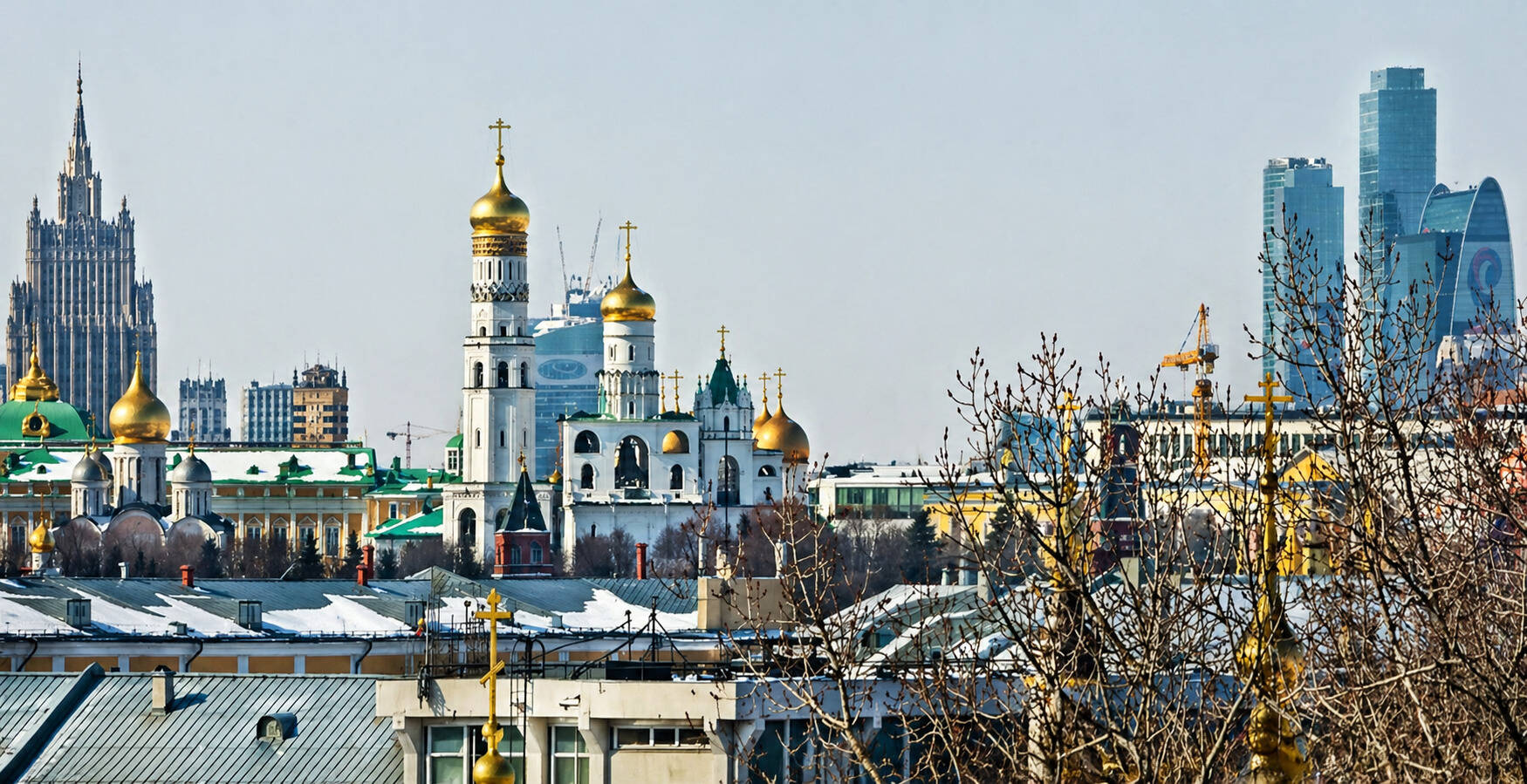
The route the ‘Journey into Christmas’ tour runs along Teatralny Proyezd near the Bolshoi Theatre; the discussion of The Nutcracker here connects the stage with Moscow’s festive calendar. The page describes a themed walking tour and does not promise attendance at a performance.
Sources
- Tchaikovsky Museum: Iolanta and The Nutcracker — An Unsolved Code
- Tchaikovsky Museum: List of the Composer’s Works
- Mariinsky Theatre: The Story of the Joint Premiere of Iolanta and The Nutcracker
- Mariinsky Theatre: The Libretto and Vasily Vainonen’s Production
- Mariinsky Theatre: Hoffmann’s Anniversary and January 2026 Performances
- Bashkir Opera and Ballet Theatre: Yuri Grigorovich’s Libretto
- Bakhrushin Museum: props from Grigorovich and Virsaladze’s production of The Nutcracker
- Bakhrushin Museum: programme booklet for Yuri Grigorovich’s 1966 production
- Bakhrushin Museum: programme for The Nutcracker, 28 October 1912
- Bakhrushin Museum: ‘Eastern Princess’ doll by Simon Virsaladze
- P. E. Vaidman: Petipa’s scenario outline and the music of The Nutcracker
- Tchaikovsky Research: movements and premiere of The Nutcracker Suite
- Russian State Archive of Literature and Art: The Nutcracker on the Bolshoi Theatre stage
- Russian Ballet. An Encyclopaedia: The Nutcracker
- Balletopedia: Yuri Grigorovich’s production at the Bolshoi Theatre
- Mariinsky Theatre, Primorsky Stage: Eldar Aliev’s The Nutcracker
- Mariinsky Theatre: Vasily Vainonen’s The Nutcracker, poster for 23 December 2022
- Mariinsky Theatre: December 2024 programme
- Mariinsky Theatre: the history of Mikhail Shemyakin’s production
- Petersburg Diary: the return of Vainonen’s The Nutcracker in 2024
- Kommersant: Tatyana Kuznetsova on The Nutcracker in the winter repertoire
- Radius Tour Bureau: Journey to Russian Christmas itinerary
- Mariinsky Theatre: Galina Ulanova and Vainonen’s version of The Nutcracker
We took a tour of Taganka designed for 12-year-old children. It was an excellent programme. We covered a great deal of ground and learnt so much. We discovered the story of Dryanaya Street and discussed the Vladimir Highway, the surrounding monasteries and churches, and the Old Believers. We now know where Korovin was born, where Stanislavsky was born and raised, where the Morozov merchant children lived, and why Arseny Morozov was considered such an outrageous figure in his day. We also discussed Solzhenitsyn, discovered where Stalin Avenue was supposed to be built, saw the bunker, walked to the Russian metochion of the Mount Athos Monastery, and learnt why the Illuzion cinema made Taganka famous. Of course, no tour would have been complete without Vysotsky and Lyubimov. We also touched briefly on Taganka Prison, although naturally we did not go there. All in all, it was an exceptionally rich and informative tour! Our guide Alexander was superb!
Our thanks to our guide Alexander for a magnificent sightseeing tour. Alexander’s love for Moscow and its history, his wide-ranging knowledge, elegant and engaging delivery, and personal charm make the tour not merely interesting and informative, but truly delightful! Thank you, Alexander! Tatiana and Tatiana, St Petersburg
On July 18th, we participated in the "Soul of Moscow" group tour led by Alexander. Kitay-gorod and its surroundings revealed a new side to us, and everyone thoroughly enjoyed it. Some of us began intensively studying related materials to broaden our horizons. We'll be back, and we highly recommend it! You won't regret it.
Good afternoon, on June 23rd we had a tour called " The Soul of Moscow ," led by Alexander. He's a very pleasant young man. We visited such lovely courtyards and alleys with him that we never even knew existed, and we learned so much. We really enjoyed everything, and we hope to continue our acquaintance. Alexander! Thank you! We had a great time with you, and we thoroughly enjoyed it. See you there!
This isn't my first time with Radius. This time, I took the Moscow metro . The goal was not only to admire the underground palaces but also to learn how to navigate the metro. As a resident of a region without a metro, I was a bit apprehensive and didn't understand how to navigate the metro. Of course, the internet helps, but live communication is much better. Tour guide Yulia handled this task perfectly. The information was accessible and interesting, the presentation was calm, and the communication style was very friendly. Thank you very much for the tour and the practical experience.
Good afternoon! I gave the "Soul of Moscow" tour to some of the capital's guests. We were thrilled to hear our guide, Anton. It was so informative and engaging, and very warm. To say we were absolutely delighted is an understatement. It turned out to be a truly family-friendly excursion. We learned so many interesting facts. The material was presented professionally, all our questions were answered, and we saw so much. It was simply WOW! Thank you so much, Anton, he's the best!!!!! From now on, I'll only come to you, the Radius team. I highly recommend it. I promise we'll see each other again soon on other tours.
Overall, the tour left a positive impression! Thanks to Alexander for the walk through the courtyards and atmospheric spots of Kitay-Gorod; we certainly wouldn't have done it on our own. The tour was comfortable, and the guide spoke confidently and calmly. One thing we personally missed: we would have liked more of the historical part, relating to ancient Moscow and the history of Kitay-Gorod. There were quite a few stories about the Soviet period and the bar scene, but for our group, this wasn't particularly relevant. We think the program could be a little more tailored to the age and interests of the group. It would also have been interesting to add more historical facts, monuments, and details about old Moscow and the area itself. That said, the tour was still interesting, and some places and churches were truly memorable. These aren't really "cons," but rather suggestions for an even more comprehensive program.
Hello! We had a corporate group of 10 people. Our guide was Anton, and we had a tour of Bulgakov. I would like to point out the excellent organization; everything went smoothly. The managers were very accommodating to our changes in the number of participants. The bus was very comfortable. Anton is a super-engaged and motivated guide. He lives this history and is delighted to share his knowledge and create an unforgettable experience. Everything went well. I highly recommend it!
Thank you for a fascinating tour! It gave me so much food for thought to explore! Note: Review of the "Zamoskvorechye" tour with guide Maria.
I'd like to express my gratitude on behalf of our team! Thank you for keeping to our scheduled schedule despite our lack of organization. Our colleagues appreciated your preparation for the tour! It was informative. Note: Review of the "Modern Residential Complexes, Factory Past, and Avant-Garde" tour of the ZILART residential complex with guide Maria. Maria prepared and conducted a customized tour for employees of the Samolet Group of Companies development company.
Thank you! You have great talent. Good luck! ☺️ You're a wonderful guide! Thank you again! Note: This is a review of the corporate tour "The Heart of the Capital" with guide Maria.
Thank you for a wonderful day today!!)) Note: review of the excursion "The Soul of Moscow" with guide Maria
On behalf of the whole family, I want to thank you for a very informative and interesting tour! Note: This is a review of the "Palace Dungeons" tour with guide Maria.
Good afternoon! I'd like to express my gratitude and that of my guide for organizing the tour! We were very pleased. We'd like to do it again in October, but on a different route — ZIL. Note: This refers to the tour for Samolet Group developers, led by guide Maria.
Thanks to Alexander for the bar tour of Baumanka ! It was fun, exciting, and we discovered so many new places! Awesome! May we reach new heights!
Good afternoon! I was on a tour of Sukharevskaya Square — we went all the way to Tsvetnoy Boulevard. I didn't expect it to be so interesting! For those wondering whether to go — go for it! It truly became one of my most memorable summer memories!
Anastasia, good morning! Thank you and Masha for yesterday! The speakers are happy. The connection through the headphones was often lost, especially at the checkpoint, but that's just our current situation. You could hear if you were standing close, no more than 1.5 meters away. Colleagues have already asked for your contact information. I'd be happy to share it and look forward to another opportunity to work with you. Special thanks to the Director for the Bureau . Note: " Heart of the Capital " tour for participants of the 2025 Moscow Oncology Forum. Guides: Anastasia and Maria.
We'd like to thank Anton and Alexander for leading the tour! It was fascinating to hear how the Krasnaya Presnya district developed and how Prokhorov's influence on our city's development. It was a pleasant immersion into a quiet, previously unexplored area!
Good afternoon, thank you so much, Anastasia. The " Uncle Gilyai " tour was fantastic. Even though we're Muscovites and know a lot about Moscow, the experience was amazing, so much new and interesting happened. We'll definitely be back.
Thank you for the " Heart of Moscow " and " Khamovniki " tours. Anton, a knowledgeable and passionate Moscow guide, gave me the tour. He's a great storyteller, intelligent, well-read, and captivating. You've truly opened up my Moscow to me! I'll definitely be back next summer to explore Moscow with you. I'll recommend your wonderful tour program to all my friends!
Excursions with the Radius travel agency are always a positive experience if you choose them. We planned a tour of Zamoskvorechye on our next visit. We've worked with our guide, Anton, before. We'll definitely recommend him to everyone we know. The tour is informative, not overloaded with dates, and the information is comprehensive yet easy to understand, as it's presented in a light, narrative manner, not like a history textbook, dry and academic. Thank you for this approach. We'll definitely use the Radius agency again on our next visit to Moscow.
Thank you so much for the tour of Zamoskvorechye . Despite the weather, it was very interesting and informative! Note: this refers to the tour with guide Anton.
A huge thank you to Anastasia. We had a fantastic tour of the Patriki district. We learned so much. Anastasia is a true master of her craft. The tour was captivating, not at all boring, lively and interesting. Everyone was delighted. We were full of new impressions. I definitely recommend it. You won't be disappointed!
We explored the Soul of Moscow with my family and Radius on my birthday. Everyone thoroughly enjoyed the walk! Anton shared so many interesting facts about the capital and its history, taking us into spiritual depths no one else had even suspected. Most of us were either born or longtime Moscow residents who spent a lot of time walking around. It was educational, heartwarming, and unforgettable. 🙂 Overall, this wasn't my first time walking around Moscow with Anton, and each time was a real adventure!