Moscow’s German Quarter brought together Western foreigners of various nationalities. In the 17th century, the word «German» was used for anyone whose speech seemed unintelligible, so people from the German lands, the Netherlands, England, Scotland, Sweden, France and Italy all lived along the Yauza under this common designation. They were united by their service to Russia, their Western European origins and the settlement’s special legal status; the name should not be understood in its modern national sense.
In 1652, the authorities allocated Western foreigners a separate quarter — the New German Quarter. Officers commanded Russian servicemen, physicians worked at court and in government departments, merchants connected Moscow with foreign markets, and craftsmen hired and trained local workers. The designated territory made the community more conspicuous and easier to supervise, while economic and official ties connected it with the city every day.
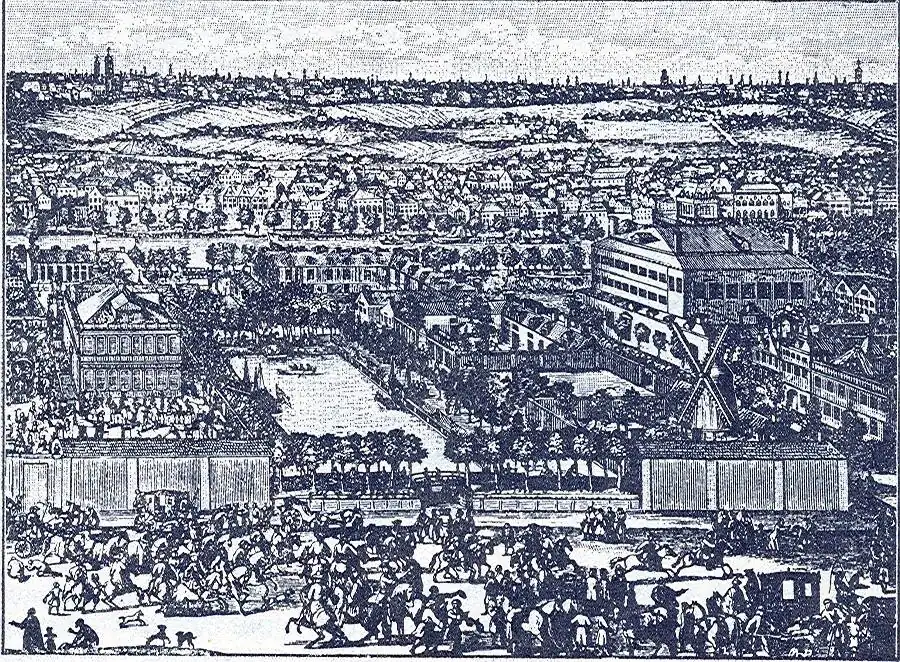
Moscow’s German Quarter in the late 17th century. The second half of the panorama, based on an engraving by Heinrich de Witta; this reproduction was published in 1914. Wikimedia Commons, German Sloboda 2.jpg, author: Heinrich de Witta, licence: Public domain source
What did the word «German» mean in 17th-century Moscow?
In the 17th century, the word «German» did not refer solely to someone from the German lands. It derives from a Proto-Slavic term for someone mute or speaking unintelligibly; in Russian usage, it became a collective name for Western Europeans whose speech local people could not understand. The quarter’s name reflected the host city’s perspective, while the foreigners themselves distinguished between their different origins, languages and faiths.
This generalisation had its limits. Moscow documents referred separately to Greeks, Armenians, Tatars and people from the lands of the Polish–Lithuanian Commonwealth, while the word «Germans» was applied particularly consistently to Western Christians. A more precise term was used in official contexts: the New Foreign Quarter, also known as the Novo-Inozemnaya Sloboda. This designation better reflects the community’s diversity.
The name served as an administrative designation. Within this framework, the Scottish Catholic Patrick Gordon, a Dutch merchant, an English officer and a Lutheran pastor remained people of different countries, languages, denominations and social circles. For the Moscow authorities, however, they all belonged to a distinct group of Western foreigners whose residence, worship, service and ownership of properties required separate regulation.
Why was the New German Quarter established in 1652?
The Muscovite state needed Western specialists, who had lived for decades in various parts of the city, including near Pokrovka Street and the Myasnitsky and Sretensky Gates. The purchase of properties, employment of Russian workers, sale of alcoholic drinks and proximity of non-Orthodox houses of worship to Orthodox parishes all gave rise to conflict. The Law Code of 1649 restricted foreigners from acquiring urban property, and in 1652 the authorities decided to relocate unbaptised Western Europeans beyond the city limits.
The government allocated an undeveloped plot on the right bank of the Yauza, south of the royal village of Pokrovskoye. To the west, it lay beyond the Earthen City, while the river channel, the Chechora and several small waterways formed its natural boundaries. Its central axis was German Street — today’s Baumanskaya Street. Lanes branched off from it, while kitchen gardens stretched towards the rivers.
The resettlement combined religious segregation with the organisation of specialists needed by the state. Complaints from the townspeople and the mistrust of the Orthodox clergy influenced the decision, yet the sovereign continued to employ foreigners. Officers, physicians, apothecaries and craftsmen were brought together in a place where government departments could more easily keep records of them, allocate land and oversee their service.

‘The Arrival of Foreigners in 17th-Century Moscow’, a 1901 painting by Sergey Ivanov. The artist depicted the newcomers being welcomed in winter at a Moscow outpost. Wikimedia Commons, S. V. Ivanov. Foreigners' arrival to Moscow, XVII century. (1901).jpg, author: Sergey Ivanov, licence: Public domain source
The settlement had predecessors, although their histories do not form a single continuous narrative. Western merchants and specialists had been coming to Moscow long before the mid-seventeenth century; under Vasili III, a settlement for foreigners existed in the Nalivki district. In the second half of the sixteenth century, another foreign settlement emerged near the Yauza, populated in part by prisoners from the Livonian War, but it was destroyed during the Time of Troubles. The settlement founded in 1652 was described as new: following the destruction of the earlier neighbourhood, the authorities re-established a Western European quarter in the area.
Who lived in the German Quarter?
The New German Quarter was home to people from various parts of Western Europe. A study by the Russian Academy of Sciences’ Institute of Ethnology and Anthropology identifies Germans, Dutch, English, Swedes, Italians and French residents, while documents and biographies also mention Scots, Danes and people from other lands. The 1665 census recorded 206 households. This figure refers to a household count and does not indicate the size of the population.
Military men accounted for a large proportion of the householders. After the Smolensk War of 1632–1634, some of the officers recruited in Western Europe remained in Russian service. The regiments of the «new order» needed men familiar with the infantry, cavalry and artillery practices of Western European armies. The quarter was therefore home to generals, colonels, captains, lieutenants, sergeants and lower-ranking servicemen, whose origins ranged from the German principalities and the Netherlands to England and Scotland.
Military men formed a significant, but by no means the only, part of the population. They lived alongside merchants, physicians, apothecaries, gunsmiths, metal founders, clockmakers, painters and interpreters. In the early 18th century, when entry became easier for independent craftsmen, researchers also record teachers, musicians, gardeners, cooks and tutors among the residents. A person’s profession and the demand for a rare skill shaped the composition of the community just as much as their place of birth.
Religious affiliation also divided the quarter’s population. The quarter had Lutheran and Reformed congregations, while Dutch and English Calvinists maintained separate communities; for many years, Catholics had to campaign for the right to a permanent priest and a proper church. The number of houses of worship varied, wooden buildings were relocated and rebuilt, and the use of bells was restricted. There was no single «German faith» in the quarter.

The Evangelical Lutheran Church of St Michael at Gorokhovoye Pole. Moscow, photographed in 1883 and published in an 1884 album. Wikimedia Commons, N.A.Naidenov (1884). Views of Moscow. 77. Lutheran.png, author: Nikolay Naidenov (1834-1905)., licence: Public domain source
Why did a person’s occupation determine their address and the size of their property?
The planners projected the official hierarchy onto the layout of the settlement: the size of each land allotment depended on rank and profession. Historical and cultural assessments based on construction records and the Complete Collection of Laws cite differing standards. Senior officers and doctors were allocated the largest plots; company officers, apothecaries and goldsmiths received smaller ones; and sergeants, corporals and lower-ranking servicemen were given the most modest plots.
Officials who did not have a household of their own in Moscow were allocated plots measuring eight by six sazhens. Merchants received land in proportion to their former holdings in the city. The size of a plot reflected a person’s position, salary and place in the official hierarchy; distinguished birth alone was not enough to secure a large property.
This spatial hierarchy explains why the settlement as a whole cannot be judged by the names of its most prominent residents. Researchers have more detailed information about stone-built residences, officers’ households and the homes of wealthy merchants than about the dwellings of hired workers, widows, servants and apprentices. This imbalance in the sources makes it essential to consider the social structure of the neighbourhood rather than simply compiling a list of notable figures.
Was the quarter a small European town?
The settlement was distinguished by its more regular layout and prominent non-Orthodox places of worship, but describing it as a «little piece of Europe» oversimplifies its character. The main Nemetskaya Street and the lanes crossing it formed a clear framework; foreign observers noted houses built «in the German style», well-kept gardens and a different arrangement of household plots. Most buildings remained wooden: builders used materials customary in Moscow and took account of the local climate and fire risk.
Shops, taverns, outbuildings and kitchen gardens made this a busy urban neighbourhood. A market operated nearby, later preserving the memory of the settlement in the name German Market. Behind the façades and Lutheran churches, residents stored goods, kept horses, prepared food and repaired weapons and tools. These activities occupied a greater place in everyday life than the conspicuous trappings of a Western lifestyle.
Travellers compared the settlement to a small European town because its compact area brought together non-Orthodox places of worship, unfamiliar styles of dress, domestic customs and a variety of languages. The residents adapted the customs they had brought with them to Moscow conditions, while Russian workers built the houses and tended to the households. Within a single neighbourhood, the religious customs of several communities blended with Moscow building techniques and a shared urban marketplace.

Bernhard Tanner’s map of Moscow, 1678. Beyond the city limits, the map marks ‘Kukui’ — the Kukui district associated with the German Quarter. Wikimedia Commons, Tanner Moscow map.jpg, author: Bernhard Tanner, licence: Public domain source
How was the quarter connected to the rest of Moscow?
Everyday life in the settlement depended on its ties with the city. In complaints from the 1640s, townspeople wrote that foreigners were hiring local workers, while the authorities sought to regulate relationships that were already well established. Russian servants, suppliers and apprentices became part of foreign households, while workshops and shops catered to demand in Moscow.
Government service created even more connections. Foreign officers received salaries, submitted petitions and commanded regiments, while physicians and apothecaries worked for the court and government departments. Interpreters took part in diplomatic affairs, while merchants carried letters and goods between Moscow, Arkhangelsk and European ports. Religious communities communicated with patrons abroad through Moscow’s system of permits and negotiations.
The exchange worked both ways. Foreigners learnt Russian, government-office procedures, forms of patronage, and local methods of building and trade. Their position depended on boyar patrons and subordinates; their children grew up in Moscow society, and some families remained in Russia for several generations. Russian craftsmen worked in foreign households, while their owners used local utensils, materials and building techniques. Written sources and archaeological finds attest to this mutual adaptation.
What does Patrick Gordon’s diary reveal about everyday life in the quarter?
The writings of the Scotsman Patrick Gordon allow us to reconstruct the network of everyday affairs concealed behind the collective term «foreign community». The diarist was a Catholic, an officer in Russian service and one of the quarter’s influential residents. In January 1684, after returning to Moscow, he received «the leading figures of the Sloboda», dined with Colonel von Mengden and, the following day, visited the boyars Miloslavsky and Sheremetev.
In the same entries, Gordon discussed the war and international alliances with Prince Vasily Golitsyn, received his salary from the treasury, met with foreign envoys and sent letters through an English merchant. He had news from abroad translated into Russian for the government. Over the course of several days, visits to private homes, official duties and diplomatic correspondence linked the Foreign Quarter with the boyars’ residences and government departments.
Gordon served Russia for decades while retaining his Scottish identity and Catholic faith. He sought religious rights and long hoped to return to his homeland. The officer had multiple affiliations: he was part of the Russian military and political system while maintaining family, commercial and religious ties beyond its borders.

A memorial stone at Vvedenskoye Cemetery. The German inscription states that the remains of ‘Colonel Gordon’, a contemporary of Peter the Great and Lefort, were reinterred here in 1877. Wikimedia Commons, Vvedenskoye — Patrick Gordon 01.jpg, author: NVO, licence: CC BY-SA 3.0 source, license
What role did Peter I play in the already established quarter?
By the beginning of Peter I’s independent reign, the Foreign Quarter had existed for around four decades. It already had established streets, religious communities, workshops and professional networks. Here, the young tsar met officers, shipwrights, physicians, merchants and people who spoke European languages; his visits brought the quarter particular renown.
Peter’s connections were the result of earlier state policy. Long before the tsar began his independent reign, Muscovy had invited Western specialists, established new-model regiments and drawn on foreign medical expertise. Peter increased the scale and pace of this adoption and gave it political significance.

A modern aerial view of Lefortovo Palace, May 2017. Wikimedia Commons, Moscow 05-2017 img20 Lefortovo Palace.jpg, author: A.Savin, licence: FAL source, license
Lefortovo Palace marks this transition through a specific building commission. In 1696, the Tsar ordered stone chambers to be built on Franz Lefort’s estate; the main structure was erected in 1697–1698 by the Russian master mason Dmitry Aksamitov. The sovereign commissioned a residence for a Swiss man in imperial service, and a local mason brought the project to life. After Lefort’s death, the palace passed to the Treasury, then to Alexander Menshikov, and finally back to the state.

Lefortovo Palace and the Sloboda Palace, viewed from what is now 2nd Baumanskaya Street. Photograph taken in 1883. Wikimedia Commons, Lefortovsky palace 1883.jpg, author: Nikolay Naidenov (1834-1905), licence: Public domain source
How did the quarter’s boundary work in practice?
The authorities turned the boundary of the New German Quarter into an administrative checkpoint. They controlled entry, trade and the residents’ legal jurisdiction while maintaining essential working ties with the rest of Moscow. The arrangements are described in detail in the instructions issued to Matvei Ivanovich Pozdeev on 30 September 1671, when he was placed in charge of the settlement.
Its issuance was preceded by a petition from Dutch and Hamburg merchants. They asked to be protected from foreign servicemen who, according to the petitioners, had mistreated them. The conflict reveals the divisions within the «foreign community»: people from Western Europe were separated by language, faith, position in service and administrative affiliation. Merchants, officers and artisans lived side by side but were subject to different rules.
The directive assigned the residents’ cases among several government offices. Foreign servicemen were to be referred to the Foreign Office, merchants to the Ambassadorial Office, and Russians to the offices where they were registered. The quarter had neither a common court nor full self-government. In the event of a dispute, the administrator established the circumstances and the administrative affiliation of each party. The residents’ administrative affiliations did not correspond to the quarter’s single ethnic label.
Access to the settlement was selectively controlled. Guards were to be posted in the streets and lanes to question those entering. Russian merchants who had come to collect money owed under transactions were admitted after explaining the purpose of their visit and were monitored within the quarter; those with no business there were denied entry. Trade and settlements continued in accordance with the procedures established by the authorities.
Some prohibitions protected state revenues. The decree banned the private sale of wine, beer, mead and tobacco to prevent illicit trade from reducing the Treasury’s income from beverage sales. The same fiscal rules applied in the settlement as elsewhere in the city. The source dispels the myth of a «free Kukui» where foreigners were supposedly allowed everything forbidden to Muscovites.
Pozdeyev was ordered to conduct a census by name of foreign merchants and their properties. The register included householders, brothers, children, nephews, sons-in-law, agents and dependants; their origins, faith and affiliation with the Ambassadorial Chancery were recorded separately. A single entry for a property represented a composite household, not one family or nationality. Relatives, business assistants and servants all took part in their shared work and trade.
Another document from 1671 describes an individual house. The wife of a foreign merchant reported to the authorities that her husband had left Moscow with permission to travel to Arkhangelsk on business, while the house he had left behind in the New German Quarter was burgled and set on fire during the night. A single petition cannot be used to assess the level of crime. The document confirms that a long-distance journey could take the head of the household away from Moscow for an extended period, that his wife represented the household before the chancery, and that people turned to state institutions for protection of their property.
The decree and petition portray the settlement as a distinct community under heightened administrative control. The authorities distinguished between state service and trade, administrative jurisdictions and religious affiliations, authorised visits and entry without legitimate business. Payments, goods, orders and petitions crossed the controlled boundary, linking the quarter to Moscow’s institutions.

Portrait of Tsar Alexei Mikhailovich on horseback. Armoury Chamber school, probably dating from the 1670s. Wikimedia Commons, Russia. Portrait of Tsar Alexei Mikhailovich on horseback. c. 1670s. State Historical Museum e1.jpg, author: Unknown authorUnknown author, Armoury Chamber School, licence: Public domain source
How residents of the quarter helped establish the court theatre
The residents of the New German Quarter helped establish Russia’s first court theatre even before Peter I began ruling in his own right. Under Tsar Alexei Mikhailovich, the production was organised by the boyar Artamon Matveyev, while rehearsals were directed by Johann Gottfried Gregory, pastor of the Lutheran church, who lived and served in the quarter.
Gregory was commissioned to prepare a play based on the biblical Book of Esther. He trained around sixty foreigners from the quarter, while the leading roles were performed by actors with professional experience. The premiere of «The Play of Artaxerxes» took place on 17 October 1672 according to the Old Style calendar, or 27 October according to the New Style, in the specially built Comedy Chamber in the village of Preobrazhenskoye. The organisers found the performers and the necessary theatrical expertise in the German Quarter, although the production itself was staged beyond its boundaries.
In June 1673, clerks and other officials became involved in the theatre. The Moscow court first entrusted the production to someone with the necessary expertise; staff from the Ambassadorial Chancery then translated the play into Russian, while members of the foreign troupe helped train the local actors. This was how a specific skill was transferred—a process often broadly described as «Western influence».
The German Quarter provided the court theatre with performers and someone capable of training them. Performances ceased after the death of Alexei Mikhailovich in 1676, but the theatre’s brief history broadens our understanding of the quarter’s residents and their occupations. Alongside military service, trade and medicine, they were also involved in teaching, translation, music and stagecraft.
Which sources can be used to verify the history of the German Quarter
A reliable account of the German Quarter must be based on a comparison of different types of sources. The decree of 4 October 1652 records the allocation of land for construction and was published in the first volume of the Complete Collection of Laws of the Russian Empire. Construction and census records provide the sizes of plots, the ranks of their owners and the number of households. These documents offer the most precise answers as to when the settlement was established and the rules that governed its creation, but they convey almost nothing of the voices of its ordinary residents.
Accounts by foreigners add vivid detail: the layout of the streets, the design of houses, gardens, religious services and relations with Muscovites. Yet travellers tended to notice what was unusual above all, while later editors might blend eyewitness testimony with their own interpretation. Patrick Gordon’s diary is valuable in a different way: the dates of visits, dinners, letters, payments and negotiations allow us to reconstruct the network of active contacts, although it reflects the perspective of a high-ranking officer rather than that of a craftsman or maidservant.
In her monograph, Vera Kovrigina compares archival documents, accounts by contemporaries and information about business and family connections. State historical and cultural assessments add cartography, archaeology and the history of individual estates. Several independent sources allow a fact to be regarded as established; a single colourful account remains only a hypothesis, even if guidebooks have repeated it for decades.
Which legends about the German Quarter require qualification
The first widespread legend claims that Kukuy took its name from the German exclamation Kuck! — «look». Early writers recounted the story, explaining that foreign women supposedly called out to one another from their windows. However, historians of language and topography do not regard this picturesque scene as a reliable etymology. The name Kukuy is associated with a pre-existing locality or watercourse; other linguistic explanations have also been proposed. There is no documentary basis for treating this colourful anecdote as established fact.
The second legend attributes the building in Starokirochny Lane to the tsar’s favourite. The monument is indeed protected under the name «Chambers (House of Anna Mons), 17th century», but the official historical and cultural assessment notes that the documented history of the property can be traced back only to 1706, when it belonged to the court physician Johann van der Hulst. By then, her relationship with Peter had already ended. It is more accurate to speak of the traditional attribution of the chambers than of a proven place of residence.

The chambers at 53 Baumanskaya Street, Building 8, traditionally known as the “Anna Mons House”. Present-day view, April 2025. Wikimedia Commons, Moscow — Anna Mons house — 2025-04 — p2.jpg, author: Alexander Sigachyov, licence: CC BY-SA 4.0 source, license
The third legend portrays the settlement as a place of endless festivities, wine and loose morals. Travellers noted unfamiliar forms of social interaction, dress and feasting, while complaints from Muscovites did indeed concern taverns. Writers of these accounts more often described affluent homes and festive occasions; workshops, military discipline and the needs of poorer residents featured less frequently in their records. The accounts of feasting should therefore not be taken as representative of the entire neighbourhood.
The phrase «window onto Europe» often obscures the contacts that existed before Peter the Great. The Muscovite authorities invited specialists and conducted foreign trade, while also controlling the confessional boundary. Peter made use of existing channels of exchange and dramatically expanded their role in the transformation of the state.
How the German Quarter ceased to be a separate foreign enclave
This isolation began to diminish in the first decades of the eighteenth century. The influx of specialists increased, foreigners were permitted to settle in other parts of Moscow, and in the 1720s the quarter was incorporated into the city. According to research by the Institute of Ethnology and Anthropology of the Russian Academy of Sciences, by the mid-eighteenth century more than half of the plots of land in the former settlement belonged to Russian owners.
Throughout the century, the Yauza district continued to change. The Soldiers’ Quarter, a military hospital, and palace and park estates developed on the left bank. These neighbouring areas had their own functions and histories and were not part of the original Foreign Quarter. Government institutions, military units, and residences gradually came to occupy a substantial part of Moscow’s eastern outskirts.
The old courtyards gave way to grand estates and stone buildings. Some foreigners moved to St Petersburg along with the imperial court, while other families settled elsewhere in Moscow. The fire of 1812 destroyed much of the wooden development on Nemetskaya Street, in the surrounding lanes and around the market. The quarter’s legal, social and architectural boundaries gradually disappeared.
What archaeology adds to the written record
Archaeologists find objects of local and Western European origin side by side in the same cultural layers of the settlement. The lower stratum, dating from the 16th–17th centuries, contains Moscow pottery made from white clay, burnished blackware and smoked ceramics, as well as polychrome relief tiles, wood, leather and bones. Alongside them lie imported «Rhenish stoneware» — dense, high-fired bottles and jugs made in Western Europe.
The origin of an object and the origin of its owner are two different matters. A Rhenish vessel attests to the movement of goods and customs, but does not establish the nationality of the householder. Newcomers bought affordable Moscow-made tableware, while local residents used imported wares. Archaeologists can trace how these objects circulated together, but a single potsherd cannot reveal the identity of its last owner.
Excavations and archaeological observations were carried out at various sites across the historic area. In 1992, several types of pottery, metal objects and painted tiles were discovered near No. 6 Brigadirsky Lane, along with the foundations of buildings dating from the 18th–19th centuries. Work undertaken in 1995 near No. 12 Ladozhskaya Street clarified the sequence of cultural layers and provided further evidence of economic activity. In 1998, investigations in Poslannikov Lane helped trace the settlement and layout of the neighbourhood.
In 2000, archaeologists investigated 650 square metres near 16/18 Radio Street. Among the remains of buildings and objects dating from the seventeenth–nineteenth centuries were pots, jugs, large earthenware vessels, bowls, coins, lead bullets, crosses worn around the neck and polychrome tiles. This collection restores to history what rarely appears in grand accounts: cooking, heating, small-scale trade, military service and everyday religious life.
Later layers contain pharmaceutical vessels and stamped Dutch white-clay smoking pipes. These objects belong to a later period in the area’s history and therefore cannot be attributed to the 1650s. Archaeologists distinguish the layers chronologically rather than combining every striking find into a single, artificial picture of «old Kukuy».

Comparative museum example: a stoneware jug from Raeren or Westerwald, first quarter of the seventeenth century. Wikimedia Commons, Jug (MNK IV-C-3185).jpg, author: anonymous , licence: CC0 source, license
Where to find the German Quarter in the modern city
The historic heart of the New German Quarter lay on the right bank of the Yauza, around present-day Baumanskaya Street and the adjoining lanes. The modern Lefortovo District covers a different area, so its administrative boundaries do not coincide with the former limits of the quarter. Lefortovo Palace on 2nd Baumanskaya Street stands near its eastern edge, while the park and hospital complex lie across the Yauza.
Few pre-Petrine buildings survive above ground, but the street network, block boundaries and archaeological layers continue to reveal how the area was organised. It is protected by the state as the German Quarter of the sixteenth–seventeenth centuries. Lefortovo Palace retains the main structure built in the late 1690s, although it has been remodelled several times; the building houses the Russian State Military Historical Archive. The chambers known as the Anna Mons House remain a rare stone building from the period, while their association with Anna Mons is a traditional attribution.
Crossing the Yauza separates two historical layers. The foreign quarter stood on the right bank, and Franz Lefort’s palace linked it to the court culture of the late seventeenth century. Across the Yauza, the eighteenth century saw the development of Golovin Garden, later Lefortovo Park, a military hospital, soldiers’ quarters and palace residences. Following the route in sequence helps distinguish the settlement founded in 1652 from the state complex of the eighteenth century.

Lefortovo Park with its ponds and Golovinskaya Embankment, April 2025. Wikimedia Commons, Moscow — Lefortovo Park — 2025-04.jpg, author: Alexander Sigachyov, licence: CC0 source, license
Why the German Quarter was part of Moscow rather than a town across from it
The Moscow authorities created the German Quarter to house and register Western foreigners in Russian service. Government offices controlled their land, legal jurisdiction and access to the quarter. Residents received state salaries and commissions, hired local workers, traded with the city and maintained family and religious ties with Europe.
Scots, Dutch people, immigrants from the German lands and French people lived in the same quarter, alongside Russian craftsmen and servants. Rank, profession, faith and administrative affiliation shaped their status more strongly than the collective label «Germans». In the eighteenth century, the quarter’s legal boundary faded away, while its family ties, professional skills, institutions and layout became part of Moscow’s history.
You can compare the historical geography with the modern city on the «Window onto Europe» tour of Lefortovo: the route runs from Baumanskaya through the former New German Quarter to Lefortovo Palace, the Yauza, the park and Hospitalny Val. The programme includes exterior views of sites connected with the past and helps distinguish the quarter on the right bank from the later palace, military and medical complexes on the left. Visits to interiors that are closed to the public are not included in the programme.
Sources
- Museum of Moscow — ‘The New German Quarter’
- V. A. Kovrigina. ‘Moscow’s German Quarter and Its Residents from the Late 17th to the First Quarter of the 18th Century’ — Russian State Library
- G. Sh. Grigoryan. ‘Ethnic Minorities in Moscow: Distribution and Population (17th to Early 21st Century)’ — Institute of Ethnology and Anthropology, Russian Academy of Sciences
- State Historical and Cultural Assessment of the German Quarter and Starokirochny Lane — Official Portal of the Moscow Government
- State Historical and Cultural Assessment of the 2nd Baumanskaya Street Area — Official Portal of the Moscow Government
- Patrick Gordon. ‘Diary’, 1684–1689 — publication of a primary source
- State Historical and Cultural Assessment of the Lefortovo Palace — Official Website of the Mayor of Moscow
- State Historical and Cultural Assessment of the Chambers Known as Anna Mons House — Official Website of the Mayor of Moscow
- Comprehensive Dictionary of the Russian Language — Etymology of the Word ‘Mute’
- Decree of Tsar Alexei Mikhailovich on the Allocation of Land for the German Quarter in Moscow, 4 October 1652 — Electronic Library of Historical Documents
- ‘Russia: Art and Culture. Theatre: 17th–18th Centuries’ — Great Russian Encyclopaedia
- State Historical and Cultural Assessment of the Site on Academician Tupolev Embankment — Archaeology of the German Quarter
- Documents concerning Western European immigrants in 17th-century Russia: the decree on the administration of the New German Quarter, dated 30 September 1671
- “The Prikazy of the Muscovite State in the 16th–17th Centuries” — Institute of Russian History of the Russian Academy of Sciences
We took a tour of Taganka designed for 12-year-old children. It was an excellent programme. We covered a great deal of ground and learnt so much. We discovered the story of Dryanaya Street and discussed the Vladimir Highway, the surrounding monasteries and churches, and the Old Believers. We now know where Korovin was born, where Stanislavsky was born and raised, where the Morozov merchant children lived, and why Arseny Morozov was considered such an outrageous figure in his day. We also discussed Solzhenitsyn, discovered where Stalin Avenue was supposed to be built, saw the bunker, walked to the Russian metochion of the Mount Athos Monastery, and learnt why the Illuzion cinema made Taganka famous. Of course, no tour would have been complete without Vysotsky and Lyubimov. We also touched briefly on Taganka Prison, although naturally we did not go there. All in all, it was an exceptionally rich and informative tour! Our guide Alexander was superb!
Our thanks to our guide Alexander for a magnificent sightseeing tour. Alexander’s love for Moscow and its history, his wide-ranging knowledge, elegant and engaging delivery, and personal charm make the tour not merely interesting and informative, but truly delightful! Thank you, Alexander! Tatiana and Tatiana, St Petersburg
On July 18th, we participated in the "Soul of Moscow" group tour led by Alexander. Kitay-gorod and its surroundings revealed a new side to us, and everyone thoroughly enjoyed it. Some of us began intensively studying related materials to broaden our horizons. We'll be back, and we highly recommend it! You won't regret it.
Good afternoon, on June 23rd we had a tour called " The Soul of Moscow ," led by Alexander. He's a very pleasant young man. We visited such lovely courtyards and alleys with him that we never even knew existed, and we learned so much. We really enjoyed everything, and we hope to continue our acquaintance. Alexander! Thank you! We had a great time with you, and we thoroughly enjoyed it. See you there!
This isn't my first time with Radius. This time, I took the Moscow metro . The goal was not only to admire the underground palaces but also to learn how to navigate the metro. As a resident of a region without a metro, I was a bit apprehensive and didn't understand how to navigate the metro. Of course, the internet helps, but live communication is much better. Tour guide Yulia handled this task perfectly. The information was accessible and interesting, the presentation was calm, and the communication style was very friendly. Thank you very much for the tour and the practical experience.
Good afternoon! I gave the "Soul of Moscow" tour to some of the capital's guests. We were thrilled to hear our guide, Anton. It was so informative and engaging, and very warm. To say we were absolutely delighted is an understatement. It turned out to be a truly family-friendly excursion. We learned so many interesting facts. The material was presented professionally, all our questions were answered, and we saw so much. It was simply WOW! Thank you so much, Anton, he's the best!!!!! From now on, I'll only come to you, the Radius team. I highly recommend it. I promise we'll see each other again soon on other tours.
Overall, the tour left a positive impression! Thanks to Alexander for the walk through the courtyards and atmospheric spots of Kitay-Gorod; we certainly wouldn't have done it on our own. The tour was comfortable, and the guide spoke confidently and calmly. One thing we personally missed: we would have liked more of the historical part, relating to ancient Moscow and the history of Kitay-Gorod. There were quite a few stories about the Soviet period and the bar scene, but for our group, this wasn't particularly relevant. We think the program could be a little more tailored to the age and interests of the group. It would also have been interesting to add more historical facts, monuments, and details about old Moscow and the area itself. That said, the tour was still interesting, and some places and churches were truly memorable. These aren't really "cons," but rather suggestions for an even more comprehensive program.
Hello! We had a corporate group of 10 people. Our guide was Anton, and we had a tour of Bulgakov. I would like to point out the excellent organization; everything went smoothly. The managers were very accommodating to our changes in the number of participants. The bus was very comfortable. Anton is a super-engaged and motivated guide. He lives this history and is delighted to share his knowledge and create an unforgettable experience. Everything went well. I highly recommend it!
Thank you for a fascinating tour! It gave me so much food for thought to explore! Note: Review of the "Zamoskvorechye" tour with guide Maria.
I'd like to express my gratitude on behalf of our team! Thank you for keeping to our scheduled schedule despite our lack of organization. Our colleagues appreciated your preparation for the tour! It was informative. Note: Review of the "Modern Residential Complexes, Factory Past, and Avant-Garde" tour of the ZILART residential complex with guide Maria. Maria prepared and conducted a customized tour for employees of the Samolet Group of Companies development company.
Thank you! You have great talent. Good luck! ☺️ You're a wonderful guide! Thank you again! Note: This is a review of the corporate tour "The Heart of the Capital" with guide Maria.
Thank you for a wonderful day today!!)) Note: review of the excursion "The Soul of Moscow" with guide Maria
On behalf of the whole family, I want to thank you for a very informative and interesting tour! Note: This is a review of the "Palace Dungeons" tour with guide Maria.
Good afternoon! I'd like to express my gratitude and that of my guide for organizing the tour! We were very pleased. We'd like to do it again in October, but on a different route — ZIL. Note: This refers to the tour for Samolet Group developers, led by guide Maria.
Thanks to Alexander for the bar tour of Baumanka ! It was fun, exciting, and we discovered so many new places! Awesome! May we reach new heights!
Good afternoon! I was on a tour of Sukharevskaya Square — we went all the way to Tsvetnoy Boulevard. I didn't expect it to be so interesting! For those wondering whether to go — go for it! It truly became one of my most memorable summer memories!
Anastasia, good morning! Thank you and Masha for yesterday! The speakers are happy. The connection through the headphones was often lost, especially at the checkpoint, but that's just our current situation. You could hear if you were standing close, no more than 1.5 meters away. Colleagues have already asked for your contact information. I'd be happy to share it and look forward to another opportunity to work with you. Special thanks to the Director for the Bureau . Note: " Heart of the Capital " tour for participants of the 2025 Moscow Oncology Forum. Guides: Anastasia and Maria.
We'd like to thank Anton and Alexander for leading the tour! It was fascinating to hear how the Krasnaya Presnya district developed and how Prokhorov's influence on our city's development. It was a pleasant immersion into a quiet, previously unexplored area!
Good afternoon, thank you so much, Anastasia. The " Uncle Gilyai " tour was fantastic. Even though we're Muscovites and know a lot about Moscow, the experience was amazing, so much new and interesting happened. We'll definitely be back.
Thank you for the " Heart of Moscow " and " Khamovniki " tours. Anton, a knowledgeable and passionate Moscow guide, gave me the tour. He's a great storyteller, intelligent, well-read, and captivating. You've truly opened up my Moscow to me! I'll definitely be back next summer to explore Moscow with you. I'll recommend your wonderful tour program to all my friends!
Excursions with the Radius travel agency are always a positive experience if you choose them. We planned a tour of Zamoskvorechye on our next visit. We've worked with our guide, Anton, before. We'll definitely recommend him to everyone we know. The tour is informative, not overloaded with dates, and the information is comprehensive yet easy to understand, as it's presented in a light, narrative manner, not like a history textbook, dry and academic. Thank you for this approach. We'll definitely use the Radius agency again on our next visit to Moscow.
Thank you so much for the tour of Zamoskvorechye . Despite the weather, it was very interesting and informative! Note: this refers to the tour with guide Anton.
A huge thank you to Anastasia. We had a fantastic tour of the Patriki district. We learned so much. Anastasia is a true master of her craft. The tour was captivating, not at all boring, lively and interesting. Everyone was delighted. We were full of new impressions. I definitely recommend it. You won't be disappointed!
We explored the Soul of Moscow with my family and Radius on my birthday. Everyone thoroughly enjoyed the walk! Anton shared so many interesting facts about the capital and its history, taking us into spiritual depths no one else had even suspected. Most of us were either born or longtime Moscow residents who spent a lot of time walking around. It was educational, heartwarming, and unforgettable. 🙂 Overall, this wasn't my first time walking around Moscow with Anton, and each time was a real adventure!