Radius does not have tours of Chekhov's Moscow, much less Shakespeare's Moscow. But today, seeing a photograph of Sophia Loren on Anton Pavlovich's grave, the idea came to mind of comparing the works of these two pillars of world drama.
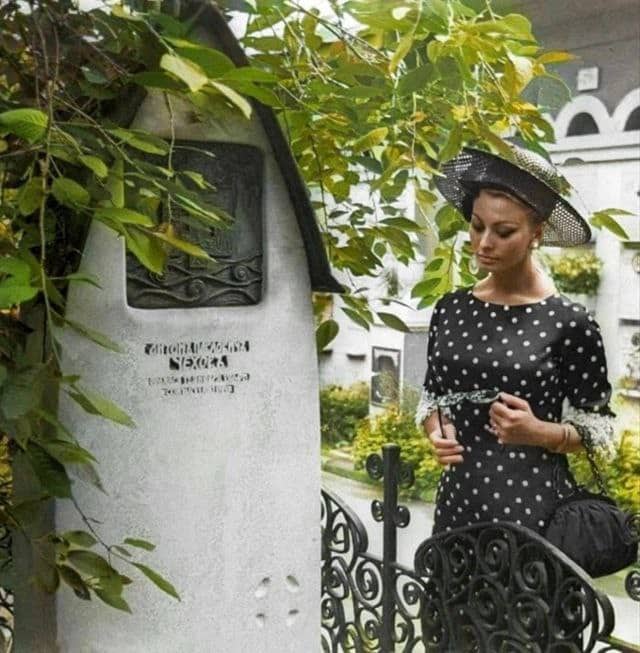
Italian actress Sophia Loren visited the grave of Anton Pavlovich Chekhov at the Novodevichy Cemetery
In general, the world popularity rating of playwrights looks something like this:
- William Shakespeare
- Anton Chekhov (it's unusual to write his name without his patronymic)
- Moliere was a 17th-century French playwright whose comedies remain relevant and popular, touching on themes of human vices and social mores.
- Henrik Ibsen was a Norwegian playwright and one of the founders of modern realistic drama, whose works often raise pressing social and moral issues.
- Bernard Shaw was an Irish playwright and Nobel Prize laureate in Literature, known for his satirical plays that criticize social norms and political institutions.
That is, Chekhov ranks second in terms of citation in the world’s theaters, although he is several times inferior in popularity to Shakespeare.
Even schoolchildren (at least Russian ones) know when and where both playwrights lived.
William Shakespeare
-
- Period of creativity: approximately from 1589 to 1613.
- Country: England.
- Lived: 1564–1616.
Anton Chekhov
-
- Period of creativity: approximately from the 1880s to 1904.
- Country: Russia.
- Lived: 1860–1904.
Shakespeare wrote during the English Renaissance, a time of political change and artistic flourishing.
Chekhov wrote during the pre-revolutionary period in Russia, reflecting the social and cultural changes of a time that was important for all Russians - on the eve of great revolutionary upheavals, when one era irrevocably replaced another.
Volumes of creativity
William Shakespeare wrote 38 full-length plays:
- Tragedies: Hamlet, Othello, King Lear, Macbeth and others.
- Comedies: A Midsummer Night's Dream, Much Ado About Nothing, Twelfth Night, etc.
- Historical chronicles: "Richard III", "Henry IV" (parts 1 and 2), "Henry V" and others.
- Romances: "The Tempest", "The Winter's Tale", "Pericles", etc.
These plays are written primarily in verse, specifically in blank verse - unrhymed iambic pentameter. This verse size was widely used in English drama of the time and became a characteristic feature of Shakespeare's style. However, it is worth noting that his works also contain prose fragments.
Shakespeare used a combination of poetry and prose for various purposes:
- Characterization: Noble and high-ranking characters usually speak in verse, which emphasizes their status and education. Commoners, servants, and comic characters often speak in prose.
- Emotional State: The shift from poetry to prose can reflect a change in a character's emotional state, such as loss of control or insanity.
- Comic Elements: Prose is often used in comic scenes to create contrast and relieve tension.
Examples of the use of prose and poetry in plays:
- In Hamlet, the protagonist usually speaks in verse, but in some scenes he switches to prose, which reflects his internal conflict and madness.
- In Much Ado About Nothing, the comic character Dogberry speaks in prose, emphasizing his low social status and comic stupidity.
- In historical chronicles, official speeches and monologues of kings and noblemen are usually written in verse, while everyday scenes may contain prose.
Anton Chekhov wrote six (one might say four) full-length plays in prose:
- "Gull"
- "Uncle Vanya"
- "Three Sisters"
- "The Cherry Orchard"
- "Leshy" (it was reworked into the play "Uncle Vanya")
- "Ivanov" (Chekhov's first play staged)
We will leave the small forms (Shakespeare’s 154 sonnets, poems and more than 500 stories by Chekhov) out of the equation and will not list them.
Famous theatres associated with the names of playwrights
William Shakespeare
-
- The Globe Theatre, London: A historic theatre where many of Shakespeare's plays were originally performed. The modern reconstruction of the theatre also actively stages his works.
- Royal Shakespeare Company, Stratford-upon-Avon and London: Britain's leading theatre specialising in Shakespearean plays.
- National Theatre, London: A major repertory theatre that regularly features Shakespeare in its programme.
- Shakespeare in the Park, New York City: An annual summer outdoor festival featuring free performances of Shakespeare's plays.
Anton Chekhov
-
- Moscow Art Theatre (A.P. Chekhov Moscow Art Theatre): founded by Konstantin Stanislavsky and Vladimir Nemirovich-Danchenko, it became the main venue for premiere productions of Chekhov's plays.
- Vakhtangov Theatre, Moscow: known for its interpretations of classic Russian plays, including works by Chekhov.
- The National Theatre, London: frequently includes Chekhov's plays in its repertoire, presenting them to an international audience.
- American Repertory Theatre, Cambridge, MA: Known for its innovative productions of classic plays, including works by Chekhov.
In fact, this list of theaters is a convention. Both playwrights are staged on Broadway in New York, and at the Royal National Theater in London, and in thousands of theaters around the world, as well as on the stages of world festivals named after geniuses.
Motives and themes of creativity
William Shakespeare is known for his masterful use of poetic language, innovations in play structure, and developments in dramaturgy. His themes are:
-
- An exploration of human nature, his plays delve deeply into the psychology of his characters, revealing the complexity of human emotions and motivations.
- Universal themes: love, power, jealousy, betrayal, ambition, the struggle between fate and free will.
- Political and social commentary: Through historical chronicles and tragedies, Shakespeare explores issues of power, government, and society.
- Poetic language: use of iambic pentameter, metaphors and rhetorical devices.
Anton Pavlovich contributed to the development of modernist drama by introducing subtext techniques and rejecting traditional dramatic conflicts. His choices are:
-
- Realism and the everyday: focus on everyday life and details that reflect deep human experiences.
- Internal Conflicts: Characters often struggle with unfulfilled dreams, disappointments, and feelings of worthlessness.
- The theme of time and change: a sense of a passing era, generational change and missed opportunities.
- Subtext and innuendo: much remains between the lines, which requires the viewer or reader to actively participate in the interpretation.
***
Perhaps Shakespeare's works have more universal meanings, and his name is known in every corner of the Earth. But the name of Chekhov, like Tolstoy, Dostoevsky, Bulgakov, is extolled in the world by their colleagues - writers, playwrights and critics. Chekhov is valued for his laconicism, humor, but at the same time realism and emotional depth of characters and situations that continue to resonate with modern audiences.
Many authors of modern world bestsellers considered Chekhov their teacher in writing.
- Ernest Hemingway adopted from Chekhov the "iceberg" technique, where most of the meaning is hidden below the surface of the text.
- James Joyce acknowledged Chekhov's influence on his early stories, particularly in the collection Dubliners, where he explores the inner world of ordinary people.
- Tennessee Williams: The American playwright noted that Chekhov's plays influenced his approach to creating characters and dramatic situations filled with psychological complexity.
- William Faulkner, winner of the Nobel Prize in Literature, admired Chekhov's ability to reveal the depth of the human soul and use unobtrusive plot to convey complex ideas.
- Alice Munro, another Nobel laureate, is often compared to Chekhov for her mastery of the short story and her deep understanding of human relationships.
- Haruki Murakami: The Japanese writer acknowledged that Chekhov's works influenced his own style and thematic choices, particularly in exploring the inner worlds of characters.
- Virginia Woolf, Franz Kafka, Minimalists Raymond Carver and Katherine Mansfield, and many others also cited Chekhov as their literary mentor.
Shakespeare had a huge influence on the English language, literature and world culture. In addition, thanks to him, world theatre as we know it was created. Chekhov, too improved Shakespearean theatre, influencing the development of modern drama and helping to deepen the psychology of acting. In many ways, Chekhov's works became the basis for Stanislavsky's system.
And here are Chekhov's own words:
— It’s not Shakespeare that’s important, but the notes to him.
Note on Shakespeare and Chekhov. Yes, we don’t conduct excursions on Chekhov, but our “writer’s” excursion menu includes routes dedicated to the Moscow of Bulgakov, Yesenin, Pushkin and Gilyarovsky.
The best way to learn about history and culture is to take a guided walk through the actual sites of these events. You can also book a tour «Theater capital" and others.
We had a corporate group of 10 people. Our guide was Anton, and we had a tour of Bulgakov. I would like to point out the excellent organization; everything went smoothly. The managers were very accommodating to our changes in the number of participants. The bus was very comfortable. Anton is a super-engaged and motivated guide.
He lives this story and takes great pleasure in sharing his knowledge and creating impressions.
Everything went well. I recommend it!
Note: Review of the excursion Zamoskvorechye with guide Maria
Note: Review of the tour "Modern Residential Complexes, Factory Past, and Avant-Garde" around the ZILART residential complex with guide Maria. prepared and conducted a tour based on an individual request for employees of the development company GC "Samolet"
Note: Review on corporate excursion "The Heart of the Capital" with guide Maria
Note: Review of the excursion "The Soul of Moscow" with guide Maria
Note: Review of the excursion Palace Dungeons with guide Maria
I'd like to express my gratitude and that of my supervisor for organizing the tour! We were very pleased.
We would like to repeat this in October, but on a different route – ZIL.
Note: This is about a tour for developers of the Samolet Group of Companies, conducted by guide Maria.
Was on excursions along Sukharevskaya Square - we reached Tsvetnoy Boulevard, I didn’t expect it to be so interesting!
For those who are in doubt whether to go or not - go, it really has become one of the cool summer memories!!!
Thank you and Masha for yesterday!
The speakers are happy. The connection in the headphones often failed, especially at the checkpoint, but this is our current life situation. It was audible if they were standing close, no further than 1.5 meters. Colleagues have already asked for your contacts. I will gladly share and will be glad to have a new opportunity to work with you. Special thanks to the Director for the Bureau
Note: excursion "Heart of the capital» for participants of the Moscow Oncology Forum 2025. Guides - Anastasia and Maria
It was very interesting to hear how the Krasnaya district developed. Presni, how Prokhorov's figure influenced the development of our city. A pleasant dive into a quiet, previously unexplored area!
Note: we are talking about the excursion with the guide Anton
There was a great tour of the area. Patricks.
We learned a lot of new things. Anastasia is a master of her craft. The tour was exciting, not boring at all, lively and interesting. Everyone was satisfied. Full of new impressions. I definitely recommend it. You will be satisfied!
Overall, this wasn’t the first time I’ve walked around Moscow with Anton, and each time it was a real adventure!
I wanted to express my gratitude once again for the wonderful excursion on Saturday - we really enjoyed the walk, the information and the communication with you, then we discussed for a long time what everyone remembered and what struck them. It would seem that you have lived in Moscow all your life, there was Moscow studies at school, but it turns out that you still don’t know so much!! In general, thank you very much, my mother said it was the best gift for her birthday!
Note: this is about the excursion "Soul of Moscow«
I will definitely recommend this company to my friends and we will use its services ourselves.
Excellent organization of excursions, all wishes were taken into account, punctuality at the highest level
Note: Review of the excursion-performance, which the guide Alexander specially developed as part of the order "Dream Tour".