The Housing Question in Bulgakov’s Life and Work began with a literal search for a permanent address. In late September 1921, the writer arrived in Moscow with no home of his own. After staying with friends for several days, he and Tatyana Lappa moved into a room in communal flat No. 50 at 10 Bolshaya Sadovaya Street. He lived there until November 1924.
Documents link flat No. 50 to the origins of the ‘bad apartment’. Bulgakov did not copy it as if from a ready-made blueprint: he first recorded his experience of communal living in his diary and autobiographical prose, then condensed it into grotesque scenes in his feuilletons, and many years later transferred certain names and details of domestic life to The Master and Margarita. In the novel, the writer combined selected details with fantastical exaggeration.
September 2026 marks 105 years since Bulgakov’s arrival in Moscow. Flat No. 50 can be explored through the history of the building’s occupancy, its changing list of residents, Tatyana Lappa’s testimony, diary entries, early stories and the housing policy of the early 1920s — without the usual collection of legends.
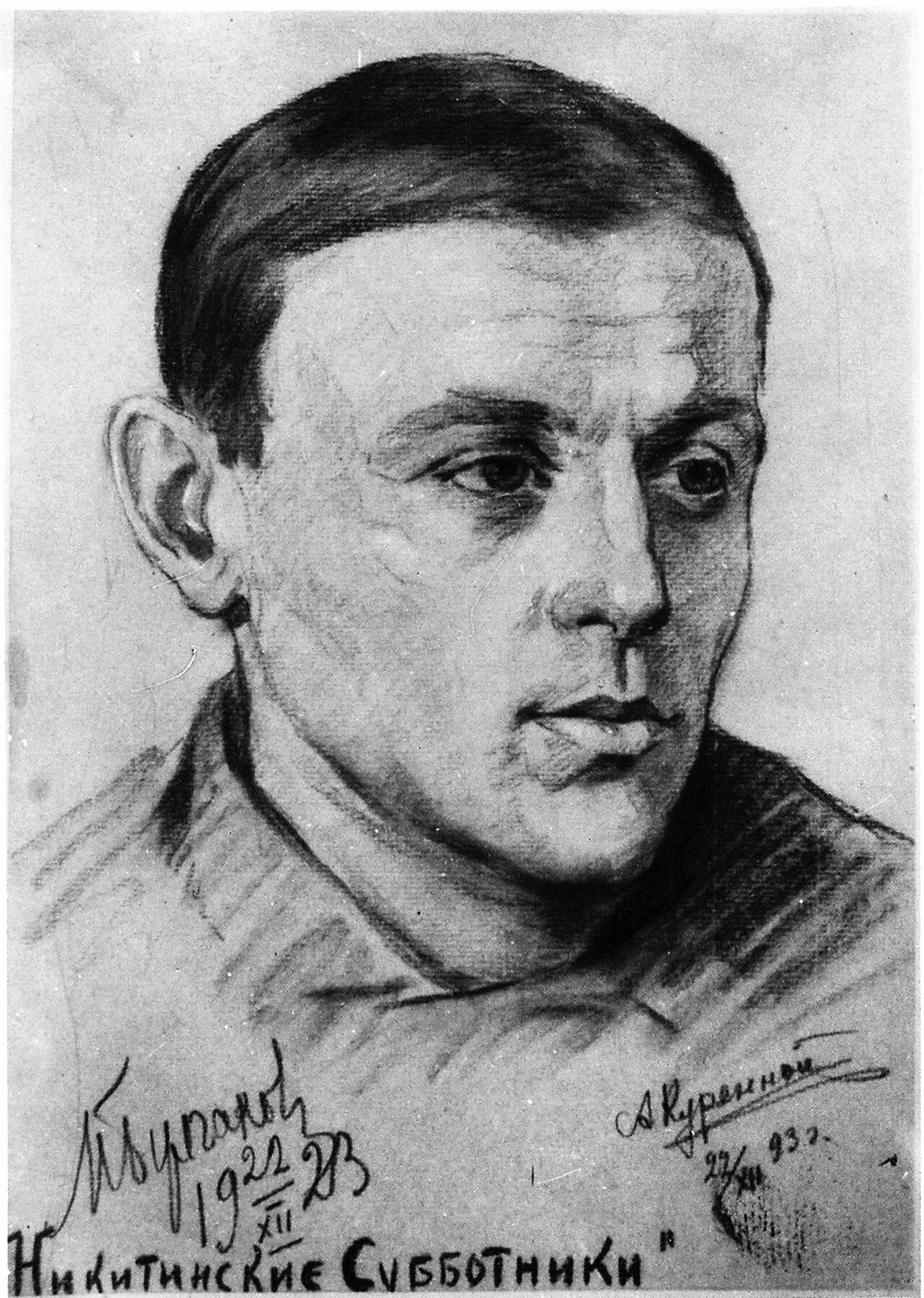
Graphic portrait of Mikhail Bulgakov by Alexander Kurennoy, 1923. Wikimedia Commons, Mikhail Bulgakov 1923.jpg, author: Alexander Avvakumovich Kurennoy (1865–1944), licence: Public domain source
September 1921: Why a Room Was Essential to a Writer’s Life
In the communal flat, Bulgakov depended on an official entitlement to housing and the decision of the building management. He arrived in Moscow in late September 1921 intending to leave medicine and become a writer, but spent his first few days without a permanent address. An online museum exhibition notes that he stayed overnight with friends and acquaintances before securing a room on Bolshaya Sadovaya Street.
In his autobiographical story ‘A Reminiscence’, the writer turned those days into a complete narrative. The narrator waits for six hours at the housing office, only to be told that a room might become available in two months. This episode is important when examining Bulgakov’s biography, but it cannot be read as a verbatim record of the appointment: the author establishes a rhythm, selects details and transforms the bureaucratic wait into a vivid scene. It is more reliable to say that the text conveys a real kind of obstacle and a personal sense of hopelessness, rather than the conversation word for word.
The solution came through the family. Andrei Zemsky, the husband of the writer’s sister Nadezhda Bulgakova, was leaving for Kyiv and made his room in flat No. 50 available to his relatives. Bulgakov moved into the vacated room; the state did not provide him with new accommodation. Moving in was not enough: official registration was required, and relations with the building management remained fraught.
Tatyana Lappa later recalled that attempts were made to evict the couple and that their residence was officially registered after Mikhail Bulgakov appealed to Nadezhda Krupskaya. In ‘A Reminiscence’, the same episode is presented as a personal meeting: the written resolution includes a request that a warrant be issued allowing the couple to live together. The agreement between the two accounts supports the core of the story, but their exact dialogue belongs to different genres of recollection. The documents permit a narrower conclusion than the literary scene: after the appeal to Krupskaya, the couple’s residence was registered, despite the building management’s previous refusals.

Nadezhda Krupskaya, 1922. Wikimedia Commons, KrupskayaY 1922PorMariaUlyanova (cropped).jpg, author: Maria Ulyanova, licence: Public domain source
What Flat No. 50 Was Like Before Bulgakov
Communal housing emerged within a building designed for an entirely different way of life. According to materials from the House No. 10 museum project, Ilya Pigit built the apartment house for members of the intelligentsia, with artists’ studios, four- and five-room flats, baths and telephones. Before the Revolution, nine rooms in the sixth entrance housed a dormitory for the Moscow Higher Courses for Women.
After 1918, the building’s purpose changed. It was nationalised, and the flats were allocated to employees of Moscow printing works. The building was designated a workers’ commune; in May 1922, it was transferred to a housing association. This sequence is more important than the familiar contrast between a ‘luxurious past’ and a ‘dreadful communal flat’: as the residents changed, so did the management, the allocation of costs, the rights to individual rooms and responsibility for heating, plumbing and repairs.
The history of the layout is more complex than a single number on a door. The museum project links flat No. 50 with flat No. 41 and shows how formerly separate premises were transformed into a corridor system. Lappa recalled rooms on both sides of a long passage, a communal kitchen and no bathroom. Later accounts differ in their estimates of the dimensions, but the broad outline remains consistent: the couple received a relatively spacious, bright room, while almost all domestic facilities remained communal.
The room gave Bulgakov space for a writing desk, books and a lamp. Beyond the door, residents made a din, the communal kitchen bustled, visitors came and went, and family quarrels flared up; heating and repairs depended on the communal household and the board’s decisions. All of this affected his work no less than editorial deadlines. Private life remained at the mercy of the communal corridor.

Ilya Pigit’s apartment house at 10 Bolshaya Sadovaya Street: a night view of the façade. Openverse, Wikimedia, Pigit's Apartment House at night 01, author: Andrey Korzun, licence: by-sa 4.0 source, license
Who Lived Alongside the Writer and Why Residents’ Lists Matter More Than Legends
The residents of flat No. 50 changed constantly and differed in both occupation and legal status. The register published by the museum lists a paint mixer at the Goznak factory, a female print-shop clerk, a pie seller, a bakery worker, a shop assistant, a typesetter, unemployed residents and students. Bulgakov himself is recorded in the document as an employee of the Gudok newspaper, while Tatyana Lappa is listed as financially dependent on her husband.
At the same time, the register cautions against simply counting the occupants. People moved in, deregistered and transferred to neighbouring flats; by 1925, the former composition of the household had changed considerably. Any statement giving an exact and unchanging number of neighbours therefore creates a false sense of certainty. Life in the communal flat was fluid, and a list compiled on a particular date captures only a single snapshot.
The best-known neighbour is Anna Fyodorovna Goryacheva, whom the museum associates with Bulgakov’s Annushka. The biographical correspondence is convincing in terms of the name, their proximity and recurring domestic conflicts. But a literary character is not the same as an entry in a residence register. Annushka serves different purposes in different works: in one, she takes part in a domestic disaster; in another, she becomes a link in a chain of fantastical causality. The literary figure accumulates traits and actions that the real person may never have possessed or performed.
Other correspondences are less famous but no less revealing. Lappa’s memoirs mention the family of a police chief and a boy who often visited the Bulgakovs; the museum links this thread to the story ‘The Psalm’. Drunken printing workers and a flat where celebrations descend into fighting provided material for ‘The Moonshine Lake’. Such connections make it possible to trace the source of an observation, but do not justify declaring every episode a disguised chronicle of a particular neighbour’s life.
The building register presents a more complex picture than the familiar class caricature. Bulgakov wrote scathingly of drunkenness, violence and interference with his work, yet his neighbours had a range of occupations and social positions. Memoirs also preserve instances of everyday mutual support: visitors drank tea, while the couple tried to make their room comfortable. In the writer’s prose, conflict arises from the enforced proximity of people who did not choose one another.

The kitchen in the exhibition at the Mikhail Bulgakov State Museum, photographed in 2014. Wikimedia Commons, Bulgakov Museum 05.JPG, author: Tothkaroj, licence: CC BY-SA 4.0 source, license
Which Sources Allow Us to Reconstruct Life in the Communal Flat
Sources of varying reliability tell the story of flat No. 50, and they cannot be combined into a single, indisputable account. Building registers record surnames, ages, places of employment and membership of the housing association. They are accurate as of the date on which they were compiled, but say almost nothing about voices, smells, conflicts or the daily allocation of space.
Bulgakov’s diary brings us closer to the events themselves. The entry dated 29 October 1923, quoted in the museum materials, links the start of the heating season with an open window, the cold and irritation at his neighbours’ behaviour. The writer records his own reaction to disruptions to his work, so the account is contemporary with the event but conveys only his personal perspective.
The memoirs of Lappa, Yuri Slyozkin, Konstantin Paustovsky and Valentin Kataev add details of the room’s layout, its furniture, the kitchen and their host’s manner. According to Lappa, the room was bright and had two windows; the couple assembled their interior from old items and chance purchases. Kataev recalled a writing desk piled with manuscripts and clippings. Paustovsky remembered an enormous, dark communal flat and a cockerel that had lost all sense of the city’s daily routine. These details are valuable, but they were recorded later and were already coloured by the writer’s fame.
Finally, there are feuilletons and first-person stories. They are closer to lived experience than the later novel, but they are still works of literature. Bulgakov compresses time, combines incidents, heightens dialogue and assigns roles so that domestic chaos acquires a narrative structure. Readers would do well to remember a simple rule: a matching name or object confirms the origin of a detail, but not the historical accuracy of the entire plot.

The exhibition of Mikhail Bulgakov’s room in flat No. 50, photographed in 2014. Wikimedia Commons, Bulgakov Museum 11.JPG, author: Tothkaroj, licence: CC BY-SA 4.0 source, license
How ‘The Moonshine Lake’ Turns Noise from Beyond the Wall into Literature
In ‘The Moonshine Lake’, the communal flat operates as a mechanism of constant intrusion. The narrator tries to write while one incident after another unfolds beyond his door: a drunken visit, a scene involving a cockerel, domestic violence, a summons to the building authorities and another round of revelry. In the original 1923 text, the events follow one another almost hour by hour, and communal living consumes all the protagonist’s free time.
The comic effect does not diminish the gravity of what is happening. A coarse remark gives way to a threat, a fight to an attempt to intervene, while the administrative representative proves to be part of the same environment. Bulgakov offers no saving external arbiter: neither the building manager nor the chairman of the board restores order, because they too are governed by the communal logic of personal connections, fear and drink.
At the end of the story, the domestic plot is directly linked to literary work. The narrator’s wife asks him to move away, and he replies that they cannot obtain another room until the novel is finished. The economic chain is clear: feuilletons provide an income, writing feuilletons requires an opportunity to work, and communal life destroys that opportunity. Yet the same disruption supplies material for the next text. The flat simultaneously obstructs literature and furnishes it with plots.
This duality explains why Bulgakov’s communal flat cannot be reduced to a satire of bad neighbours. The protagonist also depends on the shared system: he fears an influential board member, locks his room, seeks temporary refuge with relatives and transforms personal humiliation into a professional form. The author’s irony maintains a degree of distance, but does not conceal the anxiety of eviction and financial ruin.
The story ‘The Psalm’ reveals another possibility within the same material. The museum links its plot to a real neighbouring family; Bulgakov builds it around a brief encounter between an adult and a child, exposing the vulnerability of domestic life. The writer assigns the neighbours different functions: they provoke noise, fear, pity or unexpected trust. A list of ‘prototypes’ that ignores the texts themselves therefore impoverishes the author’s conception.

An Underwood typewriter made for the Russian market before 1917, on display at the Bulgakov House Museum in Moscow. Wikimedia Commons, Bulgakov House Museum. Photo 5.jpg, author: Alina Vozna, licence: CC BY-SA 4.0 source, license
Why Bulgakov Needed the Fictional Elpit Building
In the short story ‘No. 13: The Elpit Workers’ Commune Building’, a private Moscow experience becomes the story of an entire building. Bulgakov initially portrays the fictional Elpit as a well-appointed apartment building, and then as a workers’ commune whose management system has collapsed. The parallel with Pigit’s building on Bolshaya Sadovaya is clear. The story does not reproduce the documented history of No. 10.
The principal boundary between fact and fiction lies in the catastrophe. In the story, a breach of household rules causes a fire. In reality, the building on Bolshaya Sadovaya was not destroyed. Bulgakov takes the recognisable structure of an apartment building, the experience of nationalisation and the residents’ domestic habits, and turns them into a chain of cause and effect with a symbolic conclusion.
This technique is important for understanding the subsequent evolution of Flat No. 50. The writer retains the material foundations — heating, wiring, stoves, doors, shared spaces and building management — but changes the scale of the consequences. A minor act by a single resident begins to determine the fate of the entire building. In The Master and Margarita, this same capacity of an everyday detail to set an immense plot in motion would be taken to fantastical extremes.
The collection Treatise on Housing, published in 1926, established the housing theme as a distinct strand in Bulgakov’s early prose. By then, the writer had already left Bolshaya Sadovaya, but he continued to draw on his communal-living experience in short stories, plays and novellas. He remembered the noise of a particular corridor and the distinctive language of the era: densification, housing association, flat management, housing warrant, application, entitlement to living space.

The façade of No. 10 Bolshaya Sadovaya, where Mikhail Bulgakov lived from 1921 to 1924. The photograph was taken on 9 March 2017; the number ‘1895’ in the filename is not the date of the photograph. Wikimedia Commons, Moscow BolshayaSadovaya10 1895.jpg, author: Ludvig14, licence: CC BY-SA 4.0 source, license
How housing policy entered the language of literature
The communal-housing conflicts in Bulgakov’s work cannot be understood without knowing the rules governing the allocation of housing after 1917. The decree issued by the All-Russian Central Executive Committee on 20 August 1918 abolished private ownership of urban property within state-defined limits and transferred the management of a substantial portion of the housing stock to public authorities. Densification became a means of accommodating workers, office employees and military personnel in premises occupied by their former owners and tenants.
The scholar Elena Abelyuk shows that Bulgakov’s prose consistently records this system of concepts. The statutory living-space allowance determined a person’s right to a room, while the addition of a partition could change the legal status of a space. The decision to move someone in depended on the resident’s social position; the building committee and housing association managed the day-to-day running of the property. By weaving this vocabulary into his characters’ conflicts, the writer showed how the regulations worked in practice.
A revealing example is the recurring allowance of sixteen square arshins — approximately 8.09 square metres. It appears in Heart of a Dog and Zoya’s Flat as an argument used by characters in disputes over living space. The figure sounds comical only to a reader whose life does not depend on it. For the character, the allowance determines whether they will keep their room, acquire a new neighbour and be able to call at least part of the flat their own.
The instruction issued by the People’s Commissariat for Internal Affairs of the RSFSR on 14 November 1921 established housing associations as a mechanism for the economic management of residential buildings. In May 1922, the workers’ commune in the building on Bolshaya Sadovaya was reorganised according to this model. Positions and procedures changed along with the form of management, but the individual resident remained dependent on collective decisions. The threat to ‘submit an application’ or influence an eviction was therefore no empty abuse.
In Bulgakov’s satire, characters use administrative formulas in personal disputes. A building representative uses their official position to conceal self-interest, a neighbour expresses irritation in the language of rights and regulations, and claimants immediately submit applications for a vacant room. In this way, the writer shows authority at work outside a private door, in the kitchen and along the corridor.
A glossary of housing authority in the early 1920s
Bulgakov’s scenes become clearer when the reader distinguishes between the various housing terms: similar words represented different ways of controlling a building or room. Elena Abelyuk compares the language of literature with the decrees and instructions of the period, making it possible to distinguish the concepts by their function.
- Densification
- The compulsory settlement of additional residents in space deemed surplus under the prevailing allowance. The decision was made by the housing authorities, and an individual room could be divided by a partition.
- Self-densification
- The option of finding additional residents for surplus living space before the authorities moved someone in. The decree issued by the Council of People’s Commissars of the RSFSR on 25 January 1920 allowed two weeks for this search, after which compulsory densification could follow.
- Housing association
- A form of economic management for residential buildings established by Instruction No. 478, issued by the People’s Commissariat for Internal Affairs of the RSFSR on 14 November 1921. The association was responsible for the building’s operation and enjoyed financial autonomy; the building on Bolshaya Sadovaya adopted this form of management in May 1922.
- Responsible tenant and flat representative
- A resident who represented the flat in dealings with the building administration. This person oversaw payments, the maintenance of the premises and compliance with communal-living rules, and also reported on events to higher authorities.
The building committee and the board of the housing association cannot be regarded as exact synonyms. Building committees appeared earlier and had a narrower range of administrative duties; after the reform, the old term remained in everyday use. Abelyuk illustrates this linguistic confusion with Heart of a Dog, where the same group of officials is referred to both as the building committee and as housing-association members. An isolated colloquial term without an accompanying document cannot therefore provide a precise date for a real event.

Part of an exhibition at the Mikhail Bulgakov State Museum in Moscow: display materials and a historical image of the building. The photograph was taken on 21 June 2014. Wikimedia Commons, Bulgakov Museum 12.JPG, author: Tothkaroj, licence: CC BY-SA 4.0 source, license
Where the documentary record ends and fiction begins
Facts about the flat and literary texts require different approaches to interpretation. One source confirms a date and a surname, another preserves a subjective impression, and a third reshapes experience for the sake of the plot. Biography should therefore be verified against documentary evidence, while a work of fiction should be analysed as the product of the author’s creative transformation.
| Type of source | What can be established | What it does not prove |
|---|---|---|
| Building registers and records | The residents at a given date, their ages, places of employment and membership of the association | The precise course of conflicts, people’s motives and who uttered particular remarks |
| Bulgakov’s diary | The writer’s response at the time of an event and the dates of certain incidents from everyday life | An impartial picture of relations among all the residents |
| The recollections of Lappa and Bulgakov’s friends | The layout, furniture, habits and atmosphere of the room and kitchen | The absolute accuracy of memories recorded much later or the verbatim wording of conversations |
| Autobiographical short stories and feuilletons | The type of real-life experience, the author’s judgement and the transformation of everyday life into plot | That every event occurred exactly as described and involved the named characters |
| "Master and Margarita" | The flat’s mature artistic significance and the connection between everyday life and the fantastical | A chronicle of Flat No. 50 and biographies of its real residents |
This approach to reading dispels two persistent misconceptions. The first is that a character can be fully ‘unmasked’ by finding a single name in a building register. The second is that the presence of fiction negates a text’s historical value. Bulgakov’s prose accurately preserves the tensions inherent in the housing system, even as it redistributes real-life traits among the characters and subordinates events to the work’s composition.
Recurring themes and situations suggest that Flat No. 50 became, for Bulgakov, a model of a perpetually permeable home where one resident’s actions quickly affect the neighbours. This is a scholarly interpretation, not a statement by the writer himself or an entry in a housing record.

A museum installation featuring household objects at the Mikhail Bulgakov State Museum in Moscow. Wikimedia Commons, Bulgakov Museum 02.JPG, author: Tothkaroj, licence: CC BY-SA 4.0 source, license
How Flat No. 50 Became the ‘Bad Flat’
In The Master and Margarita, Bulgakov retained the number, the recognisably Moscow setting and the housing administration. He transformed the flat in building 302-bis, associated with Berlioz and Styopa Likhodeyev, into the Moscow residence of Woland and his retinue. The communal flat of Bulgakov’s own life is not reproduced here: the disappearance of residents, the struggle for living space and the foreigner’s visit are interwoven with fantasy.
Bulgakov also preserves the housing conflict in the behaviour of Nikanor Ivanovich Bosoy. The chairman of the housing association considers the heating costs and agrees to accommodate the foreigner. After Berlioz’s death, applicants submit 32 requests for the three newly vacant rooms. These details convey the logic of Moscow life, where scarce living space immediately became a matter of both administrative and personal interest.
The link between biography and fiction is especially clear in the example of a real-life neighbour. Museum materials name Anna Goryacheva as one of the inspirations for the character, yet Annushka in the novel is drawn into a chain of chance events: the oil she spills leads to Berlioz’s death, while the horseshoe she finds carries the plot forward after the ball. Bulgakov preserves the real name and the memory of his neighbour, but gives the character fictional deeds.
The scale of the space also changes. Bulgakov replaces the cramped room for which he had to struggle in 1921 with a flat of impossibly vast internal dimensions, where Woland’s ball takes place. The everyday fear of losing one’s home remains embedded in the fantasy of Moscow. People still seek living space, submit applications, inspect documents and try to profit, but now they encounter a force that turns familiar procedures against them.
The phrase ‘Flat No. 50 became the “Bad Flat”’ neatly summarises its literary genealogy. From real experience, Bulgakov took the number, the memory of the place, several names and the sense of insecurity inherent in communal living. Woland, the disappearances, the spatial transformations and the resulting chain of events were products of the writer’s imagination.

A present-day view of No. 10 Bolshaya Sadovaya Street from the Garden Ring—the actual building that housed Bulgakov’s communal flat. Wikimedia Commons, Bulgakov House Moscow (1).jpg, author: Vladimir OKC, licence: CC BY-SA 3.0 source, license
Why the Time Gap Between the Communal Flat and the Novel Matters
The writer left Flat No. 50 in November 1924 and did not begin The Master and Margarita until 1928–1929. The Mikhail Bulgakov Museum dates his work on the novel through 1940, meaning that this image took shape over more than a decade and continued to evolve after he left Bolshaya Sadovaya Street. Even the minimum four-year interval between his experience of communal living and the start of the work rules out the idea that it was a direct record of life as he observed it.
The first version was written in another home, on Bolshaya Pirogovskaya Street, where Bulgakov lived from 1927 to 1934. It was there that he burnt the manuscript, individual pages of which survive in the manuscript collection of the Russian State Library. The place where he acquired the life experience and the place where he worked on this version were not the same: Flat No. 50 existed in the novel as a memory, already filtered through feuilletons, short stories and his subsequent impressions of Moscow.
In the spring of 1939, the writer completed the epilogue, and on 4 October he began another revision. Elena Sergeyevna Bulgakova recorded that her husband made his final changes on 13 February 1940. He died on 10 March 1940, still not considering the work fully complete. The text’s long evolution makes it impossible to assign every detail of the flat a single date of origin. It confirms that the early material drawn from communal life entered the novel through artistic reworking, not through the mechanical transfer of real residents and events.
Three Stages of Literary Reworking
| Text and Period | Preserved Real-Life Detail | Artistic Transformation | Limits of the Evidence |
|---|---|---|---|
| ‘No. 13: The Elpit Workers’ Commune Building’, 1922 | The tenement building, its nationalisation, the commune board, heating and restrictions on everyday life | The building’s fate is condensed into a short story of decline and fire; an individual transgression assumes consequences for the entire building | Pigit House is recognisable as one source for the model, but the fire and the story’s characters are not a chronicle of No. 10 |
| ‘Moonshine Lake’, 1923 | A noisy flat, drunkenness, a cockerel, family quarrels, the building superintendent, fear of the board and the impossibility of writing in peace | The events of a single holiday are accelerated and arranged as an escalating comedy of bureaucracy and everyday life | The first-person narration and recognisable neighbours point to an autobiographical basis, but do not turn the dialogue and sequence of scenes into a factual record |
| The Master and Margarita, 1928–1940 | The flat number, Annushka, the housing association, the shortage of living space and applications for vacant rooms | The causal logic of communal life is combined with fantasy: everyday calculations continue to operate amid impossible events | The parallels explain the origins of the motifs, but Woland, the residents’ disappearances and the design of the flat belong to the world of the novel |
In each of the three texts, Bulgakov gives the material drawn from communal life a new purpose. ‘The Elpit Workers’ Commune Building’ explores the fragility of an entire building; ‘Moonshine Lake’, the loss of personal time and workspace; and The Master and Margarita, the influence of the housing shortage on people’s actions within a fantastical plot. This conclusion is based on the structure of the texts; Bulgakov himself never articulated such a programme.

Building 2 at 35A Bolshaya Pirogovskaya Street, associated with Mikhail Bulgakov’s life and work in Moscow in the 1920s and 1930s. Wikimedia Commons, House 35A on Bolshaya Pirogovskaya-001.jpg, author: Abogomazova, licence: CC BY-SA 4.0 source, license
What Happened Inside the Bulgakovs’ Room
Bulgakov’s own room served as both a refuge from communal life and a place to work. Lappa recalled a writing desk, a sofa, a mirror, a folding bed, cupboards and an armchair; later, the couple recovered a table that had belonged to her family and bought a small suite of furniture. These individual pieces created a sense of order that was impossible to maintain throughout the flat.
The way the room was arranged was directly connected with Bulgakov’s profession. The museum lists his places of employment: editorial and secretarial work, the Main Political Education Committee, the Scientific and Technical Committee of the Zhukovsky Air Force Academy, and the newspapers Gudok and Nakanune. The writer combined several occupations and often worked on literary texts at night.
It was while living on Bolshaya Sadovaya Street that Bulgakov wrote The White Guard, Diaboliad, The Fatal Eggs, and his early short stories and feuilletons. ‘Moonshine Lake’ shows directly how noise and the fear of eviction could disrupt the work on which both his income and his ability to leave depended. Bulgakov produced major works despite these conditions.
At his writing desk, the author transformed a room allocated and controlled by the system into a place of private creativity. He turned a newspaper clipping into a line of dialogue, a neighbours’ quarrel into a composition, and an administrative term into a satirical motif. In this way, his experience of communal living underwent its first stage of literary transformation long before The Master and Margarita.

Part of the Bulgakov Museum exhibition: a desk with a newspaper, telephone and lamp; on the wall is an architectural drawing of a building on Potsdamer Strasse in Berlin. Wikimedia Commons, Bulgakov Museum 03.JPG, author: Tothkaroj, licence: CC BY-SA 4.0 source, license
Why the Housing Theme Extends Beyond a Single Moscow Flat
Bulgakov’s experience on Bolshaya Sadovaya Street became the source material for prose about the housing system of the early Soviet city. Recurring features of this prose include the subdivision of living space, struggles over square metres, building officials, temporary residents, hidden rooms, applications, queues and the threat of eviction. These motifs appear in ‘Moscow in the 1920s’, Heart of a Dog, Zoya’s Apartment, ‘Moonshine Lake’ and other works.
Elena Abelyuk describes Bulgakov’s body of work as a literary encyclopaedia of communal life, a definition she supports by pointing to the recurrence of its institutions and rules. Bulgakov gave them a new dramatic function each time. A house committee may be ridiculous in one work, dangerous in another and helpless in a third; the statutory allowance of living space may be a bureaucratic figure, a threat or an occasion for ingenious self-defence.
The housing shortage also shapes the characters’ moral choices. A room becomes a reward, a means of exerting pressure or a motive for denunciation; a door does not guarantee privacy, and official status does not guarantee justice. The novel takes these possibilities to grotesque extremes, but they remain recognisable because they are rooted in the real social practices of the 1920s.
Woland’s famous remark about the housing problem is often repeated as a universal aphorism about Muscovites. In its biographical and historical context, it has a more specific resonance: behind the joke lie years of housing crisis, a new system for allocating living space and the author’s personal experience of needing a room in 1921 in order to remain in Moscow.
What 105 years of hindsight reveals
As of 2026, the history of the flat can conveniently be divided into four periods. Late September 1921 — his arrival and search for accommodation; 1921–1924 — life with Tatyana Lappa in Flat No. 50; 1922–1924 — early prose and feuilletons about the building, its neighbours and the housing system; 1928–1940 — many years of work on The Master and Margarita. This chronology makes it possible to compare archival evidence with literary works without equating real people with fictional characters.

Patriarch’s Pond from above on 25 May 2017: the pond, pavilion and surrounding city blocks. Wikimedia Commons, Moscow 05-2017 img39 Patriarshiy Pond.jpg, author: A.Savin, licence: FAL source, license
Conclusion: what communal Moscow contributed to the novel
Communal Moscow gave Bulgakov a set of enduring relationships: the struggle for living space, dependence on building management, the erosion of privacy, the coexistence of incompatible habits and the ability of an everyday mishap to set off a chain of major consequences. On Bolshaya Sadovaya Street, the writer observed this system; in his early prose, he explored ways of transforming it into literature; and many years later, he combined these observations with fantasy.
You can see how this literary memory is woven into the city’s topography on the walking tour ‘The Master and Margarita Tour’: the route from Triumfalnaya Square to Pushkinskaya Square links the building containing Flat No. 50, Patriarch’s Ponds, Nikitsky Gate and other locations from the novel. Comparing them helps distinguish the authentic topography from the author’s imaginative reworking and avoids treating real buildings as literal settings from the book.
Sources
- The Housing Question Online Exhibition — Mikhail Bulgakov Museum
- Flat No. 50 — House 10, a special project by the Mikhail Bulgakov Museum
- Bulgakov’s Family and Friends Remember Flat No. 50 — Mikhail Bulgakov Museum
- E. S. Abelyuk. ‘Under the Magnifying Glass of Commentary: Soviet Housing Policy and Its Reflection in the Works of M. A. Bulgakov’
- Decree of the All-Russian Central Executive Committee on the Abolition of Private Ownership of Urban Real Estate. 20 August 1918 — Digital Library of Historical Documents
- M. A. Bulgakov. ‘Moonshine Lake’, 1923
- M. A. Bulgakov. Letters and Diary in the Collected Works
- Exhibition ‘A Novel About the Master: The Final Revisions’ — Mikhail Bulgakov Museum
- ‘Manuscripts Don’t Burn’: The First Draft of the Novel at the Bolshaya Pirogovskaya Street Flat — Mikhail Bulgakov Museum
- ‘No. 10, Also Known as 302-bis’ in the Works of Mikhail Bulgakov — Mikhail Bulgakov Museum
- M. A. Bulgakov. ‘No. 13: The Elpit Workers’ Commune Building’
We took a tour of Taganka designed for 12-year-old children. It was an excellent programme. We covered a great deal of ground and learnt so much. We discovered the story of Dryanaya Street and discussed the Vladimir Highway, the surrounding monasteries and churches, and the Old Believers. We now know where Korovin was born, where Stanislavsky was born and raised, where the Morozov merchant children lived, and why Arseny Morozov was considered such an outrageous figure in his day. We also discussed Solzhenitsyn, discovered where Stalin Avenue was supposed to be built, saw the bunker, walked to the Russian metochion of the Mount Athos Monastery, and learnt why the Illuzion cinema made Taganka famous. Of course, no tour would have been complete without Vysotsky and Lyubimov. We also touched briefly on Taganka Prison, although naturally we did not go there. All in all, it was an exceptionally rich and informative tour! Our guide Alexander was superb!
Our thanks to our guide Alexander for a magnificent sightseeing tour. Alexander’s love for Moscow and its history, his wide-ranging knowledge, elegant and engaging delivery, and personal charm make the tour not merely interesting and informative, but truly delightful! Thank you, Alexander! Tatiana and Tatiana, St Petersburg
On July 18th, we participated in the "Soul of Moscow" group tour led by Alexander. Kitay-gorod and its surroundings revealed a new side to us, and everyone thoroughly enjoyed it. Some of us began intensively studying related materials to broaden our horizons. We'll be back, and we highly recommend it! You won't regret it.
Good afternoon, on June 23rd we had a tour called " The Soul of Moscow ," led by Alexander. He's a very pleasant young man. We visited such lovely courtyards and alleys with him that we never even knew existed, and we learned so much. We really enjoyed everything, and we hope to continue our acquaintance. Alexander! Thank you! We had a great time with you, and we thoroughly enjoyed it. See you there!
This isn't my first time with Radius. This time, I took the Moscow metro . The goal was not only to admire the underground palaces but also to learn how to navigate the metro. As a resident of a region without a metro, I was a bit apprehensive and didn't understand how to navigate the metro. Of course, the internet helps, but live communication is much better. Tour guide Yulia handled this task perfectly. The information was accessible and interesting, the presentation was calm, and the communication style was very friendly. Thank you very much for the tour and the practical experience.
Good afternoon! I gave the "Soul of Moscow" tour to some of the capital's guests. We were thrilled to hear our guide, Anton. It was so informative and engaging, and very warm. To say we were absolutely delighted is an understatement. It turned out to be a truly family-friendly excursion. We learned so many interesting facts. The material was presented professionally, all our questions were answered, and we saw so much. It was simply WOW! Thank you so much, Anton, he's the best!!!!! From now on, I'll only come to you, the Radius team. I highly recommend it. I promise we'll see each other again soon on other tours.
Overall, the tour left a positive impression! Thanks to Alexander for the walk through the courtyards and atmospheric spots of Kitay-Gorod; we certainly wouldn't have done it on our own. The tour was comfortable, and the guide spoke confidently and calmly. One thing we personally missed: we would have liked more of the historical part, relating to ancient Moscow and the history of Kitay-Gorod. There were quite a few stories about the Soviet period and the bar scene, but for our group, this wasn't particularly relevant. We think the program could be a little more tailored to the age and interests of the group. It would also have been interesting to add more historical facts, monuments, and details about old Moscow and the area itself. That said, the tour was still interesting, and some places and churches were truly memorable. These aren't really "cons," but rather suggestions for an even more comprehensive program.
Hello! We had a corporate group of 10 people. Our guide was Anton, and we had a tour of Bulgakov. I would like to point out the excellent organization; everything went smoothly. The managers were very accommodating to our changes in the number of participants. The bus was very comfortable. Anton is a super-engaged and motivated guide. He lives this history and is delighted to share his knowledge and create an unforgettable experience. Everything went well. I highly recommend it!
Thank you for a fascinating tour! It gave me so much food for thought to explore! Note: Review of the "Zamoskvorechye" tour with guide Maria.
I'd like to express my gratitude on behalf of our team! Thank you for keeping to our scheduled schedule despite our lack of organization. Our colleagues appreciated your preparation for the tour! It was informative. Note: Review of the "Modern Residential Complexes, Factory Past, and Avant-Garde" tour of the ZILART residential complex with guide Maria. Maria prepared and conducted a customized tour for employees of the Samolet Group of Companies development company.
Thank you! You have great talent. Good luck! ☺️ You're a wonderful guide! Thank you again! Note: This is a review of the corporate tour "The Heart of the Capital" with guide Maria.
Thank you for a wonderful day today!!)) Note: review of the excursion "The Soul of Moscow" with guide Maria
On behalf of the whole family, I want to thank you for a very informative and interesting tour! Note: This is a review of the "Palace Dungeons" tour with guide Maria.
Good afternoon! I'd like to express my gratitude and that of my guide for organizing the tour! We were very pleased. We'd like to do it again in October, but on a different route — ZIL. Note: This refers to the tour for Samolet Group developers, led by guide Maria.
Thanks to Alexander for the bar tour of Baumanka ! It was fun, exciting, and we discovered so many new places! Awesome! May we reach new heights!
Good afternoon! I was on a tour of Sukharevskaya Square — we went all the way to Tsvetnoy Boulevard. I didn't expect it to be so interesting! For those wondering whether to go — go for it! It truly became one of my most memorable summer memories!
Anastasia, good morning! Thank you and Masha for yesterday! The speakers are happy. The connection through the headphones was often lost, especially at the checkpoint, but that's just our current situation. You could hear if you were standing close, no more than 1.5 meters away. Colleagues have already asked for your contact information. I'd be happy to share it and look forward to another opportunity to work with you. Special thanks to the Director for the Bureau . Note: " Heart of the Capital " tour for participants of the 2025 Moscow Oncology Forum. Guides: Anastasia and Maria.
We'd like to thank Anton and Alexander for leading the tour! It was fascinating to hear how the Krasnaya Presnya district developed and how Prokhorov's influence on our city's development. It was a pleasant immersion into a quiet, previously unexplored area!
Good afternoon, thank you so much, Anastasia. The " Uncle Gilyai " tour was fantastic. Even though we're Muscovites and know a lot about Moscow, the experience was amazing, so much new and interesting happened. We'll definitely be back.
Thank you for the " Heart of Moscow " and " Khamovniki " tours. Anton, a knowledgeable and passionate Moscow guide, gave me the tour. He's a great storyteller, intelligent, well-read, and captivating. You've truly opened up my Moscow to me! I'll definitely be back next summer to explore Moscow with you. I'll recommend your wonderful tour program to all my friends!
Excursions with the Radius travel agency are always a positive experience if you choose them. We planned a tour of Zamoskvorechye on our next visit. We've worked with our guide, Anton, before. We'll definitely recommend him to everyone we know. The tour is informative, not overloaded with dates, and the information is comprehensive yet easy to understand, as it's presented in a light, narrative manner, not like a history textbook, dry and academic. Thank you for this approach. We'll definitely use the Radius agency again on our next visit to Moscow.
Thank you so much for the tour of Zamoskvorechye . Despite the weather, it was very interesting and informative! Note: this refers to the tour with guide Anton.
A huge thank you to Anastasia. We had a fantastic tour of the Patriki district. We learned so much. Anastasia is a true master of her craft. The tour was captivating, not at all boring, lively and interesting. Everyone was delighted. We were full of new impressions. I definitely recommend it. You won't be disappointed!
We explored the Soul of Moscow with my family and Radius on my birthday. Everyone thoroughly enjoyed the walk! Anton shared so many interesting facts about the capital and its history, taking us into spiritual depths no one else had even suspected. Most of us were either born or longtime Moscow residents who spent a lot of time walking around. It was educational, heartwarming, and unforgettable. 🙂 Overall, this wasn't my first time walking around Moscow with Anton, and each time was a real adventure!