The history of the Illuzion cinema in the Kotelnicheskaya Embankment skyscraper began on 18 March 1966, when Gosfilmofond opened a venue for archival screenings in the former Znamya cinema. Films from the archive’s collection began to be shown in the existing auditorium.
In the 2019 state historical and cultural expert assessment report Znamya is named as Illuzion’s predecessor, while the 2022 report states that in 1966 the cinema was renamed and adapted to screen films from Gosfilmofond’s collection. The documents allow us to trace the sequence of changes, but do not give the exact date of the first screening under the former name.
Was there a cinema in the high-rise before Illuzion opened?
Yes. The Znamya cinema operated within the residential complex on Kotelnicheskaya Embankment. The 2019 heritage protection document locates it in the north-west side wing; the 2022 document describes its premises on the lower floor and the single-storey auditorium extension on the courtyard side. This means that the opening of the Illuzion cinema in 1966 should not be understood as the construction of a cinema auditorium from scratch.
The auditorium formed part of the high-rise's public amenities: alongside the flats, architects Dmitry Chechulin and Andrey Rostkovsky included shops and other services in their design. The 2019 heritage protection report lists Znamya alongside a tailoring studio and a post office. The cinema occupied part of a complex comprising several blocks, so its history cannot begin simply with the appearance of the Illuzion sign.

Entrance to the Illuzion cinema in a residential block of the high-rise on Kotelnicheskaya Embankment. Present-day view. Wikimedia Commons, Moscow. Illuzion Cinema in a Residential Building on Kotelnicheskaya Embankment. 2010-07-27 19-57-22.jpg, author: Shesmax, licence: CC BY-SA 4.0 source, license
The date when Znamya began operating needs to be treated with caution. The wording of the heritage protection reports establishes the existence and location of Illuzion's predecessor, but provides neither a cinema programme nor a document recording its first screening. Inferring the cinema's exact opening date from the block's construction period would mean substituting one source for another.
How the earlier cinema was incorporated into the high-rise
The 1940 drawings described in the 2022 report placed the cinema auditorium in the courtyard behind the central Block B. After Chechulin and Rostkovsky revised the design, it was built beside a side block: the entrance faced the main façade, while the auditorium extended into the courtyard. Comparing the original design with the completed building shows how the cinema's position within the residential ensemble changed.
The 2022 report lists the spaces associated with the earlier auditorium: a foyer, an entrance hall, ticket offices, administrative offices and a reading room. It also describes a single-storey extension on the courtyard side housing the auditorium. This list records the planned use of the spaces, but does not in itself tell us how often the reading room was used or how it was furnished in each period. From an architectural history perspective, what matters is that these spaces were intended for audiences to spend time in before and after screenings.
In his article ‘The Znamya Cinema’, film historian Nikolay Mayorov gives the opening date as 18 December 1954 and links it to a screening of the film The Reserve Player; the page includes a reproduction of a short article from Vechernyaya Moskva dated 21 December 1954. The heritage protection reports do not specify this date; the available reproduction is no substitute for checking the complete newspaper issue and the cinema programme. A published catalogue of archival documents contains an entry dated 24 December 1954 recording the completion of Znamya's construction, but this likewise does not establish the exact date of the first screening. This dating requires further archival research; for the main chronology, the established fact is sufficient: the earlier cinema existed before 1966.
Mayorov provides another piece of evidence about the auditorium before Gosfilmofond took it over: a reproduced seating plan from Moskovskaya Kinonedelya dated 18 August 1958. The film historian records a capacity of 332, a flat floor and 35 mm projection with mono sound, typical of the period. These details belong to a specific description of the earlier cinema and help us picture the space's original function. However, the figure of 332 cannot be applied without qualification to the opening of the new venue: documents concerning the auditorium's subsequent transfer and later alterations do not confirm that the seating arrangement remained unchanged between these dates.

A block of the high-rise on Kotelnicheskaya Embankment with the entrance to the Illuzion cinema. Photograph taken in 2011. Wikimedia Commons, Illuzion Cinema in the Building on Kotelnicheskaya Embankment in Moscow.jpg, author: Okorok, licence: CC BY-SA 3.0 source, license
In interview with the newspaper Moskva Tsentr, published in March 2016 to mark Illuzion's fiftieth anniversary, Gosfilmofond employee Vladimir Solovyov, who had helped establish it, recalled that he had found the auditorium himself. According to him, the auditorium later operated for a time as a branch of the Udarnik cinema. Here, the different types of source diverge: a participant's recollection describes its administrative affiliation in the mid-1950s, while Goskino's 1965 order still uses the earlier name, Znamya. Without documents from the city's cinema network, it is impossible to determine exactly when its branch status changed or whether this was accompanied by a change of sign. For the main conclusion, it is enough to establish that Gosfilmofond took over an existing cinema auditorium.
What changed with Goskino's decision in 1965?
The decision gave the earlier auditorium a new purpose: to become a Moscow venue for screening Soviet and foreign films from Gosfilmofond's collection. The 2019 heritage protection report cites USSR Goskino Order No. 428 of 12 November 1965 and names Viktor Privato, director of the film archive, as the project's initiator. The text of the order survives in a publication of archival documents in Kinovedcheskie Zapiski; it allows us to check precisely what was ordered and compare the plan with the actual opening.
The archive's earlier history explains the reasoning behind this choice. The official Gosfilmofond page states that the organisation grew out of the All-Union Film Repository, which was reorganised as the State Film Fund in 1948. Preserving film prints and screening them for the public are different tasks. Opening a dedicated cinema connected the archive's collection with an audience: a rare film, or one that had not been shown for years, could be seen on the big screen, rather than known only through a catalogue entry.
The 2022 report describes the change in very specific terms: in 1966, Znamya was renamed Illuzion and adapted to screen films from the fund's collection. The change of sign therefore accompanied a change of purpose. The published material does not allow us to reconstruct precisely which technical works were carried out in 1965–1966; the word ‘adapted’ does not justify attributing any known later alteration of the auditorium to this period.

The ‘ILLUZION’ sign on the cinema's façade in the high-rise on Kotelnicheskaya Embankment. Present-day view. Wikimedia Commons, Illuzion Cinema Sign.jpg, author: Dariaanoshina, licence: CC BY-SA 4.0 source, license
Planned for January, opened in March
The original text of Order No. 428, published in Kinovedcheskie Zapiski, helps clarify the meaning of the decision. The document, dated 12 November 1965, instructed that Gosfilmofond's cinema should open in January 1966 specifically in Znamya's premises at 1/15 Kotelnicheskaya Embankment. The actual opening took place on 18 March. The January deadline in the order did not coincide with the first official screening. These two pieces of evidence do not establish why the schedule changed or what work occupied the intervening period.
The order instructed T. A. Lomasova, head of the city's cinema administration, and V. S. Privato, director of Gosfilmofond, to formalise the transfer of Znamya's premises and equipment for use under a lease. The agreement and regulations governing the new cinema were to be submitted for approval by 1 December 1965. A separate instruction to the information and advertising bureau concerned promoting the venue. This sequence alone shows the organisational nature of the transition: use of the auditorium and its equipment had to be formalised, operating rules established and the public informed about the new programme.
In its preamble, the order refers to an earlier Goskino directive, No. 276 of 2 July 1965. Its text is not included in the publication consulted, so the November document cannot be regarded as the very first discussion of the project. This source records a specific next step: the selection of Znamya's premises and instructions to the officials involved. It contains no cost estimate, adaptation drawings or list of equipment actually transferred under the agreement.
Gosfilmofond states that it joined the International Federation of Film Archives in 1957. The documentary publication in Kinovedcheskie Zapiski includes a directive of the USSR Council of Ministers dated 20 August 1957, permitting the fund to send and receive films duty-free as part of exchanges with foreign archives. Such programmes could have been assembled before then; in 1966, a permanent Moscow venue became available for screening them to the public.
Documents of various kinds confirm Viktor Privato's role. The heritage protection report names him as the venue's initiator, the order assigns the director responsibility for formalising the transfer of the premises, and the fund's institutional history links his leadership with the development of international contacts. Yet the opening cannot be reduced to one person's individual initiative: the document names the city's cinema administration, Gosfilmofond and the information and advertising bureau. Illuzion emerged from decisions made by the archive, the capital's cinema network and the State Committee for Cinematography.
What happened on 18 March 1966?
On this day, Illuzion opened to audiences as Gosfilmofond's cinema. The historical account in the heritage protection report and the cinema's own website agree on the date; the report names Sergei Eisenstein's Battleship Potemkin as the opening film. The fund's official history also gives 18 March 1966 as the opening date of its dedicated cinema in the high-rise.

Audience members and a speaker in Illuzion's auditorium in 2018. On the screen: CINEMA NIGHT: ‘FRONTIERS’. Wikimedia Commons, Illuzion Cinema Auditorium.jpg, author: Dariaanoshina, licence: CC BY-SA 4.0 source, license
Vladimir Solovyov's testimony clarifies what this date signifies. In a 2016 interview, he said that a screening had taken place on 16 March, two days before the official opening. He recalled that Battleship Potemkin was shown, followed by Charlie Chaplin's City Lights. The newspaper article conveys a participant's memories half a century later; it is no substitute for a cinema listing or an internal programme for 16 March. It does, however, explain why ‘first screening’ and ‘official opening’ may refer to different days without contradicting the official date.
In the same interview, Solovyov linked the establishment of a permanent cinema to Gosfilmofond's touring film evenings and letters supporting the idea. The 1965 order confirms the decision to open the venue, but contains no information about the letters. This episode remains a participant's recollection rather than a documented reason for the opening.
The cinema's official website states that, as early as 1966, Illuzion worked with foreign archives to organise retrospectives of cinema from various countries and programmes devoted to directors including D. W. Griffith, Fritz Lang and Boris Barnet. This confirms that the new cinema showed both Soviet and foreign films from its first year.
How the first months of operation were assessed
A draft resolution of the Committee for Cinematography, prepared after Illuzion's first nine months of operation and published in Kinovedcheskie Zapiski, offers a rare insight into its work in 1966. It describes regular exhibitions in the foyer, lectures before screenings and the publication of illustrated booklets. Month-long programmes celebrated the cinema of the Soviet republics and other countries. This is an internal assessment of the institution rather than an independent audience survey, but it clearly reveals how the programme worked: films were accompanied by commentary and further reading.
The same document reports that attendance and gross box-office targets for the nine months had been exceeded. The quoted passage contains no absolute figures, so it cannot be used to infer audience numbers or how full any particular screening was. The draft proposed that the committee endorse the cinema's work and extend retrospective screenings to other cities. This indicates that the archive cinema was seen as a model for distributing programmes, rather than simply as the success of a single venue.
According to the same draft, a branch opened at the Krasnye Tekstilshchiki club in September 1966 for members of Moscow film clubs. For 1967, the authors envisaged a venue operating under an agreement at the S. M. Kirov Palace of Culture in Leningrad. The document distinguishes between the Moscow branch that had opened and the proposed Leningrad branch; it does not establish that the latter actually began operating. Yet the very idea of expanding shows how quickly Illuzion's format extended beyond the walls of the high-rise.
The draft resolution also proposed instructing Gosfilmofond director Privato and cinema director Samoylov to improve the promotion of the films being shown, particularly those produced by Soviet studios. Even a positive internal assessment did not mean that the organisers considered their task fully accomplished. The programme, poster, lecture and advertisement worked together: an archival film still had to be located in the collection, introduced to audiences and presented in a way that explained why the screening was worth attending.
How did an archive cinema differ from ordinary film screenings?
Its programming drew on the collections and work of film archives, giving audiences access to classics, retrospectives and rare prints. The historical account in the 2019 report mentions programmes of foreign cinema in the 1960s, while Illuzion's website lists programmes organised with archives from other countries as early as its opening year. Both sources confirm the principle behind the selection, but neither allows the full screening programme to be reconstructed.
A retrospective brings together several films by one director or from one country's cinema in a single programme. This allows audiences to compare works rarely seen in general release. According to the cinema's historical account, the 1966 programmes were prepared jointly with foreign archives; the same account gives specific examples of retrospectives.

The foyer of the Illuzion cinema: columns with relief decoration, a chandelier and doors at the far end. View from 2018. Wikimedia Commons, Illuzion Cinema Foyer.jpg, author: Dariaanoshina, licence: CC BY-SA 4.0 source, license
Illuzion also developed educational activities. The historical account in the 2019 report states that a film university offering three-year courses in cinema history was established at the cinema in the 1970s; the programmes continued until 1991. This shows that the cinema served as a place for discussing films as well as screening them. The report alone could not establish the full curriculum or who attended the courses.
The connection with the archive remains evident in later programmes too. Gosfilmofond describes Illuzion as its principal venue for archival film screenings, while the cinema lists screenings from 35 mm prints, retrospectives and silent films with musical accompaniment among its formats. This information comes from current official pages checked on 3 November 2026; the programme and admission arrangements should be checked separately for the date of your visit.
Vladimir Golubev, in recollections published in Kinovedcheskie Zapiski, described this system from the audience’s perspective. He first visited Illuzion after it opened and recalled that the same film was usually shown throughout the day; after a screening, visitors could buy a ticket for the following day. For him, this arrangement made it possible to watch older films in succession, rather than choose between several new releases on an evening programme. His recollections do not establish a rule for the cinema’s entire history or replace a screening schedule. Their value lies elsewhere: they give archival screenings a concrete dimension rooted in the audience’s experience — the time involved, the sequence of viewings and the anticipation of the next film.
Golubev also recalled a major retrospective of Italian neorealism in autumn 1969: within a single season, he was able to see Rome 11:00, Bicycle Thieves and The Path of Hope. Viewers could compare films from this movement. The same author openly acknowledged that he had not seen the retrospectives in Illuzion’s first three seasons, mentioning only accounts he had heard of retrospectives devoted to Fritz Lang and to Italian and Polish cinema. His personal experience in 1969 can therefore serve as an audience member’s testimony, while details of the early period would require independent verification against the cinema’s own programmes.
What ‘archival’ means
Gosfilmofond holds far more archival items than there are film titles in the programme. The storage department’s official page gives figures as at 1 January 2025: 1,134,310 reels of film in permanent storage, including 660,515 in the domestic collection and 473,795 in the foreign collection. These are reels, rather than individual films; a feature film consists of several reels and may survive in different types of film material. Treating these storage units as a count of films would artificially inflate the scale of the repertoire.

The main building of Gosfilmofond of Russia in Belye Stolby: arched façade and entrance. Wikimedia Commons, 330A3447.jpg, author: Dariaanoshina, licence: CC BY-SA 4.0 source, license
The distinction is also evident in the archive’s own publications. In its announcement of the public catalogue’s launch dated 23 October 2019 Gosfilmofond reported that information on more than 60,000 films was then available in a test section of its website. The same announcement stated that over a million items of film material were held in storage as at 1 January 2019. These figures count different things: the catalogue describes works, while the second figure refers to physical media and their constituent parts. Nor can the 2019 announcement be presented as a current estimate of the number of catalogued films in 2026. For readers interested in Illuzion, this explains why the journey from an archival item to a screening requires cataloguing, selection and inspection of the particular print.
The archive preserves more than images on film. Gosfilmofond lists cutting continuities, photographs, posters, programme bills, scripts and other paper materials; as at 1 January 2025, these amounted to 535,915 archival items. These documents help establish a film’s contents, its production history and the circulation of a print. The journey from a can in the archive’s storage facilities to a thoughtfully curated Illuzion programme therefore involves identification and research into written evidence, even if the audience sees only the final screening.
Before a screening, a specialist assesses the condition of the physical material. The archive’s technical inspection department records defects in reports and notes separately whether the material can be used to make prints or screened in a cinema. The official page describes cleaning, preventive conservation and restoration of the film base and emulsion layer. The presence of a film in the collection therefore does not mean that any surviving print can immediately be put through a projector. This limitation explains why an archival screening programme depends on the work of storage and restoration specialists.
Gosfilmofond states that it digitises material on 16, 35, 65 and 70 mm film. Beforehand, its technical condition is documented in a report: a specialist records defects and whether it is suitable for viewing or printing, or requires restoration. The technical workflow described by the archive ends with the digital material being written to LTO storage. The result serves as a preservation backup, but digitisation alone does not mean that audiences will see the digitised version: a film print may also be prepared for a particular screening. This distinction helps readers interpret the programme accurately, where ‘archival film’, ‘35 mm’ and ‘digital restoration’ describe different aspects of the programme.

Equipment for working with film at Gosfilmofond in Belye Stolby. Wikimedia Commons, MosObl Belye Stolby asv2021-08 img09 GFF.jpg, author: A.Savin, licence: FAL source, license
The storage department’s information on temperature and humidity concerns the archive’s storage facilities, rather than the auditoriums on Kotelnicheskaya Embankment. In the archive, film is kept under controlled conditions; it requires acclimatisation when taken out of storage, and environmental conditions are recorded regularly. The public cinema has a different task — screening material that has been prepared for viewing. Distinguishing between these locations matters: Illuzion is Gosfilmofond’s public venue, but it is not the film storage facility in Belye Stolby itself.
Later programmes show that the archival mission has not been reduced to endlessly repeating famous classics. Gosfilmofond’s announcement marking the cinema’s 57th anniversary in 2023 listed a silent film with musical accompaniment, a rare film introduced by film historian Evgeny Margolit, and the premiere of a restored version of You Have Never Dreamed… This describes a specific anniversary programme in 2023, rather than promising that such a programme will be repeated on any other day. The general principle is clear: material from the collection is presented within a context prepared by specialists.
Another dated example is the 28th Moscow International Archival Film Festival, held at Illuzion from 25 September to 4 October 2026. Gosfilmofond’s official announcement mentioned screenings from original 35 mm prints alongside digitally restored films. These two ways of presenting archival heritage coexist; the word ‘archival’ alone does not promise that every screening uses a physical film print. The festival has already ended, so its programme provides evidence of the venue’s practice rather than a current screening schedule.
What does the architecture reveal about the auditorium’s two lives?
The cinema was already incorporated into the residential building’s lower floors when it was known as Znamya. The 2019 report describes the entrance beneath the ‘Muses of Creativity’ bas-relief, the foyer, the auditorium, and the basement and mezzanine rooms of Block VK. The auditorium’s extension into the courtyard and the portal facing the main façade show how the public areas of the complex were connected to the high-rise.
The interior described in the 2019 report cannot be regarded as entirely dating from 1966. The report lists surviving features of the auditorium — a cornice with foliate ornament, a frieze, a chandelier, wall sconces and ventilation grilles. It also records later alterations: acoustic panels lowered the apparent ceiling height, and the rake of the seating was changed in 2004. Elements of the decorative finish survived in the foyer, but the wall colour and the pattern of the stone floor changed.
The heritage reports differ in their accounts of seating capacity. The 2022 report describes the auditorium in the corner section of Block VK as seating 300; the historical account in the 2019 report states that the number of seats was reduced from 369 to 217 in 2004. The documents do not explain the difference between 300 and 369, so neither figure can be described without qualification as Znamya’s original capacity.
Film historian Mayorov gives a third figure, 332 seats, for the cinema auditorium in 1954. This leaves three figures from three documents: 332 in the author’s reconstruction of the early period, around 300 in the 2022 heritage report, and 369 before the 2004 alterations according to the historical account in the 2019 report. They do not form a confirmed sequence of expansions: the sources serve different purposes, and seating plans for each alteration are not available here. All that can be stated reliably is that the main auditorium had 217 seats after the seating rake was changed in 2004; this figure matches the cinema’s current description. Examining such a marked discrepancy also helps address the question of the opening date: a phase in the cinema’s history cannot be dated from a single capacity figure without reference to a specific document.

Carved columns and a chandelier in the foyer of Moscow’s Illuzion cinema, 2021. Wikimedia Commons, Illusion 2021.jpg, author: Nikita Andreev, licence: CC BY-SA 4.0 source, license
Which details survived the changes
The 2019 heritage report allows us to trace the audience’s route more precisely than a general photograph of the façade. Beyond the entrance are the entrance-area rooms, followed by a large six-column foyer in front of the auditorium. The administration offices and projection room occupy the mezzanine, reached by a small staircase. The lower level contains the cloakroom and ancillary rooms. This arrangement reveals how the building functioned: audience circulation, service areas and projection were assigned separate zones.
In the large foyer, the report notes three surviving portals leading into the auditorium and decorative plasterwork. In the entrance area, it describes old joinery fittings with their hardware, along with a chandelier. The auditorium retains its cornice and frieze with foliate ornament, while suspended acoustic panels conceal the original ceiling height. The phrase ‘historic interior’ therefore requires qualification: the experts recorded original features alongside changes made during later alterations to the auditorium.
The document records changes even where a surface appears similar to its predecessor. According to the experts’ 2019 assessment, the foyer’s stone floor differed in pattern from the original and incorporated new lighting for the columns. The walls and supports had been repainted light grey in place of ochre. The cinema’s announcement of its 2018 reopening describes precisely this light-grey repainting and a new black granite floor. The agreement between the two documents helps date the change in appearance, but it does not make the granite laid in 2018 an original finish from an earlier period.
The scheme reviewed by experts in 2019 proposed work to restore certain foyer details: removing later coatings from the foliate decoration of the columns and capitals, restoring the historic colour scheme on the basis of research, and recreating the chandeliers. The document presents these measures as design proposals, divided into phases; approval of the document does not automatically mean that all the planned work was subsequently carried out. Describing the present condition requires separate evidence that the work was completed, or an inspection, neither of which is provided by the materials consulted.
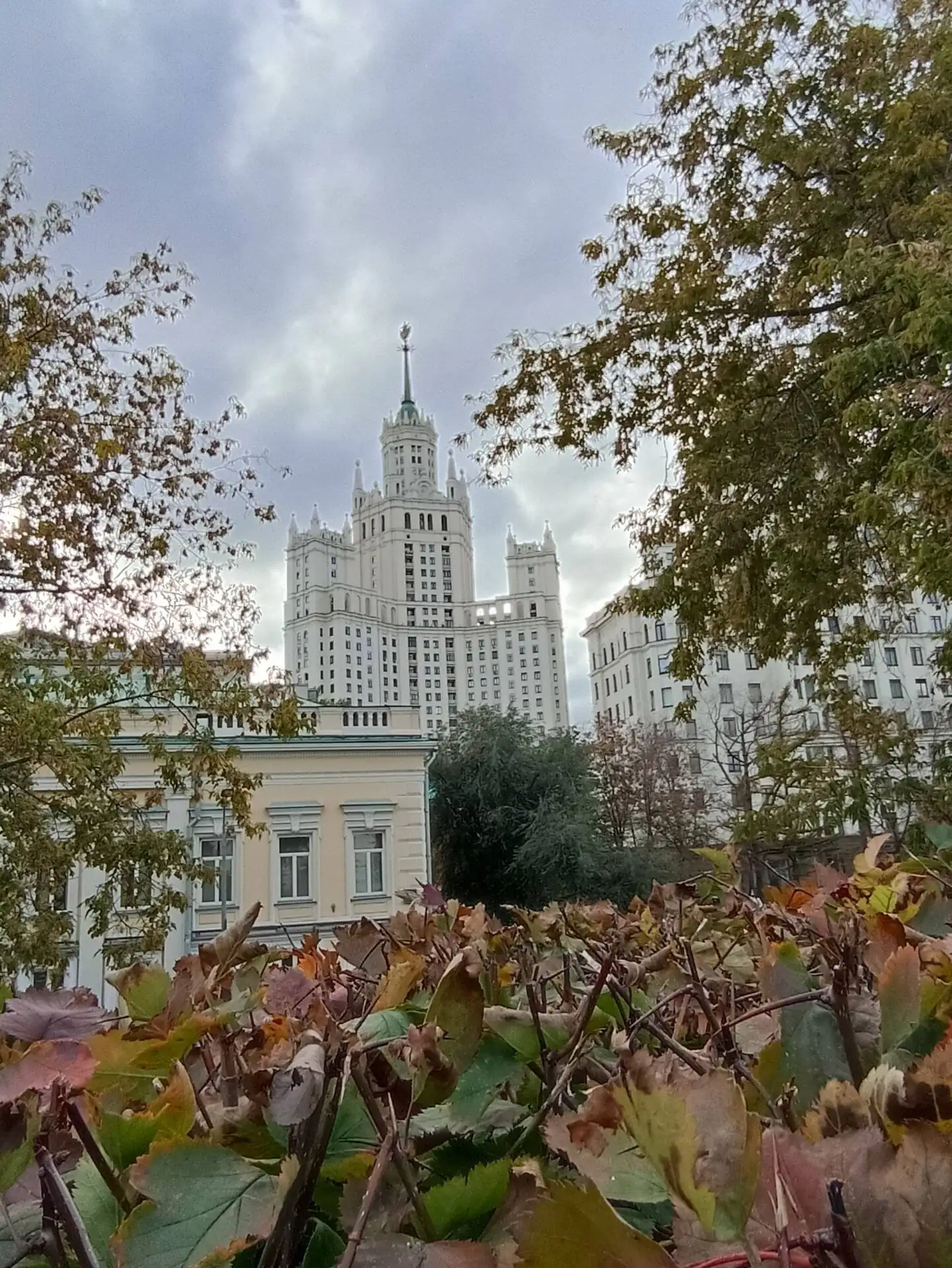
The high-rise building on Kotelnicheskaya Embankment, seen from behind the trees.
Similar caution is needed regarding the small auditorium. The 2019 report states that a room was converted into a small screening room in the early 2000s. As at 3 November 2026, the cinema’s official page lists the 217-seat Main Auditorium, the 21-seat Small Auditorium and two intimate screening rooms. The present visitor layout differs substantially from the original single-auditorium arrangement, but these two documents do not allow us to reconstruct the precise sequence in which each additional screening room appeared.
Why do later reopenings leave Illuzion’s founding date unchanged?
The reopenings after refurbishment in 2014 and 2018 belong to Illuzion’s later history: Gosfilmofond’s cinema began operating on 18 March 1966. The 2019 report records alterations in 2004 and a closure in June 2012, followed by reopening two years later. The cinema’s official announcement dates its next reopening, following cosmetic refurbishment, to 24 August 2018.
In 2018, the historic entrance arch was opened up, the sign was recreated to match the 1966 design, and the foyer’s finishes were renewed. These changes illustrate the distinction between evoking an era and preserving original fabric: the name sign reproduced the 1966 design, whereas the heritage report describes several interior features as surviving originals. For readers, this is more useful than the broad term ‘restoration’, which blurs the distinction between an old feature and its later replacement.
Which dates mark the different changes
The 2019 historical account links the 2004 alterations to new lighting and sound equipment and a change to the seating rake. It reports that the main auditorium’s capacity was reduced to 217 seats; the cinema’s current page gives the same figure of 217 for the Main Auditorium. This agreement confirms the auditorium’s present capacity, but does not resolve the discrepancy between the figures of 300 and 369 given in different heritage reports for the earlier period.
At the reopening on 24 August 2018, audiences watched ‘Lost Comedy’, a compilation of rediscovered short films screened from 35 mm prints with accompaniment by a jazz orchestra. The cinema described the screening as part of a new chapter in its work. The refurbishment changed the entrance and interior finishes, while films from the collection continued to form the basis of individual programmes.

Construction of the high-rise residential building on Kotelnicheskaya Embankment. Moscow, 1950. Wikimedia Commons, Kotelnicheskaya Skyscraper 2.jpg, author: Naum Granovsky, licence: CC BY 4.0 source, license
Illuzion’s history thus comprises three datable layers: the creation of a cinema auditorium within the post-war complex, Goskino’s 1965 decision to establish a dedicated venue, and the opening of the archival cinema on 18 March 1966. The name Znamya recalls the premises’ life before Gosfilmofond. The renaming marked a different cultural role: films from the collection gained a permanent public screen.
You can see Illuzion’s entrance and the high-rise itself on the ‘Taganka’ tour: both landmarks are listed in its route description. For a walk tailored to your own interests, the bureau offers individual excursions.
Sources
- State Historical and Cultural Expert Assessment Report on the Illuzion Cinema, 2019
- State Historical and Cultural Expert Assessment Report on the Kotelnicheskaya Embankment Building, 2022
- Gosfilmofond of Russia: Our Work and History
- Illuzion Cinema: About Us
- Illuzion Cinema: Official Reopening Following the 2018 Renovation
- “Kinovedcheskie Zapiski”: “From the History of Gosfilmofond (II). Gosfilmofond: From Birth to Maturity”, a publication of archival documents
- Nikolai Mayorov. Znamya Cinema — “First in Cinema”
- Gosfilmofond of Russia: Collection Storage
- Gosfilmofond of Russia: Technical Inspection of Film Materials
- Gosfilmofond: Programme for Illuzion Cinema’s 57th Anniversary
- Gosfilmofond: opening of the 28th Moscow International Archive Film Festival, 2026
- ‘Moskva Tsentr’, No. 11 (643), 25 March 2016: an interview with Vladimir Solovyov about the Illuzion cinema
- Vladimir Golubev. ‘Notes of a Film Enthusiast’, ‘Kinovedcheskie Zapiski’, No. 64
- Gosfilmofond of Russia: digitising the archive
- Gosfilmofond of Russia: film catalogue, announcement dated 23 October 2019
- Archive of Contemporary Russian History. N. S. Khrushchev’s ‘Special File’, 1954–1956: catalogue of documents
- 28th Moscow International Archive Film Festival: official website
- Mos-Radius: ‘Taganka’ tour
We took a tour of Taganka designed for 12-year-old children. It was an excellent programme. We covered a great deal of ground and learnt so much. We discovered the story of Dryanaya Street and discussed the Vladimir Highway, the surrounding monasteries and churches, and the Old Believers. We now know where Korovin was born, where Stanislavsky was born and raised, where the Morozov merchant children lived, and why Arseny Morozov was considered such an outrageous figure in his day. We also discussed Solzhenitsyn, discovered where Stalin Avenue was supposed to be built, saw the bunker, walked to the Russian metochion of the Mount Athos Monastery, and learnt why the Illuzion cinema made Taganka famous. Of course, no tour would have been complete without Vysotsky and Lyubimov. We also touched briefly on Taganka Prison, although naturally we did not go there. All in all, it was an exceptionally rich and informative tour! Our guide Alexander was superb!
Our thanks to our guide Alexander for a magnificent sightseeing tour. Alexander’s love for Moscow and its history, his wide-ranging knowledge, elegant and engaging delivery, and personal charm make the tour not merely interesting and informative, but truly delightful! Thank you, Alexander! Tatiana and Tatiana, St Petersburg
On July 18th, we participated in the "Soul of Moscow" group tour led by Alexander. Kitay-gorod and its surroundings revealed a new side to us, and everyone thoroughly enjoyed it. Some of us began intensively studying related materials to broaden our horizons. We'll be back, and we highly recommend it! You won't regret it.
Good afternoon, on June 23rd we had a tour called " The Soul of Moscow ," led by Alexander. He's a very pleasant young man. We visited such lovely courtyards and alleys with him that we never even knew existed, and we learned so much. We really enjoyed everything, and we hope to continue our acquaintance. Alexander! Thank you! We had a great time with you, and we thoroughly enjoyed it. See you there!
This isn't my first time with Radius. This time, I took the Moscow metro . The goal was not only to admire the underground palaces but also to learn how to navigate the metro. As a resident of a region without a metro, I was a bit apprehensive and didn't understand how to navigate the metro. Of course, the internet helps, but live communication is much better. Tour guide Yulia handled this task perfectly. The information was accessible and interesting, the presentation was calm, and the communication style was very friendly. Thank you very much for the tour and the practical experience.
Good afternoon! I gave the "Soul of Moscow" tour to some of the capital's guests. We were thrilled to hear our guide, Anton. It was so informative and engaging, and very warm. To say we were absolutely delighted is an understatement. It turned out to be a truly family-friendly excursion. We learned so many interesting facts. The material was presented professionally, all our questions were answered, and we saw so much. It was simply WOW! Thank you so much, Anton, he's the best!!!!! From now on, I'll only come to you, the Radius team. I highly recommend it. I promise we'll see each other again soon on other tours.
Overall, the tour left a positive impression! Thanks to Alexander for the walk through the courtyards and atmospheric spots of Kitay-Gorod; we certainly wouldn't have done it on our own. The tour was comfortable, and the guide spoke confidently and calmly. One thing we personally missed: we would have liked more of the historical part, relating to ancient Moscow and the history of Kitay-Gorod. There were quite a few stories about the Soviet period and the bar scene, but for our group, this wasn't particularly relevant. We think the program could be a little more tailored to the age and interests of the group. It would also have been interesting to add more historical facts, monuments, and details about old Moscow and the area itself. That said, the tour was still interesting, and some places and churches were truly memorable. These aren't really "cons," but rather suggestions for an even more comprehensive program.
Hello! We had a corporate group of 10 people. Our guide was Anton, and we had a tour of Bulgakov. I would like to point out the excellent organization; everything went smoothly. The managers were very accommodating to our changes in the number of participants. The bus was very comfortable. Anton is a super-engaged and motivated guide. He lives this history and is delighted to share his knowledge and create an unforgettable experience. Everything went well. I highly recommend it!
Thank you for a fascinating tour! It gave me so much food for thought to explore! Note: Review of the "Zamoskvorechye" tour with guide Maria.
I'd like to express my gratitude on behalf of our team! Thank you for keeping to our scheduled schedule despite our lack of organization. Our colleagues appreciated your preparation for the tour! It was informative. Note: Review of the "Modern Residential Complexes, Factory Past, and Avant-Garde" tour of the ZILART residential complex with guide Maria. Maria prepared and conducted a customized tour for employees of the Samolet Group of Companies development company.
Thank you! You have great talent. Good luck! ☺️ You're a wonderful guide! Thank you again! Note: This is a review of the corporate tour "The Heart of the Capital" with guide Maria.
Thank you for a wonderful day today!!)) Note: review of the excursion "The Soul of Moscow" with guide Maria
On behalf of the whole family, I want to thank you for a very informative and interesting tour! Note: This is a review of the "Palace Dungeons" tour with guide Maria.
Good afternoon! I'd like to express my gratitude and that of my guide for organizing the tour! We were very pleased. We'd like to do it again in October, but on a different route — ZIL. Note: This refers to the tour for Samolet Group developers, led by guide Maria.
Thanks to Alexander for the bar tour of Baumanka ! It was fun, exciting, and we discovered so many new places! Awesome! May we reach new heights!
Good afternoon! I was on a tour of Sukharevskaya Square — we went all the way to Tsvetnoy Boulevard. I didn't expect it to be so interesting! For those wondering whether to go — go for it! It truly became one of my most memorable summer memories!
Anastasia, good morning! Thank you and Masha for yesterday! The speakers are happy. The connection through the headphones was often lost, especially at the checkpoint, but that's just our current situation. You could hear if you were standing close, no more than 1.5 meters away. Colleagues have already asked for your contact information. I'd be happy to share it and look forward to another opportunity to work with you. Special thanks to the Director for the Bureau . Note: " Heart of the Capital " tour for participants of the 2025 Moscow Oncology Forum. Guides: Anastasia and Maria.
We'd like to thank Anton and Alexander for leading the tour! It was fascinating to hear how the Krasnaya Presnya district developed and how Prokhorov's influence on our city's development. It was a pleasant immersion into a quiet, previously unexplored area!
Good afternoon, thank you so much, Anastasia. The " Uncle Gilyai " tour was fantastic. Even though we're Muscovites and know a lot about Moscow, the experience was amazing, so much new and interesting happened. We'll definitely be back.
Thank you for the " Heart of Moscow " and " Khamovniki " tours. Anton, a knowledgeable and passionate Moscow guide, gave me the tour. He's a great storyteller, intelligent, well-read, and captivating. You've truly opened up my Moscow to me! I'll definitely be back next summer to explore Moscow with you. I'll recommend your wonderful tour program to all my friends!
Excursions with the Radius travel agency are always a positive experience if you choose them. We planned a tour of Zamoskvorechye on our next visit. We've worked with our guide, Anton, before. We'll definitely recommend him to everyone we know. The tour is informative, not overloaded with dates, and the information is comprehensive yet easy to understand, as it's presented in a light, narrative manner, not like a history textbook, dry and academic. Thank you for this approach. We'll definitely use the Radius agency again on our next visit to Moscow.
Thank you so much for the tour of Zamoskvorechye . Despite the weather, it was very interesting and informative! Note: this refers to the tour with guide Anton.
A huge thank you to Anastasia. We had a fantastic tour of the Patriki district. We learned so much. Anastasia is a true master of her craft. The tour was captivating, not at all boring, lively and interesting. Everyone was delighted. We were full of new impressions. I definitely recommend it. You won't be disappointed!
We explored the Soul of Moscow with my family and Radius on my birthday. Everyone thoroughly enjoyed the walk! Anton shared so many interesting facts about the capital and its history, taking us into spiritual depths no one else had even suspected. Most of us were either born or longtime Moscow residents who spent a lot of time walking around. It was educational, heartwarming, and unforgettable. 🙂 Overall, this wasn't my first time walking around Moscow with Anton, and each time was a real adventure!