Lobnoye Mesto on Red Square was not a permanent stone scaffold. From its raised platform, decrees and sentences were read aloud, speeches were made to the townspeople, and religious rites were performed. Executions did take place nearby, but separate wooden structures were usually erected for them. So the question ‘Were people executed at Lobnoye Mesto?’ cannot be answered without first clarifying whether it refers to the surviving platform or the surrounding area. This distinction is explicitly drawn in the historical and cultural assessment report on Red Square and a pre-revolutionary account by the priest Ioann Kuznetsov.
Older writers used the phrases ‘near Lobnoye Mesto’, ‘on Lobnaya Square’ and simply ‘at Lobnoye Mesto’ with varying degrees of precision. An account of an event near the platform establishes its proximity, but does not prove that the executioner stood on the stone surface. Accounts of individual incidents conflict; without a precise record of where the scaffold stood, no possible exception can be ruled out with confidence. Ivan Snegiryov, in ‘Monuments of Moscow Antiquity’, challenged the idea that the platform was a place of execution as early as the 19th century.
What exactly is Lobnoye Mesto?
Lobnoye Mesto is a permanent raised platform beside the Cathedral of the Intercession, opposite the Kremlin's Spassky Gate. This is the platform enclosed by a stone parapet that visitors see on the square. A description of the monument in a publication by the State Historical Museum associates it above all with the tsar's addresses to the people and the public announcement of decisions. The question of executions concerns the wider area around the platform.
The layout of the square makes this distinction easier to understand. The permanent platform has clear boundaries: its steps, upper surface and parapet. A temporary scaffold could be erected nearby and dismantled afterwards. When a later account places an execution ‘at Lobnoye Mesto’, it may be using the landmark to locate the event, rather than describing the structure beneath the participants’ feet. A modern photograph cannot resolve that ambiguity: it shows the monument as it stands today, but not where the temporary structures once stood.
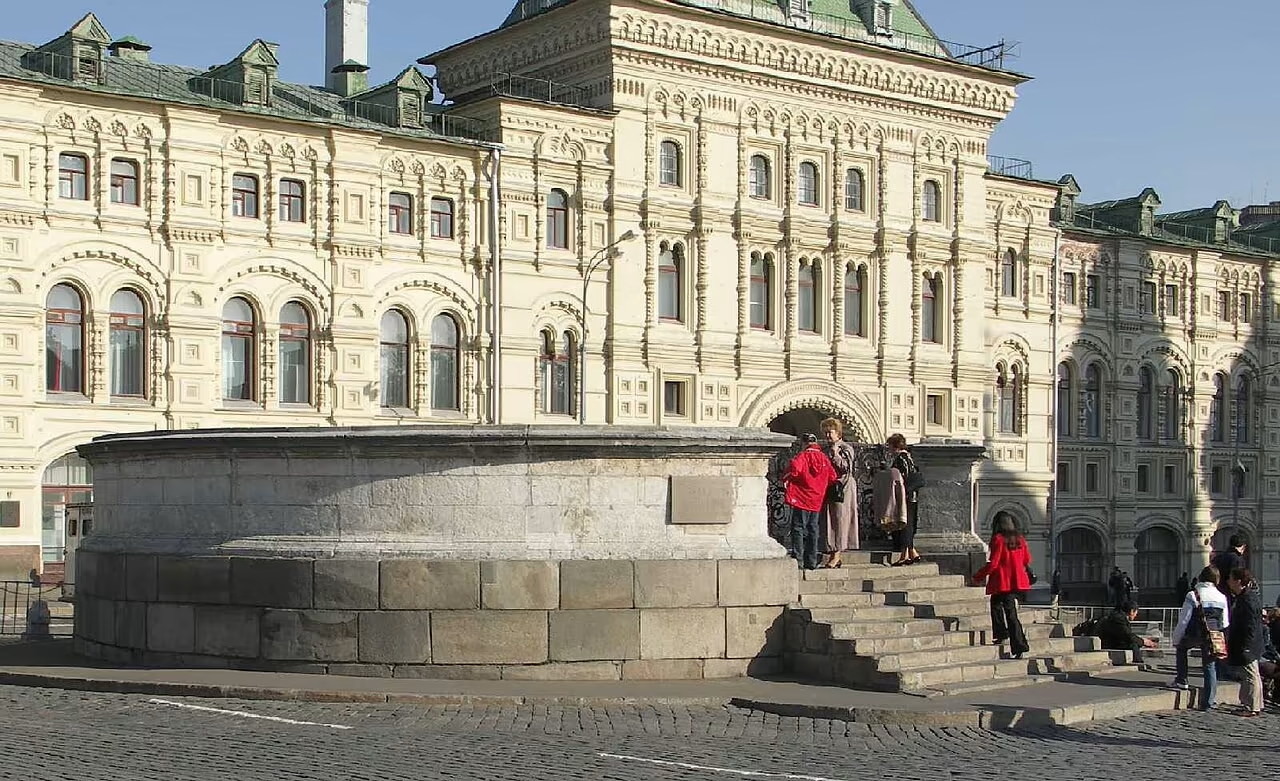
Lobnoye Mesto on Red Square in 2005: the stone parapet and steps leading to the upper platform. Wikimedia Commons, Lobnoe place Moscow.jpg, author: Kopchiowski O.P., licence: CC BY 2.5 source, license
Snegiryov cites a description of an old map of Moscow that identifies Lobnoye Mesto as a brick platform for the patriarch’s prayers and the proclamation of decrees. He also recounts observations by 17th-century foreign visitors: the traveller Adam Olearius associated it with the announcement of decisions, while Polish envoys reported a public appearance by the tsar and his heir. These accounts do not catalogue every event in the square, but they show clearly the role contemporaries associated with the platform itself. Snegiryov’s text is valuable precisely because it brings together earlier descriptions and identifies their sources.
A comparison also helps clarify the site's layout by showing what cannot be inferred: neither the steps leading up to the platform nor the low parapet, on their own, indicate permanent facilities for executions. Kuznetsov describes the upper platform and a separate circular ambo with three steps. The ambo was used for speeches and ceremonies; accounts of the square describe scaffolds for punishment as being erected separately. These different structures could stand near one another at the same time and be referred to by the same geographical name.
When does Lobnoye Mesto first appear in the historical record?
In historian Sergei Shokaryov's overview, the first mention of Moscow's Lobnoye Mesto dates to 1585. The earlier date of 1549 is often associated with a speech by Ivan IV; it is cited in materials from the Historical Museum and in And a historical and cultural heritage assessment report. The account of the tsar's speech survives in a later addition to the manuscript. It cannot be used to date the construction of the platform without qualification.
Historian V. P. Kozlov gives a detailed account of S. F. Platonov and P. G. Vasenko’s work on the Khrushchev copy of the Book of Degrees. The pages containing the speech are on different paper and in a different hand from the main manuscript; they were inserted in place of pages that had been removed. Kozlov’s research makes it possible to separate two questions: whether a council could have taken place in the mid-16th century, and whether the account of a speech specifically at Lobnoye Mesto is authentic. The possibility of the former does not establish the latter.
The later insertion describes a speech but does not date the platform’s construction. It does not rule out the platform’s existence in the mid-16th century; its age must be established from other evidence.
The Piskaryov Chronicle records masonry work at Lobnoye Mesto in the late 16th century. B. A. Uspensky dates the entry to 1598–1599, while Shokaryov gives 1598. Uspensky allows for the possibility that a wooden structure stood there earlier; Ioann Kuznetsov wrote of brick being replaced with white stone and a railing being added. The chronicle records masonry work; the material and date of the first platform remain matters of historical reconstruction.

Lobnoye Mesto on Red Square in 1884: the railing and steps in front of the shopping arcades. Wikimedia Commons, N.A.Naidenov (1884). Views of Moscow. 44. Lobnoe.png, author: Nikolay Naidenov (1834-1905)., licence: Public domain source
An expert assessment tentatively dates the original brick structure to the 1530s. Kuznetsov presents an even earlier date, 1521, as a tradition concerning a nun’s vision during an invasion, rather than as a record left by the builders. These accounts carry three different degrees of certainty: a retelling of why the structure appeared, a reconstruction proposed by researchers, and a report of stonework around the turn of the 17th century. Reducing them to a single ‘foundation date’ would obscure the distinction between tradition, hypothesis and historical evidence.
The present-day white-stone appearance dates from the 1786 reconstruction designed by Matvey Kazakov. According to the expert assessment and the publication ‘Moscow Heritage’, the cladding and parapet were added at that time. Kuznetsov writes that it was rebuilt to the original plan. Its overall form may have survived, but the white-stone details cannot be presented as witnesses to events of the 16th and 17th centuries.
The State Historical Museum’s collection page features an 1845 lithograph by Kornely Tromonin entitled ‘The Cathedral of the Intercession and Lobnoye Mesto in Moscow during the reign of Tsar Mikhail Fyodorovich’. The title refers to the 17th century, but the print was made in 1845. The work is valuable as a record of how the capital was depicted and how the artist imagined it; it cannot be presented as a sketch made by an eyewitness to 17th-century events. When considering accounts of executions, the date the print was made matters as much as the period named in its title.
What was Lobnoye Mesto used for?
Lobnoye Mesto served as a prominent public platform for proclamations and formed part of the city’s ceremonial space. State decrees were read aloud from it; prayer services were held here, and those gathered received blessings. This is how it is described by the State Historical Museum and in the historical accounts of Snegiryov and Kuznetsov. Public visibility was essential both to official announcements and to religious rites: people in the square needed to see where the words were spoken and the rites performed.
During the Palm Sunday religious procession, Lobnoye Mesto was a stopping point on the route between the Kremlin and the Cathedral of the Intercession. Snegiryov describes in detail how the patriarch ascended the platform, read from the Gospel and blessed the tsar before the procession continued. These details explain why the platform’s position near the Spassky Gate and the cathedral mattered to the ceremony. Snegiryov’s account here connects the monument, the square and the sequence of the procession.

Lobnoye Mesto, St Basil’s Cathedral and the Kremlin wall in a recent photograph of Red Square. Wikimedia Commons, Moscow — 2025 — Lobnoye Mesto and St. Basil's Cathedral1.jpg, author: Yuri D.K., licence: CC BY 4.0 source, license
In 1682, after a debate in the Kremlin, participants in a dispute over the old church rites, led by Nikita Dobrynin, nicknamed Pustosvyat, addressed the public from Lobnoye Mesto. This episode is described by Snegiryov And Kuznetsov. Ascending the platform allowed them to make their position known to the public, although the debate took place in the Kremlin. Dobrynin’s later fate became one of the arguments in the debate over executions, but his appearance on the platform and the precise location of his subsequent execution are separate questions.
The New Chronicle records that in 1605, False Dmitry’s envoys Gavrila Pushkin and Naum Pleshcheyev came from the village of Krasnoye near Moscow and read the pretender’s proclamations at Lobnoye Mesto. The boyars were brought there as well. The address was followed by the arrest of the Godunov family and a message sent to False Dmitry. The chronicler clearly condemns the envoys and calls the proclamations “deceptive”; his judgement of those involved does not diminish his specific account of where they were read. This episode shows the platform’s role in public announcements, but says nothing about where execution blocks stood in other years.
The same chronicle account records that after False Dmitry’s death in 1606, the boyars brought Vasily Shuisky up onto Lobnoye Mesto and proclaimed him tsar, then accompanied him to the Kremlin. The sequence is clear: first the public proclamation, then the ceremony in the cathedral. Kuznetsov, writing later, also mentions the proclamation of Mikhail Fyodorovich, but reconstructing that episode with the same precision requires a separate check of an early source. The evidence for one episode cannot simply be applied to another.
Snegiryov cites another kind of evidence: Polish envoys reported that the sovereign and his heir appeared before the townspeople, while Adam Olearius described the raised platform as a place for proclamations. A foreign observer might have mistaken details of the ceremony, and a later retelling might have abridged the original account. It is therefore useful to distinguish the platform’s observable function from claims about each individual episode. The agreement between the site plan and independent accounts makes the purpose of the permanent platform more convincing than a single colourful legend about its origins. Snegiryov brought these accounts together in a single section.

The Spasskaya Tower and Kremlin wall as seen from Red Square. The photograph was taken in 1883 and published in 1884. Wikimedia Commons, The Spasskaya Tower, photographed in 1883, published 1884 (Saviour Tower — Spasskaya Tower), Moscow Kremlin, Red Square.jpg, author: N.A. Naidenov. // Nikolay Naidenov (1834-1905), licence: Public domain source
Where did the executions described by historians take place?
Separate wooden platforms were erected near Lobnoye Mesto for public executions. This is how it is described in the historical and cultural expert assessment. In his description of the Cathedral of the Intercession, Ioann Kuznetsov draws an even clearer distinction: sentences were announced from Lobnoye Mesto and carried out nearby on Red Square. His text was published at the turn of the 19th and 20th centuries and reflects a scholar’s view of the monument, rather than a record of every individual execution.
Snegiryov describes execution blocks and instruments of punishment beside the stone platform; in his account, the permanent structure serves as a landmark. He places gallows and posts around it. A wooden scaffold allowed sentences to be carried out in full view of the crowd. The permanent platform served other purposes, as shown by the site plan, travellers’ accounts and descriptions of ceremonies. This distinction explains why a reference to an execution ‘near Lobnoye Mesto’ cannot simply be taken to mean that it occurred on the monument’s upper platform. Snegiryov also challenges the popular belief that the platform was routinely used to execute the condemned.
One episode prevents us from entirely separating the permanent platform from death sentences. Historian R. G. Skrynnikov, in his book “Russia on the Eve of the Time of Troubles” describes the case of the treasurer Pyotr Ivanovich Golovin in the mid-1580s. An inventory of the tsar’s archives that he cites records the boyars’ sentence of death on Golovin for allegedly stealing from the treasury. According to Skrynnikov, Golovin was taken to Lobnoye Mesto and prepared for execution, but a pardon was then announced. Golovin was sent into exile; the death sentence was never carried out.
The limits of this episode are precisely what make it important. The archival record confirms the sentence, while the account of Golovin being brought to Lobnoye Mesto and pardoned comes from the historian’s reconstruction. His wording provides no plan of the square and does not establish whether Golovin stood on the stone platform or on a temporary structure nearby. Even so, it shows that the public announcement of a sentence and the threat of execution could form a single spectacle. To claim that ‘sentences were read out, but the condemned never approached Lobnoye Mesto’ would be just as hasty as picturing it as a permanent scaffold.

Lobnoye Mesto and the surrounding square during a religious procession on 5 September 1914. Wikimedia Commons, Moscow. Red Sq. Lobnoye Mesto. Religious procession 5 September 1914 lobnoe-mesto.jpg, author: Unknown authorUnknown author, licence: Public domain source
Each type of evidence has its own limits. Design or heritage conservation records describe the permanent monument and its known alterations. A chronicle records an event but rarely maps out the square. An eyewitness account may say where the scaffold was placed, but the word ‘site’ does not always mean the upper platform. Strong evidence for an execution on the stone platform itself would therefore need to identify that platform specifically, or describe the ascent to it and the placement of execution equipment within its railing. The assessment report sets out the general practice—temporary platforms beside the permanent structure—but cannot stand in for an account of each individual occasion.
Why does the debate over Stepan Razin’s execution help clarify the layout of the square?
Sources place Stepan Razin’s execution on Red Square, while parts of his body were later displayed beyond the Moskva River. In a 1961 article, M. Ya. Popov compared early accounts with a 1674 official report on the fate of Ivan Vorobyov. He was executed in the same place; three days later, his remains were taken to Boloto and displayed beside Razin’s. Vorobyov’s case shows how the place of execution can be confused with the place where the body was subsequently displayed. None of these accounts places the execution block on the stone platform of Lobnoye Mesto.
In letters by the Moscow court official Akinfy Goryainov, cited by Popov, pits and sharpened stakes were prepared on Red Square before the execution. This detail is more precise than the later phrase ‘executed near Lobnoye Mesto’: it describes the preparations made for the execution. Even so, the letters do not show whether the scaffold stood to the north or south of the monument; naming a landmark alone is not enough to pinpoint its location.
A later study by Gleb Kazakov and Ingrid Maier compares Russian and foreign accounts from 1671. A letter by the merchant Thomas Hebdon mentions an execution block in the square before the Kremlin; an anonymous writer says that Razin turned towards Kazan Cathedral before he died. Both landmarks narrow the search, but neither pinpoints a spot within the stone enclosure of Lobnoye Mesto. The authors also caution that early European accounts often describe the prisoner’s arrival in Moscow together with his execution, which took place four days later. Mistaking his entry into the city for part of the execution can lead to misreading both an illustration and an eyewitness account.
Researchers also consider how close each writer was to the event. Hebdon wrote his letter soon after the execution; Gleb Kazakov and Ingrid Maier consider it highly likely that the merchant witnessed it himself. Yakov Reitenfels and Johann Merz were in Moscow in 1671, but their books appeared later. Their texts no longer allow us to say with confidence which details they saw and which they took from others’ accounts. Even several similar later descriptions, therefore, cannot replace independent evidence of the execution block’s precise location. Analysis of the sources distinguishes between proximity in time to the event and the precision of a geographical reference.
The display of Razin’s remains on Bolotnaya Square is also confirmed by an inspection of the area years later. According to research by Kazakov and Mayer, the Dutch ambassador Coenraad van Klenck and his secretary saw parts of Razin’s body displayed there as late as 1676. Five years had passed since the execution in 1671. This account concerns the prolonged public display of his remains across the river, not the place where the sentence was carried out. The researchers’ article makes it possible to link the two locations to different stages of the same case.

A recent aerial photograph of Bolotnaya Square in Moscow. Wikimedia Commons, Moscow, Bolotnaya Square from above.jpg, author: Krasny, licence: CC BY-SA 4.0 source, license
Another event is depicted in a surviving print. A London engraving from 1672, issued with a pamphlet about Razin, shows his arrival in Moscow: Stepan was carried on a cart fitted with a crossbar, while Frol walked behind, chained to the vehicle. Kazakov and Mayer associate the image with the prisoners’ arrival, four days before the execution. Even if the engraving accurately depicts the cart, it cannot establish where the execution block stood on Red Square. The authors describe surviving copies of the pamphlet and separately caution that European retellings confuse Razin’s arrival with his execution.
Why did the executions of the Streltsy become so closely associated with Lobnoye Mesto?
The monument became a familiar landmark, and its name came to be applied to events nearby. Writing about executions in the late seventeenth century, Snegiryov mentions gallows and posts around Lobnoye Mesto, and execution blocks on the square itself. Pylyayev later refers to the heads of executed Streltsy displayed near the monument. Both accounts describe the space around the raised platform; neither establishes that all the instruments of execution stood on its stone surface. Snegiryov’s account helps reveal this distinction without relying on assumptions drawn from the square’s present-day appearance.
Pylyayev writes of decrees issued in 1727, after which the posts and gallows near Lobnoye Mesto were removed. These structures had therefore remained nearby for decades after the executions of the Streltsy. Their position beside the stone platform helps explain why later accounts used one name for the two adjoining areas. Yet ‘around’, ‘near’ and ‘on the square’ do not mean ‘on the upper platform’.

Vasily Surikov, ‘The Morning of the Streltsy Execution’ (1881). The painting offers an artistic interpretation of the events, rather than an exact plan of the execution site. Openverse, wikimedia, Galerie Tretiakov — Vasily Surikov — The Morning of the Streltsy Execution (1881), author: Gzen92, licence: by-sa 4.0 source, license
Could the execution of Nikita Pustosvyat have been an exception?
None of the brief sources examined establishes whether Nikita Dobrynin was executed on the stone platform itself. Older accounts explicitly state that he spoke from Lobnoye Mesto in July 1682. A historical account of the events of 1682 places the subsequent execution on Red Square, while an old encyclopaedic dictionary names Lobnoye Mesto. Neither wording specifies whether the scaffold stood inside the stone parapet.
The distinction is particularly clear because the first event, Dobrynin’s speech, really did take place on the platform itself. It is easy to assume that the next event happened at the same spot. But ‘spoke on the platform, then was executed on the square’ does not establish that he was ‘executed on the platform’. A precise answer would require a description of where the execution block was set up, a plan, or an eyewitness account distinguishing the platform from the surrounding area. Until such evidence appears in the sources examined, the exact location of the execution remains uncertain.
How could a ‘punishment’ take place without a death sentence?
The story of Darya Saltykova reveals another linguistic trap. G. I. Studenkin calls her public display on a scaffold an ‘execution’; Mikhail Pylyayev describes it alongside accounts of executions near Lobnoye Mesto. Her ultimate sentence was life imprisonment; the event was a public punishment and humiliation, not a killing. Pylyayev recounts the ceremony in the square, while the historical encyclopaedia records the final sentence of 1768. The same term conceals different outcomes.
Pylyaev himself sometimes writes ‘at Lobnoye Mesto’ without distinguishing between the stone platform and the scaffold erected for the occasion. His vivid account helps explain how perceptions of the square took shape, but it is not a precise record of the site. We cannot treat ‘Saltykova was publicly punished’ and ‘she was put to death on the ancient stone platform’ as if they were the same claim. When reading a historical text, it helps to ask each time what the author meant by ‘execution’ and which structure he meant by ‘the place’.
One detailed account of Saltykova’s case preserves the sequence of events. In an essay by G. I. Studenkin, we read that on 17 October 1768 a tall scaffold was erected in the middle of Red Square with chains. The next day, Darya Saltykova was brought there, tied to a post for about an hour, then taken to the Ivanovsky Monastery. The author calls this an ‘execution’, but his own account shows that it was a public humiliation before life imprisonment. The date, the purpose-built structure and the convicted woman’s subsequent journey help clarify what the word meant.
Studenkin reproduces a passage that he presents as an eyewitness account; the provenance of this passage should be considered separately from the signed essay. Of particular importance to our question is that the author explicitly writes of the construction of a scaffold in the square the day before. A permanent stone platform could not be ‘built’ in a single day for one punishment. At the same time, ‘in the middle of Red Square’ gives no precise location and does not, in itself, tell us how far the scaffold stood from Lobnoye Mesto. The source clarifies the type of structure and the course of events, but leaves its exact position uncertain.
What happened at Lobnoye Mesto after the era of public executions?
In the 19th century, Lobnoye Mesto continued to serve as a setting for public ceremonies. According to Ivan Snegiryov's account, in 1812 Bishop Augustine blessed water on the platform after residents returned to a devastated Moscow, and in 1830 Metropolitan Filaret addressed the people here during a cholera outbreak.
The National Library of Russia holds an 1845 panoramic plan depicting an annual religious procession established in 1813 to commemorate the expulsion of the French from the city. It took place on 11 (23) October. After a service in the Dormition Cathedral, the clergy passed through the Spassky Gate to the Iveron Chapel, then went to Lobnoye Mesto for a memorial litany for the dead before returning to the cathedral. The artist depicted the procession and placed a description of the order of service at the bottom of the sheet. The plan was made three decades after the procession was established; it records a 19th-century route, not 16th-century ceremonies.

The Iveron Chapel in front of the Resurrection Gate in the early 20th century. Wikimedia Commons, Resurrection Gate in Moscow (1900s).jpg, author: Karl Fischer, licence: Public domain source
Does the monument's name prove that people were beheaded there?
No. The origin of the name is debated, but the word itself is not evidence of how the platform was used. The assessment report offers a geographical explanation: the local name for a rise and the slope down to the river. Older accounts also draw a parallel with the biblical Place of the Skull, or Calvary: Golgotha. Kuznetsov lists these possibilities without producing a building inscription that would settle why the name was chosen.
The theory that the name came from the heads of those executed is particularly weak when linked to the executions of the Streltsy under Peter I: the name appears in texts predating Peter's reign, and a chronicler recorded stonework there as early as the late 16th century. Pylyaev nevertheless recounts a similar explanation as part of later local tradition. The fact that the theory became widespread is historically significant, but it cannot establish the name's early origins. Pylyayev also lists several possibilities and shows how readily folk etymology became entwined with memories of executions.
Historian Sergei Shokaryov favours the biblical explanation over the geographical explanation based on a hillside, and cites the pilgrim Vasily Pozdnyakov, who called Golgotha Lobnoye Mesto in the 16th century. This account shows that the phrase existed in Russian religious language; it does not itself document the naming of the city's platform. Shokaryov also recounts a hypothesis proposed by researchers A. L. Batalov and L. A. Belyaev: Moscow's Lobnoye Mesto may have arisen in connection with the Palm Sunday procession in which a donkey was led, with the nearby Cathedral of the Intercession representing Jerusalem. The connection with the ceremony gives this theory substance, but it cannot take the place of a document recording the builders' decision.
The connection with Golgotha also calls for precision. It explains the religious imagery and ceremonial significance of the platform beside the Cathedral of the Intercession, but it does not make the Moscow site a literal copy of the Jerusalem hill in every respect. For the history of the square, the established facts are enough: the name was in use before Peter I's reign, and ceremonies and proclamations from the permanent platform are well documented. Settling the debate over the name's origin is unnecessary to answer where executions took place.

Lobnoye Mesto on Red Square: a contemporary view of the stone enclosure, photographed in 2025. Wikimedia Commons, Moscow — 2025 — Lobnoye mesto.jpg, author: Yuri D.K., licence: CC BY 4.0 source, license
Why did 19th-century historians disagree with one another?
Nineteenth-century historians disagreed over what Lobnoye Mesto meant in accounts of executions: the stone platform itself or the adjoining part of Red Square. In Monuments of Moscow's Antiquity Ivan Snegiryov challenged an academic dictionary that placed the carrying out of death sentences on the permanent platform. He cited an old plan designating the raised structure for prayers and decrees, as well as accounts by foreigners of ceremonies held there. These sources show the platform's usual function, but their silence on executions does not rule out every individual case.
Pylyaev's Old Moscow reveals a tension between two ways of telling the story. In one passage, he speaks of executions ‘here’ while describing Lobnoye Mesto; elsewhere, he explicitly warns that authors confuse the stone platform, the area known as Lobnaya Square and the marketplace. This is no reason to quietly choose the more convenient passage. Rather, the book shows how even a careful chronicler of old Moscow could shift from the name of a single monument to that of an entire area. The full text allows these two passages to be compared instead of quoting one out of context.
Ioann Kuznetsov, who wrote about the neighbouring Cathedral of the Intercession, distinguished between a sentence being proclaimed from Lobnoye Mesto and its execution nearby on Red Square. His account reconciles the permanent platform's ceremonial role with reports of public executions. Even so, this general account cannot establish the position of every temporary scaffold.
How should we understand this spot on Red Square?
On the square, it helps to distinguish the surviving circular platform from the open space around it. The platform was intended for public acts that people could see: speeches, proclamations, prayers and blessings. At different times, the surrounding space could accommodate temporary structures, trading, ceremonies and crowds of onlookers. The question ‘were people executed here?’ then becomes more precise: ‘which parts of an event took place on the permanent platform, and which took place in the square?’ A description of the monument and its surroundings confirms the need for this distinction.
The setting matters too. Lobnoye Mesto stands beside the Cathedral of the Intercession, on the southern side of Red Square, opposite the Spassky Gate. Its position connected it with religious processions leaving the Kremlin and made it a convenient platform from which to address the crowds. After its reconstruction in 1786, its form remained recognisable, but its decorative details date from a later period than the traditional account of Ivan IV’s address and the records of the Streltsy executions. A close look at the monument helps keep these different centuries in view without collapsing them into a single scene.

Lobnoye Mesto with the Cathedral of the Intercession in the background. A present-day view of Red Square. Wikimedia Commons, Lobnoye Mesto with St Basil’s Cathedral in the background.jpg, author: Yury D.K., licence: CC BY 4.0 source, license
So, executions near Lobnoye Mesto are a historical fact, while the image of a permanent stone scaffold is an oversimplification. Sources place executions on temporary structures nearby. The account of Pyotr Golovin’s pardon reminds us that the connection between the platform and a death sentence went beyond the general setting of the square; the precise location in this episode remains unclear. It also needs to be checked in other prominent cases. This limit to what we know is more revealing than a categorical ‘yes’ or ‘no’: it shows how the name of one monument came to stand for an entire part of the city’s history.
You can see how the platform, the Cathedral of the Intercession and the square relate to one another on the route ‘Heart of the Capital’: it follows Varvarka Street and Vasilyevsky Descent to Red Square. If you would prefer to discuss the monument at your own pace, the bureau offers individual excursions; please arrange a particular focus on Lobnoye Mesto when choosing your walk.
Sources
- State Historical and Cultural Expert Assessment of Red Square, section on Lobnoye Mesto
- State Historical Museum. What to See on Red Square
- I. M. Snegiryov. Monuments of Moscow’s Past. Lobnoye Mesto
- Ioann Kuznetsov. The Cathedral of the Intercession in Moscow. Lobnoye Mesto
- M. I. Pylyaev. Old Moscow
- The Moscow Uprising of 1682. Orthodox Encyclopaedia
- Nikita Pustosvyat. Complete Orthodox Theological and Encyclopaedic Dictionary
- Saltychikha. History.RF
- ‘Heart of the Capital’ Tour. Radius
- Private Tours. Radius
- V. P. Kozlov. Secrets of Forgery: An Analysis of Forged Historical Sources from the 18th and 19th Centuries, section on the Khrushchev Book of Degrees
- Moscow Heritage. The Redesign of Red Square and Matvey Kazakov’s Work in 1786
- State Historical Museum. K. Ya. Tromonin’s lithograph ‘The Cathedral of the Intercession and Lobnoye Mesto’ (1845)
- Russian National Library. Panoramic plan of the Kremlin and Red Square showing a religious procession, 1845
- M. Ya. Popov. On the Site of S. T. Razin’s Execution and Burial // Voprosy Istorii. 1961. No. 8
- G. I. Studenkin. Saltychikha: a depiction of the public punishment in 1768
- B. A. Uspensky. Selected Works. Vol. 1: Semiotics of History, Semiotics of Culture, p. 122, note 44
- S. Yu. Shokaryov. Everyday Life in Medieval Moscow, section on Lobnoye Mesto
- R. G. Skrynnikov. Russia on the Eve of the Time of Troubles, the case of P. I. Golovin
- The New Chronicler. Part 2, chapters 104 and 121
- G. M. Kazakov, I. Mayer. Foreign Accounts of the Execution of Stepan Razin. Slověne, 2017, no. 2
We took a tour of Taganka designed for 12-year-old children. It was an excellent programme. We covered a great deal of ground and learnt so much. We discovered the story of Dryanaya Street and discussed the Vladimir Highway, the surrounding monasteries and churches, and the Old Believers. We now know where Korovin was born, where Stanislavsky was born and raised, where the Morozov merchant children lived, and why Arseny Morozov was considered such an outrageous figure in his day. We also discussed Solzhenitsyn, discovered where Stalin Avenue was supposed to be built, saw the bunker, walked to the Russian metochion of the Mount Athos Monastery, and learnt why the Illuzion cinema made Taganka famous. Of course, no tour would have been complete without Vysotsky and Lyubimov. We also touched briefly on Taganka Prison, although naturally we did not go there. All in all, it was an exceptionally rich and informative tour! Our guide Alexander was superb!
Our thanks to our guide Alexander for a magnificent sightseeing tour. Alexander’s love for Moscow and its history, his wide-ranging knowledge, elegant and engaging delivery, and personal charm make the tour not merely interesting and informative, but truly delightful! Thank you, Alexander! Tatiana and Tatiana, St Petersburg
On July 18th, we participated in the "Soul of Moscow" group tour led by Alexander. Kitay-gorod and its surroundings revealed a new side to us, and everyone thoroughly enjoyed it. Some of us began intensively studying related materials to broaden our horizons. We'll be back, and we highly recommend it! You won't regret it.
Good afternoon, on June 23rd we had a tour called " The Soul of Moscow ," led by Alexander. He's a very pleasant young man. We visited such lovely courtyards and alleys with him that we never even knew existed, and we learned so much. We really enjoyed everything, and we hope to continue our acquaintance. Alexander! Thank you! We had a great time with you, and we thoroughly enjoyed it. See you there!
This isn't my first time with Radius. This time, I took the Moscow metro . The goal was not only to admire the underground palaces but also to learn how to navigate the metro. As a resident of a region without a metro, I was a bit apprehensive and didn't understand how to navigate the metro. Of course, the internet helps, but live communication is much better. Tour guide Yulia handled this task perfectly. The information was accessible and interesting, the presentation was calm, and the communication style was very friendly. Thank you very much for the tour and the practical experience.
Good afternoon! I gave the "Soul of Moscow" tour to some of the capital's guests. We were thrilled to hear our guide, Anton. It was so informative and engaging, and very warm. To say we were absolutely delighted is an understatement. It turned out to be a truly family-friendly excursion. We learned so many interesting facts. The material was presented professionally, all our questions were answered, and we saw so much. It was simply WOW! Thank you so much, Anton, he's the best!!!!! From now on, I'll only come to you, the Radius team. I highly recommend it. I promise we'll see each other again soon on other tours.
Overall, the tour left a positive impression! Thanks to Alexander for the walk through the courtyards and atmospheric spots of Kitay-Gorod; we certainly wouldn't have done it on our own. The tour was comfortable, and the guide spoke confidently and calmly. One thing we personally missed: we would have liked more of the historical part, relating to ancient Moscow and the history of Kitay-Gorod. There were quite a few stories about the Soviet period and the bar scene, but for our group, this wasn't particularly relevant. We think the program could be a little more tailored to the age and interests of the group. It would also have been interesting to add more historical facts, monuments, and details about old Moscow and the area itself. That said, the tour was still interesting, and some places and churches were truly memorable. These aren't really "cons," but rather suggestions for an even more comprehensive program.
Hello! We had a corporate group of 10 people. Our guide was Anton, and we had a tour of Bulgakov. I would like to point out the excellent organization; everything went smoothly. The managers were very accommodating to our changes in the number of participants. The bus was very comfortable. Anton is a super-engaged and motivated guide. He lives this history and is delighted to share his knowledge and create an unforgettable experience. Everything went well. I highly recommend it!
Thank you for a fascinating tour! It gave me so much food for thought to explore! Note: Review of the "Zamoskvorechye" tour with guide Maria.
I'd like to express my gratitude on behalf of our team! Thank you for keeping to our scheduled schedule despite our lack of organization. Our colleagues appreciated your preparation for the tour! It was informative. Note: Review of the "Modern Residential Complexes, Factory Past, and Avant-Garde" tour of the ZILART residential complex with guide Maria. Maria prepared and conducted a customized tour for employees of the Samolet Group of Companies development company.
Thank you! You have great talent. Good luck! ☺️ You're a wonderful guide! Thank you again! Note: This is a review of the corporate tour "The Heart of the Capital" with guide Maria.
Thank you for a wonderful day today!!)) Note: review of the excursion "The Soul of Moscow" with guide Maria
On behalf of the whole family, I want to thank you for a very informative and interesting tour! Note: This is a review of the "Palace Dungeons" tour with guide Maria.
Good afternoon! I'd like to express my gratitude and that of my guide for organizing the tour! We were very pleased. We'd like to do it again in October, but on a different route — ZIL. Note: This refers to the tour for Samolet Group developers, led by guide Maria.
Thanks to Alexander for the bar tour of Baumanka ! It was fun, exciting, and we discovered so many new places! Awesome! May we reach new heights!
Good afternoon! I was on a tour of Sukharevskaya Square — we went all the way to Tsvetnoy Boulevard. I didn't expect it to be so interesting! For those wondering whether to go — go for it! It truly became one of my most memorable summer memories!
Anastasia, good morning! Thank you and Masha for yesterday! The speakers are happy. The connection through the headphones was often lost, especially at the checkpoint, but that's just our current situation. You could hear if you were standing close, no more than 1.5 meters away. Colleagues have already asked for your contact information. I'd be happy to share it and look forward to another opportunity to work with you. Special thanks to the Director for the Bureau . Note: " Heart of the Capital " tour for participants of the 2025 Moscow Oncology Forum. Guides: Anastasia and Maria.
We'd like to thank Anton and Alexander for leading the tour! It was fascinating to hear how the Krasnaya Presnya district developed and how Prokhorov's influence on our city's development. It was a pleasant immersion into a quiet, previously unexplored area!
Good afternoon, thank you so much, Anastasia. The " Uncle Gilyai " tour was fantastic. Even though we're Muscovites and know a lot about Moscow, the experience was amazing, so much new and interesting happened. We'll definitely be back.
Thank you for the " Heart of Moscow " and " Khamovniki " tours. Anton, a knowledgeable and passionate Moscow guide, gave me the tour. He's a great storyteller, intelligent, well-read, and captivating. You've truly opened up my Moscow to me! I'll definitely be back next summer to explore Moscow with you. I'll recommend your wonderful tour program to all my friends!
Excursions with the Radius travel agency are always a positive experience if you choose them. We planned a tour of Zamoskvorechye on our next visit. We've worked with our guide, Anton, before. We'll definitely recommend him to everyone we know. The tour is informative, not overloaded with dates, and the information is comprehensive yet easy to understand, as it's presented in a light, narrative manner, not like a history textbook, dry and academic. Thank you for this approach. We'll definitely use the Radius agency again on our next visit to Moscow.
Thank you so much for the tour of Zamoskvorechye . Despite the weather, it was very interesting and informative! Note: this refers to the tour with guide Anton.
A huge thank you to Anastasia. We had a fantastic tour of the Patriki district. We learned so much. Anastasia is a true master of her craft. The tour was captivating, not at all boring, lively and interesting. Everyone was delighted. We were full of new impressions. I definitely recommend it. You won't be disappointed!
We explored the Soul of Moscow with my family and Radius on my birthday. Everyone thoroughly enjoyed the walk! Anton shared so many interesting facts about the capital and its history, taking us into spiritual depths no one else had even suspected. Most of us were either born or longtime Moscow residents who spent a lot of time walking around. It was educational, heartwarming, and unforgettable. 🙂 Overall, this wasn't my first time walking around Moscow with Anton, and each time was a real adventure!