Unusual tours in Moscow offer a different way to discover the city: participants descend into a museum bunker, follow a sensory route in complete darkness, take to the water, join a tasting or view the capital from above. This overview compares these formats in terms of content, duration, price, age requirements and physical restrictions.
The practical differences between the formats are considerable. For bunker tours, stairs, depth and visitor rules are important; for routes in the dark, the ability to cope with enclosed spaces; and for water-based and high-altitude experiences, the season, weather and boarding point or meeting place. An unusual approach works well when it helps bring the subject to life without overshadowing the substance.
The prices and rules in this article are based on information provided by the organisers as of the stated verification date and may change. Check them on the venue’s official page before booking. The duration, group size, level of physical exertion and restrictions for each format are examined separately below.
Unusual Moscow from the water and from above
What constitutes an unusual excursion in Moscow?
An unusual tour isn't just a rare topic. Moscow has many outstanding routes through literary addresses, Art Nouveau courtyards, avant-garde art, cemeteries, old factories, and outlying neighborhoods, but they still remain within the confines of a classic city walk. A tour becomes unusual when the very way you interact with the city changes. You not only listen to a story but also physically experience the environment differently: walking in complete darkness, descending into a former special facility, tasting a product right at the factory, viewing the city from a deck or a rooftop.
Here, it's useful to immediately distinguish between what most people think of as a "tour." A typical city tour is built around a consistent narrative and a series of points. An unusual format operates differently: it changes not only the theme but also the environment, the pace, the mechanics of participation, and often the very role of the narrator. Such routes cannot be judged by the same criteria as regular city walks. What we're seeing is a different kind of experience, and that's precisely why the most unusual tours in Moscow are increasingly becoming the choice of locals rather than visitors.
The second important characteristic is a shift in genre. In a standard tour, the primary focus remains the interpretation of the space. A non-standard version often adds an additional layer: exhibition mechanics, a sensory experience, the logistics of entering a closed area, a production demonstration, a tasting scenario, a ritual element, or a rare panoramic view. This is especially characteristic of the capital, as the city boasts a very wide range of environments: a river, underground engineering levels, industrial heritage, a strong museum network, and a high demand for intimate cultural experiences among adult audiences. Therefore, the list of the most unusual tours here naturally diversifies from several broad categories: bunker, sensory, water, gastronomic, and high-altitude.
- Sensory tour
- A route in which the main role is played not by a factual narrative, but by a change in the way of perception: darkness, sound, tactility, temperature, the physical reaction to space.
- Scenic route
- A format where value is built not on the quantity of objects, but on a rare perspective: a panorama, a river line, an elevation, an overview of an urban composition.
- Industrial excursion
- A route in which the visitor sees not only the finished cultural result, but also the process of production or operation of the environment: a conveyor belt, a factory museum, a workshop, an engineering facility.
Underground Moscow: Bunkers as the most compelling unconventional format
Bunker-703 and Bunker-42 offer two legal museum-based formats for an underground tour in Moscow. Bunker-703 focuses on engineering history and small groups, while Bunker-42 emphasises the scale of the complex and the history of the Cold War. Before choosing, compare the depth, number of steps, duration and restrictions, as these vary considerably.
Bunker 703 is one of the most accurate examples of how an unusual tour can be both atmospheric and objective. This isn't a stylized attraction, but a real underground facility, where the environment itself speaks as much as the guide. The official website states that a standard tour lasts 70-80 minutes and costs 1,600 rubles per adult, while a themed program costs 2,200 rubles. Group size is limited to 16 people. The descent and ascent here take place on foot from a depth of 42 meters. This detail is important not as a marketing metric, but as part of the overall experience: visitors don't simply hear about the fortifications and infrastructure; they literally experience a vertical transition into a different environment.

Bunker 703 in Moscow
Bunker-703's content is strong because it relies not on cheap horror but on precision. It appeals to those who appreciate engineering history, the city's hidden architecture, Soviet materiality, and its communications and life support systems. This isn't a mystery for the sake of mystery, but a story about Moscow as a complex technical system with a part invisible to everyday life. For an adult audience, this is one of the most powerful options, when what's needed isn't a cutesy route, but a rare and intense experience.
Bunker 42 is a different kind of experience. It's better known, larger, and in some ways more theatrical, but that doesn't make it any less extraordinary. The museum's official website clearly states the scale of the route: 65 meters underground and 293 steps. Ticket prices currently range from 2,300 to 4,500 rubles. The complex's website also notes that at this depth, the natural temperature remains between 18 and 20 degrees Celsius year-round. This makes Bunker 42 feel not only like a historical narrative about the Cold War, but also like a powerful physical experience of different air, different acoustics, and a different density of space.

Bunker-42 on Taganka
The difference between these two formats is useful in itself. The first is more appealing to those seeking a more technical, dry, and objective tour. The second is for those who value a large historical backdrop, the site's legend, the scale, and the very act of visiting the famous underground complex. Both options demonstrate that such unusualness in Moscow is best realized where it is supported by real infrastructure and a clear museum framework.
Why is Neglinka being remembered in the underground section today?
On 20 August 2023, eight people died during an illegal tour of Moscow's underground utility tunnels. The Prosecutor General's Office announced the sentencing of the organisers on 28 April 2025. This tragedy highlights the practical distinction between an official museum site and an illegal descent into the city's utility tunnels: for an underground tour, choose an operator with legal access, published visitor rules and limits on group size.
A sightseeing tour: How the dark format works in Moscow
There's another type of unusualness, one that has nothing to do with height, depth, or limited access. These are tours in total darkness. In Moscow, this format has long ceased to be a one-time curiosity and has become a stable cultural leisure experience. Its strength lies in the fact that it almost literally upends the usual way of consuming the city and the museum: people come not to see, but to experience. For a metropolis built on display cases, screens, lights, and visual noise, this is a particularly powerful shift.
The "Walk in the Dark" format is interesting because it intersects with a guided tour, sensory experience, and social education. The project's official website states that the route lasts 60 minutes, is suitable for ages 7+, groups are formed from 1 to 8 participants, and the routes are led by blind guides. Adult tickets, as of the end of April 2026, range from approximately 1,500 to 2,300 rubles, depending on the time slot. This set of details alone explains a lot. This is not a random attraction, but a precisely designed experience, where the group size, duration, and the very principle of conveying orientation from a blind person to a sighted visitor are all important.

Walk in the Dark Tour
Why is this format truly worthy of a place in a review of the strangest and most unusual tours? Because it challenges a key cultural expectation of visitors. A typical walk makes you want to see more. Here, vision is switched off, almost like a switch, and the city suddenly begins to speak with voices, smells, footsteps, and the proximity of objects. Not only the route changes, but also the psychological texture of the visit. This is precisely the value of this format: it doesn't pretend to be a historical narrative with decorations, but honestly offers a sensory experience of the capital, where for an hour you have to trust not your eyes, but your body. In search results, this is one of the most understandable phrases, like "tour in the dark in Moscow."
For adults, this route is especially good when they want to not just learn facts but also break the routine of everyday perception. In this sense, a walk in the dark acts as a short-circuit to viewing habits. It's not about a beautiful shot or a list of landmarks, but about recalibrating one's perceptions. Such unusual excursions for adults are especially effective for those tired of the overly predictable city life.
Moscow from the Water: An Unusual Excursion That Changes the City's Scale
Another strong Moscow experience is the water-based tour. It's worth mentioning right away: not every river cruise automatically deserves a place in this review. The ordinary river tram has long since become a popular genre. But water as a medium still radically changes the perception of the city, and some routes and scenarios truly break the mold. This is why it's logical to consider water-based tours in Moscow not as a tourist must-do, but as a distinct category of unique experiences.
The most affordable entry point to this theme today is offered by routes from the Northern River Terminal. Its official website lists short walking and excursion tours priced from approximately 350-500 rubles, depending on the route and promotion. But it's not just the price that matters. The building itself already functions as a historical part of the route. The official website states that it was built from 1932 to 1937 according to a design by architect Alexei Rukhlyadev, and the entire complex has become one of the main architectural landmarks of the Moscow-Volga Canal. This is also the origin of Moscow's famous "five seas" concept. Therefore, even a simple boat tour of Moscow, starting from this point, offers not just a glimpse of water, but also an introduction to the city's distinctive Soviet riverine symbolism.

Northern River Terminal
This makes this launch more meaningful than a typical boat ride. Passengers not only enjoy a view of the water but also a glimpse into one of the key transport utopias of Stalinist Moscow, where this complex was conceived as the city's ceremonial gateway to the White, Baltic, Caspian, Azov, and Black Seas.
A whole new level of uniqueness is offered by more scenic water-based formats, such as the Radisson Royal flotilla's itineraries. The company's official website states that it offers year-round navigation on the Moscow River, and its ice-class yachts are capable of navigating in broken ice up to 20 centimeters thick. This detail alone eliminates seasonality: a boat cruise here is no longer just a summertime experience. As of the end of April 2026, the company's website lists short itineraries starting from 1,450 rubles, basic yacht categories starting from 2,200 rubles, more intimate categories from 2,500 and 3,800 rubles, and the "Jazz on the Water" music format for 4,500 rubles. The flotilla also advertises ten ice-class yachts and year-round leisure activities on the river. What we're seeing is no longer just a sightseeing tour, but a full-fledged city evening with restaurant service, music programs, and a panoramic viewing experience. If you're looking for a more premium option, a yacht tour of Moscow is a distinct form of water-based recreation.

Radisson Flotilla yacht on the Moscow River
Water-based formats are particularly interesting because they allow for a new way to highlight the city. From the shore, the capital often appears as a collection of facades and entry points. From the water, it transforms into a fabric of lines, openings, bridges, and silhouettes. The Kremlin, the Cathedral of Christ the Savior, the House on the Embankment, the business center, monastery complexes, and old piers begin to function as a unified landscape, rather than a collection of separate stops. This is why even a relatively routine, well-executed tour still makes it onto the list of unusual excursions: it changes not the theme, but the scale of the city. This is especially important for Muscovites: interesting excursions for Muscovites, like excursions for Muscovites in general, are often built not on new addresses, but on a new way of seeing a familiar environment.
Taste as a Route: Chocolate and Tea as Unconventional Moscow Formats
One of the most underrated types of unusual excursions in Moscow is gastronomic formats. Some people still view them as secondary entertainment: they say they're no longer a meaningful excursion, but simply an excuse to eat or drink. But when executed well, a gastronomic route is a way to tell the story of the city through production, habits, trade history, rituals, and taste as a form of memory. In the capital, this approach is especially compelling where it's not just a tasting but a connection to space, past, and technology. Simply put, a good gastronomic route explains not only taste but also the urban context.
The most obvious and, at the same time, truly successful example is the Museum of the History of Chocolate and Cocoa. The venue's official website currently lists a standard ticket price of 1,800 rubles. But more importantly, the organizers describe the program in detail. The guided tour, which includes a visit to the production facility and a master class, lasts 120 minutes and is designed for ages 8+ and groups of 10 to 35 people. After the exhibition, guests enter the workshop, sample sweets straight from the production line, and then make four candies with different fillings in the "MISHKI" studio. A separate project page states that in 2009, MISHK became the first museum in Russia dedicated to the history of chocolate. This combination makes the tour particularly powerful: it's not just a sweet treat, but a rare Moscow experience where an exhibition, the factory's past, and a live demonstration of the process are combined into a single experience.

Museum of the History of Chocolate and Cocoa
The chocolate format is a good example of how an unusual tour doesn't have to be dark, closed, or extreme. It can be light, sensual, and family-friendly, yet still meaningful. For the Moscow market, where a significant portion of unusual experiences tend to lean heavily on the words "secret," "underground," and "extreme," this professional and relaxed option is even more appealing. For those looking for interesting tours in Moscow and tired of standard museums, this is one of the most reliable options.
A more intimate and even rarer option are tea ceremonies, which are increasingly becoming a distinct cultural experience in the capital. Formally, they aren't always a tour in the classic museum sense, but in essence, they are also a journey—a journey through a sequence of actions, smells, tastes, silence, and conversation. At specialized Moscow venues, you can currently find formats starting from 3,450 rubles per participant or around 6,300 rubles for two. The Tea Ceremony Pro website specifically states that the ceremony lasts 2.5 hours, is held for a group of up to 10 people, and includes a tasting of three types of tea. This specificity explains a lot. This isn't just a "tea sipping," but a scenario for a slow, focused leisure experience, which, in the pace of modern Moscow, is perceived almost as a cultural luxury.

Tea ceremony in Moscow
Moscow from above: rooftops as a short but powerful urban optic
While underground routes create the feeling of a hidden city, rooftops bring Moscow into a truly open, almost cinematic form. These walks no longer feel like underground exotica, but still retain a powerful sense of originality. It's not just the height. The rooftop shifts the city to a different scale. From below, the capital often disintegrates into transportation, shopfronts, renovations, and individual facades. From above, it assembles into a composition: towers, high-rises, river curves, domes, dense neighborhoods, and the sharp contrasts of the historic center with the glass of business.
As of the end of April 2026, Rooftour lists a price of 2,500 rubles per person. The website also states that such tours typically last one hour, and the views include the Kremlin, Moscow City, and Stalin's skyscrapers. These details make the format clearer. What we're seeing isn't an endless stroll or a deep museum-like narrative, but a short, concentrated change of perspective. This is why a rooftop tour in Moscow is particularly well-suited for those who prefer a rare perspective and a panoramic view of the city rather than a lengthy factual program.

Rooftop Tour in Moscow
This format differs from a typical photo spot in that it provides not only a view but also an explanation of the view. The guide can talk not so much about a specific building as about the Moscow skyline, the juxtaposition of the historic center, Soviet high-rises, and glass new buildings, how the river cuts through the panorama, and why some landmarks appear from the ground while others appear only from above. Without this discussion, the site quickly becomes a backdrop for a photo. If it is, it's a fully-fledged, unusual tour.
How to choose an unusual format without disappointment
In practice, the mistake most visitors make isn't choosing the "wrong tour," but rather confusing the type of experience. Some are looking for an atmospheric evening and book a challenging underground tour with stairs. Others expect conversation and meaning, but find themselves in a format built primarily on spectacle. Still others expect an intimate experience, but book a program designed for a larger group. Therefore, it's wiser to choose unusual tours not based on the poster, but on three questions: what's more important to you—information, environment, or emotion; how much physical activity is comfortable; and do you need a more private experience or are you ready for a more public experience.
For underground formats, the main filter is the physicality of the route. If comfort without long stairs is paramount to you, then an option with 293 steps down and a hike back up should be assessed differently than a typical museum in the city center. If a more intimate pace is important, it's helpful to consider the group size: Bunker-703 is limited to 16 participants, while the "Walk in the Dark" has a maximum of 8. These aren't just marketing gimmicks, but a real difference in the richness of the experience and the opportunity to ask questions.
River routes have a different main filter: do you want a route for the water itself or for the evening format? The Northern River Terminal is suitable for those interested in the history of the place and an affordable entry into Moscow on the water. The Radisson is for those looking not so much for an overview as for a long city evening with service, music, and panoramic views. The gastronomic formats also differ in meaning: the Chocolate Museum is an active tour with a production facility and master class, while the tea ceremony is a slow, almost meditative experience. They can't be compared solely by price, as they serve different purposes. If you're looking for a more precise format tailored to the pace and interests of the group rather than a mass format, this is where it becomes especially clear why people seek individual Moscow tours, personalized walks, and private guides in Moscow, rather than just a ready-made streamed product.

An evening walk along the Moscow River
When one format is better than another
| Situation | The best format | Why does it work? | When is it better to choose an alternative? |
|---|---|---|---|
| Need a rich and meaningful experience for an adult company | Bunker-703 or Bunker-42 | Strong environment, historical and engineering texture, high presence effect | If a gentle rhythm and minimal physical activity are important in a group, water or a tea ceremony is better. |
| Looking for an unusual date or an intimate evening? | Walk in the dark, rooftop, evening water route | They change the usual optics and provide not only information, but also a general emotion. | If you need a long conversation and a quiet seating arrangement, a tea party or a yacht is better. |
| We need a family format with a clear benefit for children. | Museum of the History of Chocolate and Cocoa | There is history, production, tasting and master class, that is, different levels of involvement. | If children don't handle noisy groups well, a short river walk might work better. |
| You need to see Moscow in a new way, without the weight of museums. | Roof or river route | The city changes scale and assembles into a panorama, not a list of addresses. | If you want a deeper theme rather than just a view, then an underground facility is better. |
| Experience is needed for a person who has already seen everything ordinary | Tea ceremony or darkness | They change not so much the topic as the mode of perception. | If a person is looking for architecture and city views, it is better not to go for a purely sensory format. |
How much do the most unusual excursions in Moscow cost?
The Moscow market clearly demonstrates that unique experiences aren't limited to the high-end segment. You can start with very accessible formats and gradually move into more complex ones. It's more important to understand what you're paying for: rare access, a vibrant environment, intimacy, a production-quality presentation, the level of service, or a hybrid of a tour and another leisure activity.
| Format | Example | Price guide | What makes the format unusual |
|---|---|---|---|
| Underground Museum Route | Bunker-703 | 1600 rubles standard, 2200 rubles thematic program | A real special facility, depth, engineering environment, physical descent |
| A large underground historical site | Bunker 42 | 2300-4500 rubles | 65 meters underground, 293 steps, Cold War Museum |
| Sensory tour | Walking in the Dark | approximately 1500-2300 rubles for adults | Complete darkness, groups of up to 8 people, blind guides |
| Short river excursion | Northern River Terminal | approximately 350-500 rubles | Moscow from the water and the historic river station from the 1930s |
| Water evening format | Radisson Royal Flotilla Routes | 1450 rubles for short routes, from 2200 rubles for yacht categories, 4500 rubles for "Jazz on the Water" | Year-round navigation, ice class, panoramic city evening |
| Gastronomic production tour | Museum of the History of Chocolate and Cocoa | 1800 rubles | 120 minutes, history of chocolate, production, tasting, and master class |
| A chamber tasting ritual | Tea ceremonies | from 3,450 rubles for one person or about 6,300 rubles for two | 2.5 hours, up to 10 participants, tasting of three types of tea |
| High-altitude urban route | Rooftop Tour | 2500 rubles | An hour at altitude, a rare view of the center, the Kremlin, and Moscow City |

Unusual excursion formats in Moscow
This table is also useful because it dispels the illusion of "expensive strangeness." The most unusual experience in Moscow isn't always the most expensive. Sometimes an hour in the dark or a simple river cruise can be more powerful if the environment is chosen correctly. And sometimes a higher bill doesn't mean depth, but simply better service. For the reader, this is a useful distinction: unusualness doesn't equal price.
What formats are suitable for different people?
For a couple seeking a unique city evening, three types typically work best: a walk in the dark, water, and rooftops. A dark route is good for an experience of shared trust and disorientation, a high-altitude route offers a concentrated panorama and intimacy, and a river route offers a more relaxed and extended rhythm. If conversation and observation are more important, a yacht or a high-altitude route is better. If a psychological shift and new experience are paramount, a sensory route is more effective.
For families with children, a gastronomic or museum-industrial format is often the best choice. A chocolate tour is almost a sure bet in this regard: it offers enough visual, historical, and delicious experiences to hold the attention of a diverse group of ages. Furthermore, the museum itself has age restrictions for its individual programs, making the experience more accessible to parents than many other "children's" activities. Unique family tours are especially appropriate here, rather than simply spectacular formats for photo opportunities.

Master class at the Chocolate Museum
For a group of adults who have "seen everything in Moscow," the most interesting thing is usually the combination of the environment and conversation. Therefore, Bunker-703, Bunker-42, tea ceremonies, and water-themed evenings are particularly successful. These are scenarios where the impression is built not on a cursory inspection, but on the character of the place, the rhythm, and the density of the environment.
For those who dislike crowds and mass tourism, a unique tour is often a better solution than a classic sightseeing tour. An underground site, an intimate ceremony, a private rooftop, or a more casual boat ride can provide a more authentic sense of the city than an overcrowded bus with a microphone. The capital generally reveals itself best not when you try to see everything, but when you choose one strong perception and give it time. Here, the difference between a mass tour and a city guide or private guide in Moscow, who adjusts the pace to suit the individual, is especially noticeable.
FAQ about the most unusual excursions in Moscow
What unusual excursion in Moscow would be suitable for someone who doesn't like standard museums?
Three formats are often the most successful: a dark walk, a water route, and a rooftop. They are less reminiscent of a classic museum experience and more closely connect with the personal experience of the environment.
Are there any unusual excursions in Moscow for under 1,000 rubles?
Yes, primarily for some short river cruises from the Northern River Terminal, where base or special prices can range from 350 to 500 rubles. However, most of the more colorful and unusual options are more expensive.
Which underground format should be chosen first in Moscow?
If you're looking for more engineering and subject-matter experience, it's logical to start with Bunker 703. If you're looking for a larger, more famous facility with a more atmospheric feel, Bunker 42 is a smarter choice.
Can a tea ceremony be considered an excursion?
Not always in the strict classical sense, but in the capital's contemporary urban culture, it's a distinctly immersive format. It's built as a scenario for exploring tradition, taste, and ritual, not just as a tea party.
What to choose for an unusual date in Moscow?
Three scenarios offer the most appealing experiences: darkness, water, and rooftops. They offer different types of intimacy. Darkness is the most unusual and psychological format, water is the most gentle and atmospheric, and rooftops are the most visual and concentrated. Therefore, unusual excursions for two in Moscow are almost always best sought among these three categories.

Moscow for an unusual date
What unusual excursion is best suited for a discerning adult audience?
If depth is important, underground venues and intimate tea ceremonies often win. If a beautiful city evening without the hustle and bustle is desired, well-designed waterways and high-quality rooftops are more effective.
Do you need to book unusual excursions in advance?
Almost always, yes. This is especially important for sensory trails, underground venues, intimate ceremonies, and popular water-based evening formats. Such programs have limited capacity, and this is precisely part of their quality.
Why this theme works especially well in Moscow
The main discovery of this topic is that an unusual excursion in Moscow is no longer a peripheral pastime for collectors of "something strange." It's a mature way of looking at the metropolis, not from a textbook, but through its environment. The city from below, from above, from the darkness, from the water, through taste, through an underground object, through a rare tempo—all these are different versions of the same Moscow, which barely intersect.
Therefore, the best choice depends not on the loud description on the poster, but on which specific urban layer you're looking for this time. If you're looking for heavy material history and underground infrastructure, head to the bunkers. If you're looking for a sensory shift, head to the darkness. If you're looking for a cityscape and a long visual exhalation, head to the water. If you're looking for a soft, cultural, and flavorful experience, head to the chocolate or tea room. If a rare perspective is important, head to the rooftop. This is precisely how such a review should be compiled: not by the degree of eccentricity, but by the layer of the city and the type of impression it encompasses. In a broad sense, this is a modern way of seeing the capital for someone who's no longer satisfied with the standard route through its streets.

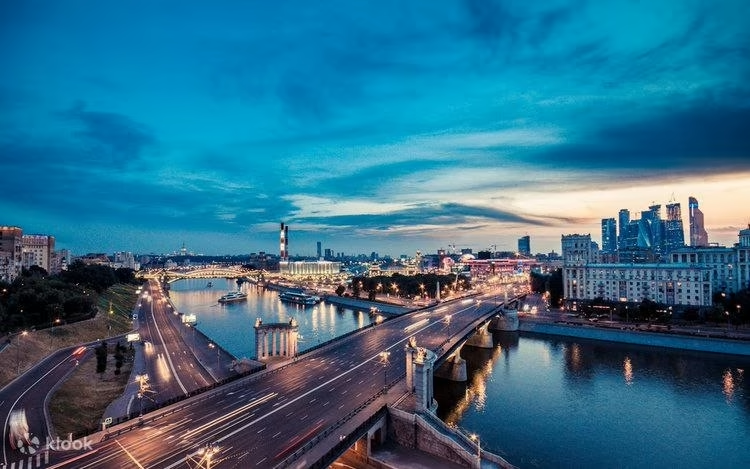
Panorama of Moscow at sunset
If after all these unusual formats you want a more classic individual walk around the capital, it is worth looking at how the bureau organizes organization of excursionsThis section contains photo reports and examples of what hiking and sightseeing routes look like, with lively, modern narration.
If none of the ready-made options matches how you would like to experience the city, we can create an itinerary from scratch. The page ‘Your Bespoke Dream Tour’ explains how we tailor the theme, pace, transport and individual stops to your particular party.
We took a tour of Taganka designed for 12-year-old children. It was an excellent programme. We covered a great deal of ground and learnt so much. We discovered the story of Dryanaya Street and discussed the Vladimir Highway, the surrounding monasteries and churches, and the Old Believers. We now know where Korovin was born, where Stanislavsky was born and raised, where the Morozov merchant children lived, and why Arseny Morozov was considered such an outrageous figure in his day. We also discussed Solzhenitsyn, discovered where Stalin Avenue was supposed to be built, saw the bunker, walked to the Russian metochion of the Mount Athos Monastery, and learnt why the Illuzion cinema made Taganka famous. Of course, no tour would have been complete without Vysotsky and Lyubimov. We also touched briefly on Taganka Prison, although naturally we did not go there. All in all, it was an exceptionally rich and informative tour! Our guide Alexander was superb!
Our thanks to our guide Alexander for a magnificent sightseeing tour. Alexander’s love for Moscow and its history, his wide-ranging knowledge, elegant and engaging delivery, and personal charm make the tour not merely interesting and informative, but truly delightful! Thank you, Alexander! Tatiana and Tatiana, St Petersburg
On July 18th, we participated in the "Soul of Moscow" group tour led by Alexander. Kitay-gorod and its surroundings revealed a new side to us, and everyone thoroughly enjoyed it. Some of us began intensively studying related materials to broaden our horizons. We'll be back, and we highly recommend it! You won't regret it.
Good afternoon, on June 23rd we had a tour called " The Soul of Moscow ," led by Alexander. He's a very pleasant young man. We visited such lovely courtyards and alleys with him that we never even knew existed, and we learned so much. We really enjoyed everything, and we hope to continue our acquaintance. Alexander! Thank you! We had a great time with you, and we thoroughly enjoyed it. See you there!
This isn't my first time with Radius. This time, I took the Moscow metro . The goal was not only to admire the underground palaces but also to learn how to navigate the metro. As a resident of a region without a metro, I was a bit apprehensive and didn't understand how to navigate the metro. Of course, the internet helps, but live communication is much better. Tour guide Yulia handled this task perfectly. The information was accessible and interesting, the presentation was calm, and the communication style was very friendly. Thank you very much for the tour and the practical experience.
Good afternoon! I gave the "Soul of Moscow" tour to some of the capital's guests. We were thrilled to hear our guide, Anton. It was so informative and engaging, and very warm. To say we were absolutely delighted is an understatement. It turned out to be a truly family-friendly excursion. We learned so many interesting facts. The material was presented professionally, all our questions were answered, and we saw so much. It was simply WOW! Thank you so much, Anton, he's the best!!!!! From now on, I'll only come to you, the Radius team. I highly recommend it. I promise we'll see each other again soon on other tours.
Overall, the tour left a positive impression! Thanks to Alexander for the walk through the courtyards and atmospheric spots of Kitay-Gorod; we certainly wouldn't have done it on our own. The tour was comfortable, and the guide spoke confidently and calmly. One thing we personally missed: we would have liked more of the historical part, relating to ancient Moscow and the history of Kitay-Gorod. There were quite a few stories about the Soviet period and the bar scene, but for our group, this wasn't particularly relevant. We think the program could be a little more tailored to the age and interests of the group. It would also have been interesting to add more historical facts, monuments, and details about old Moscow and the area itself. That said, the tour was still interesting, and some places and churches were truly memorable. These aren't really "cons," but rather suggestions for an even more comprehensive program.
Hello! We had a corporate group of 10 people. Our guide was Anton, and we had a tour of Bulgakov. I would like to point out the excellent organization; everything went smoothly. The managers were very accommodating to our changes in the number of participants. The bus was very comfortable. Anton is a super-engaged and motivated guide. He lives this history and is delighted to share his knowledge and create an unforgettable experience. Everything went well. I highly recommend it!
Thank you for a fascinating tour! It gave me so much food for thought to explore! Note: Review of the "Zamoskvorechye" tour with guide Maria.
I'd like to express my gratitude on behalf of our team! Thank you for keeping to our scheduled schedule despite our lack of organization. Our colleagues appreciated your preparation for the tour! It was informative. Note: Review of the "Modern Residential Complexes, Factory Past, and Avant-Garde" tour of the ZILART residential complex with guide Maria. Maria prepared and conducted a customized tour for employees of the Samolet Group of Companies development company.
Thank you! You have great talent. Good luck! ☺️ You're a wonderful guide! Thank you again! Note: This is a review of the corporate tour "The Heart of the Capital" with guide Maria.
Thank you for a wonderful day today!!)) Note: review of the excursion "The Soul of Moscow" with guide Maria
On behalf of the whole family, I want to thank you for a very informative and interesting tour! Note: This is a review of the "Palace Dungeons" tour with guide Maria.
Good afternoon! I'd like to express my gratitude and that of my guide for organizing the tour! We were very pleased. We'd like to do it again in October, but on a different route — ZIL. Note: This refers to the tour for Samolet Group developers, led by guide Maria.
Thanks to Alexander for the bar tour of Baumanka ! It was fun, exciting, and we discovered so many new places! Awesome! May we reach new heights!
Good afternoon! I was on a tour of Sukharevskaya Square — we went all the way to Tsvetnoy Boulevard. I didn't expect it to be so interesting! For those wondering whether to go — go for it! It truly became one of my most memorable summer memories!
Anastasia, good morning! Thank you and Masha for yesterday! The speakers are happy. The connection through the headphones was often lost, especially at the checkpoint, but that's just our current situation. You could hear if you were standing close, no more than 1.5 meters away. Colleagues have already asked for your contact information. I'd be happy to share it and look forward to another opportunity to work with you. Special thanks to the Director for the Bureau . Note: " Heart of the Capital " tour for participants of the 2025 Moscow Oncology Forum. Guides: Anastasia and Maria.
We'd like to thank Anton and Alexander for leading the tour! It was fascinating to hear how the Krasnaya Presnya district developed and how Prokhorov's influence on our city's development. It was a pleasant immersion into a quiet, previously unexplored area!
Good afternoon, thank you so much, Anastasia. The " Uncle Gilyai " tour was fantastic. Even though we're Muscovites and know a lot about Moscow, the experience was amazing, so much new and interesting happened. We'll definitely be back.
Thank you for the " Heart of Moscow " and " Khamovniki " tours. Anton, a knowledgeable and passionate Moscow guide, gave me the tour. He's a great storyteller, intelligent, well-read, and captivating. You've truly opened up my Moscow to me! I'll definitely be back next summer to explore Moscow with you. I'll recommend your wonderful tour program to all my friends!
Excursions with the Radius travel agency are always a positive experience if you choose them. We planned a tour of Zamoskvorechye on our next visit. We've worked with our guide, Anton, before. We'll definitely recommend him to everyone we know. The tour is informative, not overloaded with dates, and the information is comprehensive yet easy to understand, as it's presented in a light, narrative manner, not like a history textbook, dry and academic. Thank you for this approach. We'll definitely use the Radius agency again on our next visit to Moscow.
Thank you so much for the tour of Zamoskvorechye . Despite the weather, it was very interesting and informative! Note: this refers to the tour with guide Anton.
A huge thank you to Anastasia. We had a fantastic tour of the Patriki district. We learned so much. Anastasia is a true master of her craft. The tour was captivating, not at all boring, lively and interesting. Everyone was delighted. We were full of new impressions. I definitely recommend it. You won't be disappointed!
We explored the Soul of Moscow with my family and Radius on my birthday. Everyone thoroughly enjoyed the walk! Anton shared so many interesting facts about the capital and its history, taking us into spiritual depths no one else had even suspected. Most of us were either born or longtime Moscow residents who spent a lot of time walking around. It was educational, heartwarming, and unforgettable. 🙂 Overall, this wasn't my first time walking around Moscow with Anton, and each time was a real adventure!