Moscow Art Nouveau emerged at the turn of the twentieth century and is distinguished by its unified approach to building design: the architect brought the layout, façade, interiors, stained glass, metalwork and furniture together within a single artistic vision. In Moscow, this principle can be clearly seen in the Ryabushinsky Mansion, the Metropol Hotel, Yaroslavsky Station and the original Moscow Art Theatre building. This article explains how to distinguish Art Nouveau from eclecticism and which details to look for on a walk.
Moscow Art Nouveau has no single set of decorative hallmarks. Schechtel, Kekushev and Walcot each worked differently: some designs favour organic lines and asymmetry, while others draw on Neo-Russian motifs or more restrained geometry. A flowing grille or ceramic panel alone does not establish the style; what matters is the building’s overall composition, the relationship between its façade and layout, and the repetition of motifs in its details.
Details of Moscow Art Nouveau on the facade of the mansion
What is Art Nouveau and why did Moscow embrace it in its own way?
Art Nouveau architecture emerged as an attempt to escape the masks of history. Before it, urban architecture readily adopted the guises of Classicism, Baroque, Gothic, Old Russian motifs, and Renaissance forms. The new architecture proposed something different: not to copy the past, but to create a new, coherent style for a new era. It embraced fluid lines, natural forms, asymmetry, large windows, decorative unity of façade and interior, designer furniture, staircases, handles, stained glass, lattices, and lamps.
But the Moscow version was never a pure European Art Nouveau transplanted to Russian soil. In Moscow, it quickly acquired a local psyche. Its clients were often merchants, industrialists, bankers, factory owners—people with deep pockets and a strong desire to make a name for themselves. They were building not just housing, but a new social image. The house had to convey the message: the owner was not a provincial moneybags, but a man of taste, culture, risk, and modern energy.
Hence the Moscow peculiarity: this style here is often not restrained, but emotional. It can be refined, but rarely cold. Even when the façade is outwardly calm, it almost always oozes tension: a strange window, a sharp roofline, a mask, a wrought-iron wave, a ceramic flower, a symbolic detail. Moscow made Art Nouveau not so much a style of comfort as a style of character.
Why modernism is not equal to just a beautiful mansion
The most common mistake on such a walk is to look only at the decorative elements. People see the moldings, flowers, latticework, and a beautiful curve, and conclude: this is a beautiful house. But this architecture is interesting not for the decoration itself, but for its principle of integrity. The architect designed not only the walls but also the overall impression. The façade, entrance, staircase, stained glass, lighting, door handle, and even the design of the fence were all intended to work together as parts of a single concept.
A good building of this era has almost no random details. A window isn't simply pierced in a wall; it sets the rhythm of the façade. A staircase doesn't simply lead upward; it becomes the interior's dramatic focal point. A fence doesn't simply protect the property; it continues the design of the house. A mask or flower on the façade doesn't have to have a single, direct meaning, but creates an emotional key: anxiety, dream, temptation, mystery, natural force, theatricality.
Therefore, Moscow Art Nouveau is best understood as an architecture of mood. It doesn't speak in dry formulas. It sets the viewer's mood: it slows their pace, makes them look up, gaze at the roofline, catch the reflection in the glass, compare the heavy stone mass with the light forged pattern. This is its power: it transforms the city street into a stage, where the building becomes not a backdrop but a character.
How does Moscow Art Nouveau differ from St. Petersburg and European Art Nouveau?
European Art Nouveau is often associated with flowing lines, floral patterns, stained glass, metal, and decorative freedom. This language developed differently in Paris, Brussels, Vienna, and Barcelona, but the overall impetus was similar: new beauty for a new century. The St. Petersburg version of Art Nouveau is often perceived as more austere, northern, stony, restrained, and sometimes almost monumental. Moscow, on the other hand, gave the style more merchant freedom and a more individualistic touch.
In Moscow, Art Nouveau blended seamlessly with neo-Russian motifs, Gothic style, symbolism, eclectic memory, and even future rationality. One house might evoke European influences, another a fairytale tower, a third ancient northern Russian architecture, a fourth a theater set. This wasn't a weakness, but a characteristic of the Moscow scene: the city disliked strict formulas and constantly mixed languages.
That's why, when strolling through Moscow, it's important not to look for a single benchmark for Art Nouveau, but to see a family of variations. The Ryabushinsky Mansion and the Pertsova House both belong to the Art Nouveau era, but they speak almost different languages. It's also difficult to place the Metropol and the Yaroslavsky Station side by side: the former functions as an urban art complex, the latter as a nationally charged image of the route to the north and east. The beauty of Moscow Art Nouveau is that it can't be reduced to a single formula.
Architects, without whom the conversation would not work
The first name is almost inevitably Fyodor Shekhtel. He became the leading architect of Moscow Art Nouveau not because he built more than anyone else, but because he was able to express the style in various registers: from the neo-Gothic drama of Zinaida Morozova's mansion to the undulating symbolism of Ryabushinsky's mansion, from the industrial architecture of Levenson's Printing House to the northern Russian image of Yaroslavsky Station. Shekhtel was more than just a master of beautiful façades. He knew how to transform a commission into an architectural narrative.
Lev Kekushev is another key figure. His Art Nouveau is more fluid, powerful, and corporeal. His buildings often have a muscular feel: expressive volumes, sculptural features, strong windows, dynamic walls, and sometimes an almost animalistic energy. The Mindovsky Mansion on Povarskaya Street, built in 1903-1904, is often cited as a striking example of Kekushev's mature Moscow Art Nouveau. This is architecture that you want to not only look at but also walk around, because it works with volume.
William Walcott is important primarily through the Metropol and the very type of Moscow Art Nouveau that evoked the International Style. The initial design for the hotel was closely related to this style, and a wide range of architects and artists participated in the complex's creation. Here, Art Nouveau became not a private residence but a grand urban statement. The Metropol demonstrates that the new style could operate on the scale of a public building, a square, a hotel culture, and a large artistic ensemble.
Sergei Malyutin, Nikolai Zhukov, and Boris Shnaubert are essential to understanding the Pertsova House. Built in 1907 on the corner of Soimonovsky Proyezd and Prechistenskaya Embankment, this house reveals another facet of the era: a neo-Russian fairytale-like quality, ceramics, a sharp angle, vibrant decorative elements, and the image of the house as almost a book illustration brought into the city. It's not just architecture, but also a conversation with Russian artistic tradition.
Start with the site: how a building occupies its place in the city
Reading a building begins with its position on the plot. Identify the street’s building line, the main entrance, and the connections to the courtyard, garden and service buildings. On a traditional estate, the main house might be set back from the road and oriented towards a formal forecourt, whereas dense tenement or commercial development occupied the street frontage and extended into the plot with buildings behind.
The freely composed volume of Stepan Ryabushinsky’s mansion at 6/2 Malaya Nikitskaya Street is aligned with the surrounding block. Accounts of Schechtel’s architectural legacy note the artistic treatment of every façade, including the one facing the garden. Visitors should therefore compare the main entrance, the garden windows and the corner sections, as each reveals different aspects of the interior layout.
Alexandra Derozhinskaya’s mansion at 13 Kropotkinsky Lane is separated from the street by railings. The enormous arched, double-height window in the main façade immediately indicates a room of exceptional proportions. The service wings and railings form part of the protected ensemble, so the division of the property into formal and service areas is essential to understanding it.

The main façade of A. I. Derozhinskaya's mansion in Kropotkinsky Lane, with its large arched window and wrought-iron railings. Wikimedia Commons, Derozhinskaya's House (2014) by shakko 02.jpg, author: Shakko, licence: CC BY-SA 4.0 source, license
Public buildings make different use of their sites. The Metropol occupies a substantial stretch of street frontage opposite the Bolshoi Theatre, and its façade was designed to be viewed from the open space before it. Yaroslavsky Railway Station at 5 Komsomolskaya Square accommodated the growing flow of passengers and connected the city with the platforms. The public function of both complexes accounts for their scale, number of entrances and extensive façades.
A building’s position offers clues as to whom it was designed for. A detached house behind a fence was intended for its owner and invited guests; a hotel or railway station, for a constantly changing flow of people; while a printing works separates its prestigious offices from its production facilities. This is a preliminary conclusion that should be checked against the original plans, the historical address and information about the patron who commissioned the building.
Why the layout matters more than a collection of ornaments
The architectural glossary published by the Moscow Department of Cultural Heritage identifies the ‘inside-out’ principle as one of the foundations of Art Nouveau. The architect first arranges the rooms and the movement between them, then expresses the distinctions within the interior through the composition of volumes, windows and entrances. The façade thus reflects the logic of the layout, though it does not reproduce the plan literally.
The grand staircase forms the centre of the Ryabushinsky Mansion’s plan. The rooms are grouped around it, while the route from the entrance hall to the reception rooms creates a circular flow. The windows are positioned at different levels and vary in shape because they illuminate spaces of differing heights and functions.
The ground-floor plan published in the 2025 special issue of Moscow Heritage allows observations made from the street to be verified. The almost cubic volume conceals a complex layout: the central staircase, portals and turns along the route reveal the rooms in sequence. The wave motif acquires architectural meaning by accompanying a person’s actual movement through the building.
The mansion’s attic housed the Ryabushinsky family’s Old Believer prayer room. Its purpose cannot be determined from the street: the shape of the roof and the arrangement of the windows merely suggest an unusual room on the uppermost floor. Its religious function is confirmed by the patron’s background and the documented layout of the house.
At the Derozhinskaya Mansion, the relationship between the floor plan and the façade is handled differently. A large fan-shaped window illuminates the double-height hall and marks its place in the composition. Schechtel designed the entire interior, from the fireplaces and wooden panelling to the furniture and light fittings. The scale of the glazing makes the main hall visible from the street.
When assessing any building, it is useful to compare three sets of features: access points, natural lighting and vertical circulation. The principal and service entrances lead to different routes; a staircase window usually follows a different rhythm from the windows of the rooms; and a tall opening may belong to a hall, a staircase or an industrial space. Only a floor plan or an accurate description of the building can help determine which interpretation is correct.
Materials and engineering: where Art Nouveau was truly modern
Ceramics, wrought iron and stained glass should be considered in relation to their functions. Facing tiles protected walls and created a durable coloured surface; metal made it possible to create delicate patterns in railings or span a wide opening; large expanses of glazing altered the way a room was lit. A single material could serve both a technical and a decorative purpose.

The wrought-iron fence defines the property boundary, guides visitors towards the entrance and continues the lines of the façade. When examining it, distinguish between historic ironwork, later replacements and modern sections based on the original design: matching ornamentation does not in itself prove that they were made at the same time.
At the Ryabushinsky Mansion, Shekhtel integrated engineering into the overall artistic design. Materials published by the Moscow Department of Cultural Heritage describe how air heated by stoves was channelled through an opening at the foot of the staircase. The design of the ventilation grilles continues the interior’s marine and botanical motifs, linking the heating system with the décor of the house.
The Alexander Levenson Printing Works at 9 Tryokhprudny Lane separates its public-facing and production functions. The administrative building designed by Shekhtel dates from 1900, while the three-storey production building at the rear of the site took shape between 1901 and 1909. Glazed brick, decorative tiles, stucco moulding, plaster and openwork metal were used for the office building; the workshop block is more restrained, with an architectural treatment centred on exposed brickwork.
This contrast in materials should not be seen as a conflict between an attractive façade and a utilitarian courtyard. The office welcomed clients and represented the company, while the production building required ample light, structural strength and an efficient arrangement of equipment. The ensemble was therefore given two architectural registers, each reflecting its function.
Yaroslavsky Railway Station demonstrates the different scale of this engineering challenge. Reinforced concrete and facing tiles were used in its reconstruction, and the new building was considerably larger than its predecessor. The tower on the left was originally connected with the station’s water supply. This feature should therefore not be viewed merely as a fairytale silhouette: its technical function is intertwined with the imagery of the northern route.
At the Metropol, the artistic programme is likewise underpinned by its engineering structure. The hotel’s official history names Vladimir Shukhov as the designer of its enormous glass dome, while the façades combine majolica, sculptural friezes and metal railings. The scale of this public complex required architects, artists, sculptors, ceramicists and an engineer to work together.
What the façade can reveal about the interior layout
Art Nouveau façades allow us to form testable hypotheses about the layout and function of the interior spaces. Begin by locating the plinth and entrances, then compare the window and door openings on each floor, noting the bay windows, staircase windows and corner volumes, before turning to the materials and decoration. This sequence separates structural evidence from artistic interpretation.
A large window is usually associated with a space that requires more light or visual openness. In Derozhinskaya’s mansion, it serves a double-height hall; in an industrial building, large openings may illuminate a workspace; in a shop, they may connect the sales floor with the street. The same external feature takes on a different meaning depending on the building’s function.
Asymmetry also calls for an explanation. In a mansion, it may reflect the individual arrangement of rooms; in a railway station, the distribution of passenger halls and service areas; and in a corner building, the direction of the streets. If the offset position of an entrance or tower cannot be linked to the layout, leave the question open: irregularity alone does not prove that a building belongs to a particular style.
Ornamentation links the elements of a building, but there is no universal dictionary of Art Nouveau symbols. An iris, a wave, a female mask or a sea creature may recur on the façade and in the interior, creating a unifying theme. A specific hidden meaning can be asserted only if supported by a sketch, a letter from the designer, the client’s brief or research into the motif’s origins.

The majolica panel The Princess of Dreams, based on a design by Mikhail Vrubel, in the central section of the Metropol Hotel's façade. Photo: Vladimir OKC, Wikimedia Commons, public domain. Wikimedia Commons, Mosaic by Michael Vrubel on Metropol Hotel in Moscow(1).jpg, author: Vladimir OKC, licence: Public domain source
Finally, the façade reveals how the creative work was organised. In a private mansion, the architect could control almost every aspect of the design. The Metropol was conceived as a collaborative work: an architectural competition, revisions to the brief, contributions from Walcot, Kekushev and Shevyakov, majolica by Mikhail Vrubel, Alexander Golovin and Sergei Chekhonin, friezes by Nikolai Andreyev, and decorative ceramics by Pyotr Vaulin. To attribute the entire complex to a single name is to overlook the very way in which it was created.
Five buildings, five ways to solve an architectural problem
Comparing different types of buildings provides a clearer understanding of Art Nouveau than a list of outward features. Each of the following examples addresses a specific brief: a private home, a prestigious mansion, an industrial building, a hotel complex or a transport hub. What they share is the ambition to unite function with a coherent artistic vision.
The Ryabushinsky Mansion: movement around the staircase
The Stepan Ryabushinsky Mansion at 6/2 Malaya Nikitskaya Street was built by Fyodor Schechtel between 1900 and 1902. Its main volume is almost cubic, but the windows of varying sizes, mosaic frieze and gently rounded corners dispel any sense of a static box. Every façade plays a part in the composition, reflecting the house’s freestanding position on the site.
The clearest evidence of the ‘inside-out’ approach lies in the interior. The wave-like grand staircase draws the rooms together around it and creates a succession of shifting perspectives. The parquet patterns, stained glass, door handles, light fittings and ventilation grilles all reinforce the overarching natural theme without taking the place of spatial organisation.

The grand staircase of the Ryabushinsky Mansion: the flowing line of the balustrade, the sculptural light fitting and the transition between levels of the hall. Photo: Shesmax, Wikimedia Commons, CC BY-SA 4.0. Wikimedia Commons, Moscow. Ryabushinsky House. Interiors. Main stairs — 002.JPG, author: Shesmax, licence: CC BY-SA 4.0 source, license
From the street, it is useful to compare the height and shape of the windows and then check them against the floor plan. This approach explains the asymmetry without mystification: the openings serve different rooms and levels. The purpose of the concealed prayer room in the attic is established through historical records and cannot be determined from the façade.
The Derozhinskaya Mansion: a hall presented to the street
The Alexandra Derozhinskaya Mansion at 13 Kropotkinsky Lane was built by Schechtel between 1901 and 1903. The two-storey stone building is separated from the street by a wrought-iron fence. The main façade is arranged around a large fan-shaped window, behind which lies the lofty reception hall.
The house is particularly interesting in contrast with the Ryabushinsky Mansion. In place of a mosaic frieze and a fluid cubic form, the emphasis here is on the window’s verticality, restrained surfaces and the precise relationship between the façade and the fence. This difference shows that even the same architect did not rely on a ready-made repertoire of devices: the composition changed with the house’s architectural programme.
Schechtel commissioned Viktor Borisov-Musatov to design decorative panels for the hall, but the sketches were not transferred to the walls during the client’s lifetime. During the 2009–2012 restoration, the Four Seasons compositions were created from surviving materials using modern techniques. The present-day interior embodies the historic design, but is not the original 1903 decoration preserved in its entirety.
The Levenson Printworks: two façades for one company
The administrative building of the Levenson Printing House was designed by Schechtel and built in 1900 at 9 Tryokhprudny Lane; the production building in the courtyard dates from 1901–1909. The office faces the street, while the production facilities extend into the depths of the site. The layout of the property keeps visitor and workforce circulation separate.
The materials used for the office façade—glazed brick, ceramic tiles, plaster, stucco and metal—showcased the firm’s quality. The administrative section housed Levenson’s private office, designed by Schechtel, while a relief of Johannes Gutenberg was placed above the cashier’s window. The decoration reflects the client’s profession rather than serving as a generic layer of floral ornament.
The production building is no less important than the formal frontage. Its more restrained brick architecture derives its expressive power from the rhythm of the windows, its structural design and the arrangement of the workspaces. The administrative building was restored between 2013 and 2016, so the present condition of its interior decoration should be assessed against pre-restoration records.

The upper section of the main façade of the Levenson Printworks' administrative building. The restored inscription on the frieze reads ‘A. A. LEVENSON PRINTWORKS PARTNERSHIP’.
The Metropol: a collaborative work on the scale of a city square
The Metropol complex at 2 Teatralny Proyezd was built between 1899 and 1904 and opened to guests in January 1905. Savva Mamontov originally envisaged a ‘theatre with a hotel’ opposite the Bolshoi Theatre. Nikolai Shevyakov and Lev Kekushev won the design competition, but Mamontov chose William Walcot’s fourth-place entry; after the project brief was revised, Shevyakov and Kekushev returned to the project.
The Metropol’s official history attributes the majolica panel The Princess of Dreams to a work by Mikhail Vrubel inspired by Edmond Rostand’s play, while the other façade panels are associated with Alexander Golovin and Sergei Chekhonin. The sculptural friezes were created by Nikolai Andreyev, the decorative vases by Pyotr Vaulin, and the glass dome by engineer Vladimir Shukhov. This distinguished ensemble of contributors explains why the complex cannot be attributed to any single creator.
The Metropol’s façade was conceived as a public artistic statement. The panels, sculptures, inscription, balconies and dome are designed to be viewed from the square and from afar. The architecture brings together a hotel, a restaurant and the original vision for a theatre complex.
Yaroslavsky Railway Station: the image of a journey and a real transport machine
Yaroslavsky Station acquired its present appearance when the building was expanded between 1902 and 1904 to a design by Fyodor Schechtel, although heritage records consider its broader construction history through to 1907. Lev Kekushev had already rebuilt the eastern wing and platform in 1895–1896, and in 1901 he prepared the initial proposal for its further redevelopment.
The station was built in response to growing passenger and freight traffic after the railway was extended to Arkhangelsk and joined by other lines. Culture.ru states that the new structure was roughly three times the size of its predecessor. Before examining the decorative rooflines, kokoshniks and ceramic panels, therefore, one should consider the arrangement of the entrance and concourse and their connection to the platforms.
The asymmetrical portal, vertical volumes of varying heights and tall roof create a National Romantic image of the route north. At the same time, the building incorporates reinforced concrete and facing tiles, while one of its towers served as a water tower. Schechtel brought historical associations, new construction methods and transport logic together in a unified design.

The main façade of Yaroslavsky Railway Station on Komsomolskaya Square today. Photo: Mike1979 Russia, Wikimedia Commons, CC BY-SA 4.0. Wikimedia Commons, Yaroslavsky Rail Terminal Moscow 2023-09-05 8482.jpg, author: Mike1979 Russia, licence: CC BY-SA 4.0 source, license
How to distinguish the original design from later restoration
The condition of a historic building in the twenty-first century cannot automatically be taken as evidence of how it looked when it was built. A building changes owners and functions, acquires new building services, loses decorative finishes, and undergoes repairs and conservation-led restoration. Any construction date must therefore be accompanied by a chronology of subsequent interventions.
The Derozhinskaya Mansion offers a rare example of restoration completing an unexecuted part of a design. Borisov-Musatov's sketches existed, but the walls of the hall were originally left without these compositions. The reconstruction carried out in 2009–2012 was based on the historical design and expert research, although its materials and scaling belong to contemporary restoration practice.
At Yaroslavsky Railway Station, several periods of construction overlap. The heritage protection document distinguishes between the volumes dating from the 1860s, alterations made in the late nineteenth century, Schechtel's 1904 redesign of the façade and later elements, including Soviet decoration. A detail visible today may be a valuable part of the building's history without having formed part of Schechtel's original design.
The administrative building of the Levenson Printworks acquired the present appearance of its elaborate decoration following the restoration carried out in 2013–2016. To assess the authenticity of a particular surface, a general statement that ‘the building has been restored’ is not enough. One needs the restoration plans, photographs of its condition before the work and details of what was uncovered, consolidated, supplemented or recreated.
The practical rule is simple: distinguish between the date of the design, the date of construction, the date of a particular alteration and the date of restoration. For the façade, old photographs and the officially designated protected features are useful; for the interior, one should consult plans, inventories, on-site investigations and restoration reports. The building's present state of preservation is a fact in its own right, not proof that everything visible today was there from the outset.
What drawings, photographs and heritage protection documents can confirm
The reliability of an architectural analysis depends on whether the source is suited to the question being asked. A drawing reveals the design intent, a photograph records the building's condition on the date it was taken, an on-site investigation distinguishes between layers of material, and a heritage protection document establishes a legally significant chronology. These sources complement one another.
| Source | What it confirms | What it does not prove on its own |
|---|---|---|
| Original design and drawings | The concept, layout and intended finishes | That the design was fully realised and remained unchanged during construction |
| Historical photograph | Visible details and the condition of the building when the photograph was taken | Authorship, concealed structures and the building’s earlier appearance |
| Plan, inventory or technical document | The purpose and relationship of the rooms, and their fittings on a particular date | The symbolic meaning of the composition and everyday practices without additional evidence |
| The list of protected features and the expert assessment report | Significant volumes, façades, elements and materials, and the periods of construction | That every protected feature formed part of the architect’s original design |
| Restoration report | The layers uncovered, losses, conservation methods and extent of reconstruction | That a restored detail is authentic material from the early 20th century |
| Memoir, guidebook or urban legend | The history of how the building was perceived and the existence of a particular version of events | The factual accuracy of that version without independent corroboration |
For a disputed detail, it is useful to construct a short chain of evidence: what the design specified, what can be seen in a historical photograph, what was found in situ and what was reconstructed during restoration. Phrases such as ‘conceived as part of the architect’s original design’, ‘documented in the photograph’ and ‘carried out in 2009–2012’ preserve the distinction between the original design, historic fabric and modern work.
The WW monogram beneath the panel on the List Mansion provides grounds for attributing the decorative element to William Walcot. It does not substantiate the story of a gift or professional reconciliation: such a conclusion would require a letter, contract or testimony from someone involved. Symbols should be approached in the same way. The aquatic theme of the Ryabushinsky Mansion can be described as a recurring system of motifs, but interpreting every flower in biographical terms requires separate, authoritative research.
A plan or technical description is also needed to determine a room’s function. A large window indicates a tall or well-lit space, but without a drawing it cannot confidently be identified as a hall, staircase, workshop or shop. Nor does an external inspection reveal whether the interior is currently accessible: the conditions governing the use of a heritage building must be checked separately for a specific date.
A repeatable sequence of observation
Begin with the precise address and the building’s official name. A single urban property may contain several structures dating from different periods, while its familiar name may refer only to the main house. Verify the architect and construction period against the heritage register, a museum page or restoration records.
Next, examine the site from publicly accessible vantage points. Note whether the house stands on the street line or is set back behind a fence, and whether it has a garden, courtyard and service buildings. Record which façades were designed to face the street and which face into the property.
The third step is movement. Locate the main, staff and service entrances, staircase windows, carriageway or connection to the platform. Try to reconstruct the route taken by an owner, guest, worker or passenger, but identify any assumption as such until it can be checked against the plan.
The fourth step is materials. Distinguish the load-bearing wall, cladding, ceramics, metal, glass and plaster decoration. Compare the condition of adjoining areas: differences in joints, texture and colour may indicate repairs, although they cannot be dated without documentary evidence.
Only then should you turn to ornament and imagery. Check whether a motif recurs in the fence, windows and interior, and whether it is connected with the building’s function or the architect’s artistic programme. The result should be a verifiable connection between the detail observed and the way the building is organised.

Decoration of the entrance portal at Yaroslavsky Station: ceramic panels, ornamented columns and a relief bearing a Soviet emblem. Present-day view, 5 September 2023. Photograph: Mike1979 Russia, Wikimedia Commons, CC BY-SA 4.0. Wikimedia Commons, Yaroslavsky Rail Terminal Moscow 2023-09-05 8489.jpg, author: Mike1979 Russia, licence: CC BY-SA 4.0 source, license
A Practical Route: How to Avoid Turning Art Nouveau into a Marathon
For your first tour, it's best to choose a cluster of five to seven addresses in a single sector rather than the entire city. This way, your architectural tour doesn't disintegrate into a collection of disparate facades. The most convenient scenario is the area around Malaya Nikitskaya, Spiridonovka, Povarskaya, Prechistenka, and Ostozhenka. Here, in two to two and a half hours, you can connect Ryabushinskogo, Morozova, Mindovsky, Derozhinskaya, and several less obvious facades without feeling like the tour has become a transportation chore.
If you want to add the Metropol or Yaroslavsky Station, it's better to do it as a separate section rather than tack them on to the walk at any cost. These buildings are important, but they change the scope of the conversation: from an intimate mansion to public architecture, a hotel, a train station, and a city square. For a self-guided tour, this means more transfers and less time for careful examination of details.
| Format | What works well | Where is the weak spot? | Who is it suitable for? |
|---|---|---|---|
| On one's own | You can walk at your own pace, choose a district and linger at the facades you like. | It's difficult to distinguish fact from urban legend and understand why a particular detail is important. | For those who already love architecture and are ready to prepare addresses in advance |
| With a guide | A coherent story emerges: the client, the architect, the style, the fate of the house, the details of the facade | A precise route is needed, otherwise a walk easily turns into a run around addresses | For those who want not only to see houses, but also to learn to read Art Nouveau |
Art Nouveau, Eclecticism, and Neoclassicism: What Are the Differences Between the Styles?
| Criterion | Modern | Eclecticism | Neoclassicism |
|---|---|---|---|
| Attitude to the past | Creates a new language, but can freely use historical motifs as material | Combines ready-made styles of the past: Gothic, Renaissance, Baroque, Russian motifs | Returns to antique and classical clarity, order and symmetry |
| Facade composition | Often asymmetrical, dynamic, built on the movement of volumes | It may be ornate and complex, but it often relies on familiar historical patterns. | Strict, balanced, with a clear axis and rhythm |
| Decor | Plant lines, masks, symbols, ceramics, forged waves, fantasy motifs | The decor depends on the chosen historical sample | Columns, pilasters, pediments, garlands, medallions, strict plastic art |
| Windows and light | Windows can be of different shapes and sizes, light becomes part of the artistic scenario | Windows are often subordinated to the historical style of the facade | Windows are usually built into the regular order of the facade |
| The main impression | Living organism, mood, individuality, symbol | Theatrical costume, historical quotation, decorative play | Order, dignity, measure, rational beauty |
This distinction is especially important in Moscow, because buildings from different styles can stand side by side, yet the eye quickly tires of the common denominator "antique." Art Nouveau isn't simply old and beautiful. It's fundamentally more dynamic, freer, and more individual. While eclecticism often embraces the past, and neoclassicism reintroduces discipline, Art Nouveau seeks a new way of life and a new way of being urban.
Style and money: why the new elite fell in love with him
Without money, Moscow Art Nouveau would not have existed. But it's important to understand that it's not just a matter of construction costs. Wealthy clients could choose any historical style and build themselves a palace in the familiar style. The new style was bolder: it demonstrated the owner's willingness to take risks with his image. Such a house could provoke admiration, irritation, gossip, ridicule, and envy. But it left no one indifferent.
Merchant and industrial Moscow was rapidly changing at the turn of the century. Money ceased to be just capital and became a cultural statement. Theaters, collections, charity, publishing projects, mansions, and apartment buildings—all of these became ways to cement the city's history. This language proved ideal for this task because it gave the client a unique identity. It was possible to build not just a large house, but a signature building.
The technical side is also important here. New materials, large openings, engineering capabilities, electricity, elevators, and modern utilities redefined comfort and status. This was the style of an era that already knew the industrial city but still believed that technology and beauty could coexist. That's why the best buildings of this period are so interesting: they stand on the border between the artisan, artistic, and industrial worlds.
The Silver Age, Symbolism, and Moscow's Anxiety
This architecture cannot be fully understood without the atmosphere of the Silver Age. This era loved symbols, allusions, mystical moods, theater, music, poetry, female figures, flowers, masks, dreams, and premonitions. But it's important not to turn the conversation into vague esotericism. Turn-of-the-century architecture wasn't a set of secret symbols for the initiated. Rather, it tapped into the general cultural sensibility of the era, where things could be more than just things.

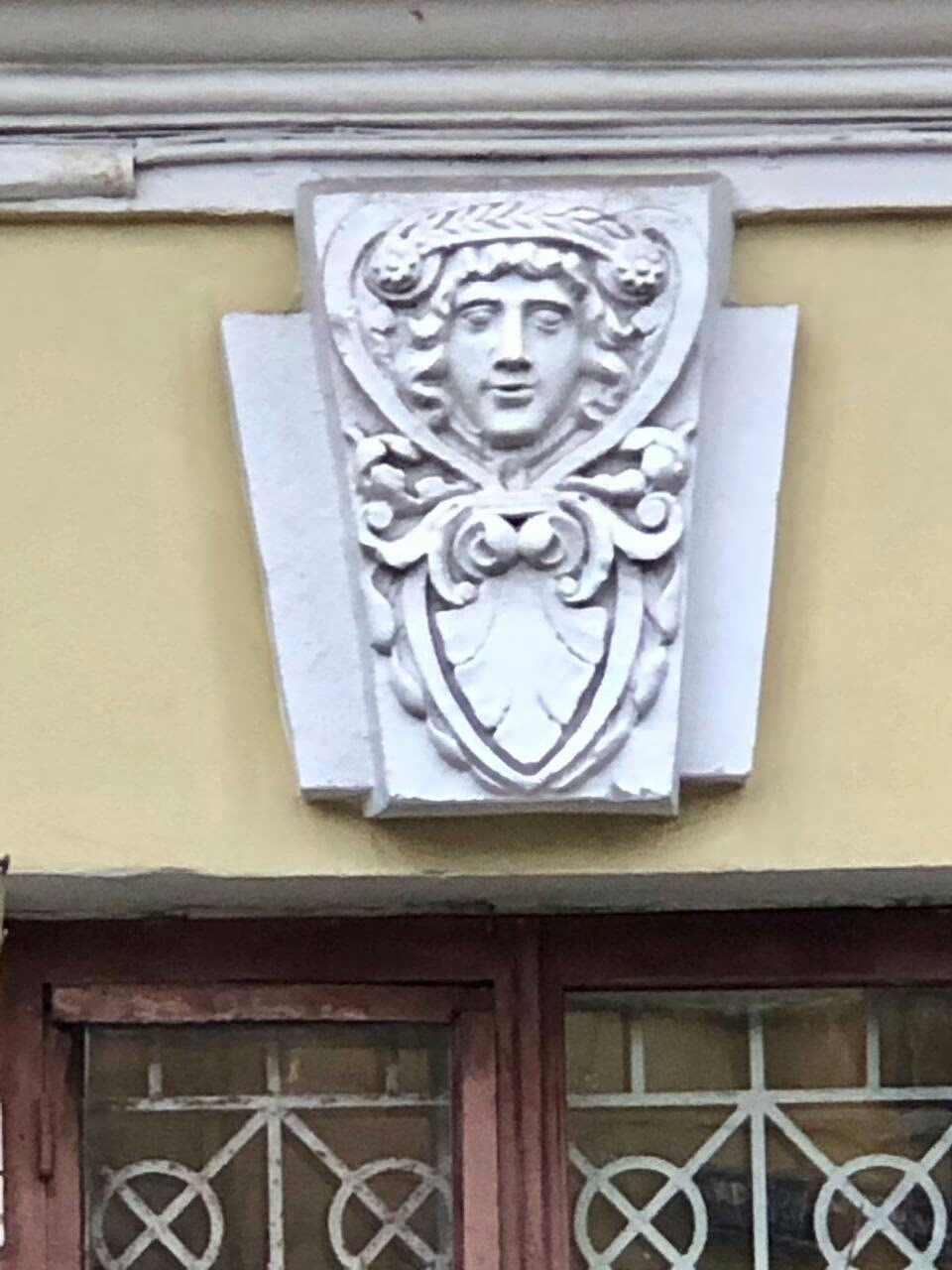
A symbolic mask on the facade of a Moscow Art Nouveau building
A staircase could become a wave. A window, the eye of the house. A mask, a hint at the façade's double life. A plant, a symbol of growth, fragility, or temptation. A female image, not a portrait of a specific woman, but a sign of beauty, dreams, danger, or unattainability. This is why Art Nouveau fits so well with literature, music, and theater: it thinks not in dry constructs, but in images.
There's a special anxiety about this Moscow architecture. It emerges before a major historical upheaval. Its heyday is brief: ahead lie revolutions, war, changes in ownership, the nationalization of mansions, and new functions for buildings. Many buildings, conceived as private worlds, will become embassies, institutions, museums, and reception centers. Therefore, today we look at Art Nouveau with a dual feeling: as a celebration of form and as the last glory of the pre-revolutionary urban world.
Where is the best place to see Art Nouveau in Moscow?
One of the best areas to experience this style is the area around Prechistenka, Ostozhenka, Povarskaya, and Arbat. Here, it is particularly well-featured as a private architectural style: mansions, fences, alleys, intimate scale, and the proximity to old aristocratic and merchant Moscow. This is the ideal area for a stroll, where attention to detail, not just miles, is crucial.

Art Nouveau in the lanes of Prechistenka and Ostozhenka
The second important area is the area around Tverskoye and Nikitskiye Streets, Spiridonovka, and the Patriarch's neighborhood. Here, we can discuss Shekhtel, the Morozovs, and Ryabushinsky, as well as the connection between Art Nouveau and Moscow's literary and cultural strata. On such routes, it's especially clear how a single neighborhood combines wealth, art, power, memory, and urban legend.
The third line features public buildings and major urban hubs: the Metropol, Yaroslavsky Station, individual apartment buildings, and commercial buildings. They demonstrate that Art Nouveau was not just a style reserved for private residences. It played a role in shaping the city's character, welcoming visitors to the capital, and shaping luxury hotels, transportation, retail, and communications.
The fourth line features less obvious addresses: printing houses, apartment buildings, small facades, fragments of forged ironwork, entryways, and ceramic details. This type of architecture is harder to sell with a postcard, but it's crucial for a true understanding of the city. It demonstrates that the style wasn't a whim of wealthy patrons, but rather a part of the urban environment.
How to watch Art Nouveau on your own
A self-guided Art Nouveau tour is possible, but it shouldn't be reduced to a simple list of landmarks; a Moscow walking tour on this topic requires a more deliberate pace. Don't try to cover every building in one day. It's better to choose one district and walk slowly. In Art Nouveau, the main meaning often lies not in the number of addresses, but in the quality of the view. One Ryabushinsky mansion can provide a greater understanding of the style than ten facades skimmed at speed.

Art Nouveau in the Spiridonovka and Patriarch's Ponds area
It's helpful to write down three questions about each building in advance. Who commissioned it? What's unusual about the building for its time? What detail sets the mood? These questions immediately remove the superficial "beauty" and force one to see the architectural logic. For example, in the Metropol, it's not just the mural that's important, but the very concept of the art complex. At Yaroslavsky Station, it's not just the tower, but the image of the train track. In the Pertsova House, it's not just the colorfulness, but also the connection to literary, fairytale, and artistic traditions.
Another technique is to look at fences and entrances. In Moscow Art Nouveau, they often say more than they seem. A fence can follow the rhythm of the façade, an entrance can be hidden or emphasized, and a staircase can become the main feature of the house. If you have the opportunity to stop in front of a building, it's best not to read the description first, but simply describe what the house does to your gaze: draws you up, draws you aside, compresses, opens you up, disturbs, amuses, beckons.
Common mistakes when talking about modernism
The first mistake is to call any elegant early 20th-century building by that name. In Moscow, authentic buildings from that era often stand alongside eclecticism, neo-Russian style, neoclassicism, and later stylizations. Therefore, an expert's assessment begins not with the question "is it beautiful or not," but with an examination of the composition: is there asymmetry, a free line, and the artist's touch on the window, railing, entrance, and façade's form?
The second mistake is looking for a single literal code in every flower or mask. Art Nouveau truly loves symbols, but not every iris, woman's face, or wave has a simple dictionary-like translation. More often, it works like this: emotional keyThe house becomes more unsettling, softer, more mysterious, more theatrical. If a guide promises to decipher every detail like a secret code, be wary of such assurances.
The third mistake is to build a route solely around famous addresses. The Ryabushinsky Mansion, the Metropol, and the Yaroslavsky Station are important, but they don't replace the surrounding environment. Style is best revealed in a context: one recognized masterpiece, two or three less obvious buildings, an apartment building, a fence, an industrial or commercial building. Then you can see not only the ceremonial display of style, but also the surrounding context. urban system, in which the style lived.
A checklist for a good Art Nouveau walk
Before a walk, it's helpful to check four things. First, the route should be geographically coherent: Art Nouveau doesn't do well with long journeys between random points. Second, it should include a variety of building types: a private residence, an apartment building, a public or commercial building. Third, it's important to understand accessibility in advance: some buildings are now occupied by embassies, institutions, or closed organizations, so they can only be viewed from the outside. Fourth, a good story should distinguish between a reliable fact, a professional hypothesis, and an urban legend.
If these conditions are met, the walk becomes not a catalog of facades, but a way to learn to see. Afterward, a person looks at Moscow differently: they notice the line of a fence, the shape of a window, the rhythm of the ceramics, the oddity of a turret, the asymmetrical entrance. This is the main result of a good Art Nouveau tour—not just learning ten addresses, but gaining a new tool for reading the city.
When you need a guide
A guide is especially necessary where the façade doesn't explain itself. Moscow Art Nouveau is easy to admire without preparation, but difficult to understand without context. You might see a wave, a mask, or an unusual window, but not understand why it's important, how it relates to the client, what was innovative, where fact ends and urban legend begins. A good Art Nouveau tour, a tour of Moscow Art Nouveau, or a good tour of Moscow architecture shouldn't just list addresses. It should teach you to look.

A walk through Moscow's Art Nouveau architecture
A private tour of Moscow is especially appropriate here, as people approach Art Nouveau with different expectations. One person is interested in the architecture, another in the Silver Age, a third in merchant Moscow, a fourth in beautiful places to stroll, and a fifth in understanding the differences between Art Nouveau and Art Deco and Eclecticism. The same street can be a route about style, money, symbolism, or Moscow's social history; this is why a private tour of Moscow and a private guide in Moscow are more accurate than the mass format.
If you're going with a guide, it's best to choose the most intelligible route rather than the longest one: a city guide should explain the logic of the style, not just point out addresses. Fewer buildings, but more precision, are better. Art Nouveau doesn't tolerate the cursory "look left, look right" format. It needs to be broken down: the façade, the client, the architect, the detail, the neighborhood, the building's fate after the Revolution. Then the walk becomes not a collection of pretty pictures, but a way to understand an entire era.
Why Art Nouveau is Important Not Just to Architecture Lovers
This topic is interesting even to those who can't tell a bay window from a avant-corps, so architectural tours can be lively and accessible without oversimplifying the topic. Because this style isn't just about architecture, but also about the human desire to break free from convention. It shows how people at the turn of the century sought a new language for the home, the city, status, beauty, and personal freedom. In this sense, Art Nouveau is very contemporary: it too exists on the continuum of taste, money, technology, and the desire to be special. Therefore, an architectural tour of Moscow based on this material works not as a lecture on styles, but as a conversation about the city and the people who wanted to speak to the future in their own language.

The mansion window as a detail of Art Nouveau
For Moscow, this is also a way to see the city not as a collection of eras, but as a tense conversation between them. In one neighborhood, you might find a classical mansion, a modernist fence, a Soviet institution, a modern residential complex, and a restaurant with a pseudo-vintage sign all located side by side. This style helps you avoid getting lost in this mix, because it was itself a style of transition. It was born at a time when old forms had already become tired, but new ones had not yet become obligatory.
That's why an article or tour about this style can be more than just a narrow architectural topic, but a welcome introduction to a conversation about Moscow in general. Through this architecture, one can discuss merchants, industrialists, artists, writers, urban comfort, female imagery, technological progress, the revolution in taste, and the fate of the private home in the 20th century. Art Nouveau architecture in Moscow here becomes not just decoration, but a historical document. This is a rare case where a façade truly becomes a doorway to greater history.
FAQ about Moscow Art Nouveau
What is Moscow Art Nouveau in simple terms?
This is the architecture of the turn of the 19th and 20th centuries, which attempted to create a new artistic language for the modern city. In Moscow, it is particularly noticeable in mansions, apartment buildings, hotels, and individual public buildings.
How is Art Nouveau different from Art Nouveau?
Art Nouveau is a European name and a broad international context for the style. Moscow Art Nouveau is part of this era, but it has local characteristics: merchant orders, a blend of neo-Russian motifs, strong symbolism, and highly individualistic artistic solutions.
Who is considered the main architect of Moscow Art Nouveau?
Fyodor Shekhtel is most often cited first. But Lev Kekushev, William Walcott, Alexander Erichson, Sergei Malyutin, and other masters who worked on the continuum of architecture, decorative arts, and urban culture are also important to the full picture.
Which Art Nouveau buildings in Moscow should you see first?
For a first look, consider the Ryabushinsky Mansion, the Metropol Hotel, Yaroslavsky Station, Pertsova House, Mindovsky Mansion, Derozhinskaya Mansion, and the Levenson Printing House. They showcase different versions of Moscow Art Nouveau.
Is it possible to see Art Nouveau without a tour?
Yes, especially if you choose a neighborhood in advance and prepare a list of addresses. But with a guide, the style unfolds more deeply: it becomes clearer who commissioned the building, why the building is designed this way, what details are important, and where architectural fact separates from legend.
Is the Art Nouveau tour suitable for children?
This is suitable if the route is designed not as an academic lecture, but as a search for details: masks, flowers, unusual windows, lattices, turrets, and hidden symbols. For younger children, a short walk is better, while for teenagers, you can add more history and context.
Where in Moscow is there the most Art Nouveau?
The areas of Prechistenka, Ostozhenka, Povarskaya, Arbatskiye Pereulok, Spiridonovka, Malaya Nikitskaya, and the Tverskoye area are particularly convenient. However, some important buildings are also located elsewhere in the city.
Bridge to a Living Walk
Moscow Art Nouveau is best revealed not in a list of dates, but in a slow walk through the city: therefore, private tours of Moscow allow more space for details and questions. Stop by a fence, compare windows, observe how a façade changes the mood of the street, and suddenly realize that before you is not just an old building, but a frozen debate about the beauty of the new century. If you want to decipher this language in real buildings, the Radius bureau offers a private tour. His Majesty Modern: a walk through architectural masterpieces of style, where facades, symbols and urban stories come together to form a coherent route.

Moscow Art Nouveau Walking Route
We took a tour of Taganka designed for 12-year-old children. It was an excellent programme. We covered a great deal of ground and learnt so much. We discovered the story of Dryanaya Street and discussed the Vladimir Highway, the surrounding monasteries and churches, and the Old Believers. We now know where Korovin was born, where Stanislavsky was born and raised, where the Morozov merchant children lived, and why Arseny Morozov was considered such an outrageous figure in his day. We also discussed Solzhenitsyn, discovered where Stalin Avenue was supposed to be built, saw the bunker, walked to the Russian metochion of the Mount Athos Monastery, and learnt why the Illuzion cinema made Taganka famous. Of course, no tour would have been complete without Vysotsky and Lyubimov. We also touched briefly on Taganka Prison, although naturally we did not go there. All in all, it was an exceptionally rich and informative tour! Our guide Alexander was superb!
Our thanks to our guide Alexander for a magnificent sightseeing tour. Alexander’s love for Moscow and its history, his wide-ranging knowledge, elegant and engaging delivery, and personal charm make the tour not merely interesting and informative, but truly delightful! Thank you, Alexander! Tatiana and Tatiana, St Petersburg
On July 18th, we participated in the "Soul of Moscow" group tour led by Alexander. Kitay-gorod and its surroundings revealed a new side to us, and everyone thoroughly enjoyed it. Some of us began intensively studying related materials to broaden our horizons. We'll be back, and we highly recommend it! You won't regret it.
Good afternoon, on June 23rd we had a tour called " The Soul of Moscow ," led by Alexander. He's a very pleasant young man. We visited such lovely courtyards and alleys with him that we never even knew existed, and we learned so much. We really enjoyed everything, and we hope to continue our acquaintance. Alexander! Thank you! We had a great time with you, and we thoroughly enjoyed it. See you there!
This isn't my first time with Radius. This time, I took the Moscow metro . The goal was not only to admire the underground palaces but also to learn how to navigate the metro. As a resident of a region without a metro, I was a bit apprehensive and didn't understand how to navigate the metro. Of course, the internet helps, but live communication is much better. Tour guide Yulia handled this task perfectly. The information was accessible and interesting, the presentation was calm, and the communication style was very friendly. Thank you very much for the tour and the practical experience.
Good afternoon! I gave the "Soul of Moscow" tour to some of the capital's guests. We were thrilled to hear our guide, Anton. It was so informative and engaging, and very warm. To say we were absolutely delighted is an understatement. It turned out to be a truly family-friendly excursion. We learned so many interesting facts. The material was presented professionally, all our questions were answered, and we saw so much. It was simply WOW! Thank you so much, Anton, he's the best!!!!! From now on, I'll only come to you, the Radius team. I highly recommend it. I promise we'll see each other again soon on other tours.
Overall, the tour left a positive impression! Thanks to Alexander for the walk through the courtyards and atmospheric spots of Kitay-Gorod; we certainly wouldn't have done it on our own. The tour was comfortable, and the guide spoke confidently and calmly. One thing we personally missed: we would have liked more of the historical part, relating to ancient Moscow and the history of Kitay-Gorod. There were quite a few stories about the Soviet period and the bar scene, but for our group, this wasn't particularly relevant. We think the program could be a little more tailored to the age and interests of the group. It would also have been interesting to add more historical facts, monuments, and details about old Moscow and the area itself. That said, the tour was still interesting, and some places and churches were truly memorable. These aren't really "cons," but rather suggestions for an even more comprehensive program.
Hello! We had a corporate group of 10 people. Our guide was Anton, and we had a tour of Bulgakov. I would like to point out the excellent organization; everything went smoothly. The managers were very accommodating to our changes in the number of participants. The bus was very comfortable. Anton is a super-engaged and motivated guide. He lives this history and is delighted to share his knowledge and create an unforgettable experience. Everything went well. I highly recommend it!
Thank you for a fascinating tour! It gave me so much food for thought to explore! Note: Review of the "Zamoskvorechye" tour with guide Maria.
I'd like to express my gratitude on behalf of our team! Thank you for keeping to our scheduled schedule despite our lack of organization. Our colleagues appreciated your preparation for the tour! It was informative. Note: Review of the "Modern Residential Complexes, Factory Past, and Avant-Garde" tour of the ZILART residential complex with guide Maria. Maria prepared and conducted a customized tour for employees of the Samolet Group of Companies development company.
Thank you! You have great talent. Good luck! ☺️ You're a wonderful guide! Thank you again! Note: This is a review of the corporate tour "The Heart of the Capital" with guide Maria.
Thank you for a wonderful day today!!)) Note: review of the excursion "The Soul of Moscow" with guide Maria
On behalf of the whole family, I want to thank you for a very informative and interesting tour! Note: This is a review of the "Palace Dungeons" tour with guide Maria.
Good afternoon! I'd like to express my gratitude and that of my guide for organizing the tour! We were very pleased. We'd like to do it again in October, but on a different route — ZIL. Note: This refers to the tour for Samolet Group developers, led by guide Maria.
Thanks to Alexander for the bar tour of Baumanka ! It was fun, exciting, and we discovered so many new places! Awesome! May we reach new heights!
Good afternoon! I was on a tour of Sukharevskaya Square — we went all the way to Tsvetnoy Boulevard. I didn't expect it to be so interesting! For those wondering whether to go — go for it! It truly became one of my most memorable summer memories!
Anastasia, good morning! Thank you and Masha for yesterday! The speakers are happy. The connection through the headphones was often lost, especially at the checkpoint, but that's just our current situation. You could hear if you were standing close, no more than 1.5 meters away. Colleagues have already asked for your contact information. I'd be happy to share it and look forward to another opportunity to work with you. Special thanks to the Director for the Bureau . Note: " Heart of the Capital " tour for participants of the 2025 Moscow Oncology Forum. Guides: Anastasia and Maria.
We'd like to thank Anton and Alexander for leading the tour! It was fascinating to hear how the Krasnaya Presnya district developed and how Prokhorov's influence on our city's development. It was a pleasant immersion into a quiet, previously unexplored area!
Good afternoon, thank you so much, Anastasia. The " Uncle Gilyai " tour was fantastic. Even though we're Muscovites and know a lot about Moscow, the experience was amazing, so much new and interesting happened. We'll definitely be back.
Thank you for the " Heart of Moscow " and " Khamovniki " tours. Anton, a knowledgeable and passionate Moscow guide, gave me the tour. He's a great storyteller, intelligent, well-read, and captivating. You've truly opened up my Moscow to me! I'll definitely be back next summer to explore Moscow with you. I'll recommend your wonderful tour program to all my friends!
Excursions with the Radius travel agency are always a positive experience if you choose them. We planned a tour of Zamoskvorechye on our next visit. We've worked with our guide, Anton, before. We'll definitely recommend him to everyone we know. The tour is informative, not overloaded with dates, and the information is comprehensive yet easy to understand, as it's presented in a light, narrative manner, not like a history textbook, dry and academic. Thank you for this approach. We'll definitely use the Radius agency again on our next visit to Moscow.
Thank you so much for the tour of Zamoskvorechye . Despite the weather, it was very interesting and informative! Note: this refers to the tour with guide Anton.
A huge thank you to Anastasia. We had a fantastic tour of the Patriki district. We learned so much. Anastasia is a true master of her craft. The tour was captivating, not at all boring, lively and interesting. Everyone was delighted. We were full of new impressions. I definitely recommend it. You won't be disappointed!
We explored the Soul of Moscow with my family and Radius on my birthday. Everyone thoroughly enjoyed the walk! Anton shared so many interesting facts about the capital and its history, taking us into spiritual depths no one else had even suspected. Most of us were either born or longtime Moscow residents who spent a lot of time walking around. It was educational, heartwarming, and unforgettable. 🙂 Overall, this wasn't my first time walking around Moscow with Anton, and each time was a real adventure!