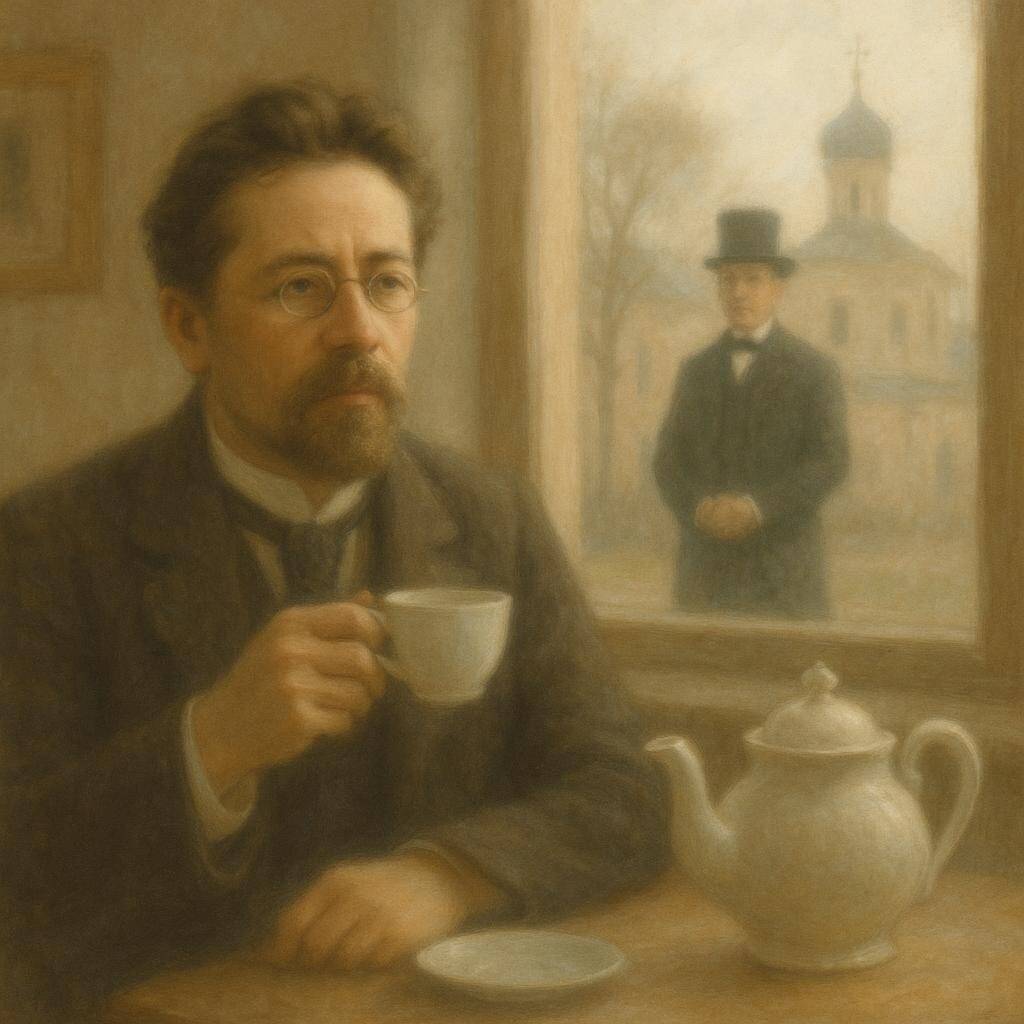
Teapot. This is the word that came to Anton Pavlovich Chekhov's mind when he was sitting in a cozy room in the house of one of his acquaintances in Kitai-gorod. It was a real Moscow spring outside: the snow had almost melted, but the air was still fresh and cool. Chekhov, known for his sense of humor, was thinking about how strange and bizarre his life had turned out.
That day he received a strange invitation from a mysterious Masonic Society of Moscow, which was collected in Ivanovsky Monastery. Chekhov found this interesting and, without thinking twice, went to the meeting. At the entrance to the monastery he was met by a gentleman in a formal suit who looked as if he had just stepped out of a 19th century portrait. The gentleman introduced himself as Mr. Smith and, having greeted Chekhov, invited him into the monastery courtyard.
The Masons, it turned out, were not only lovers of mysteries, but also enthusiasts of learning foreign languages. That day, they decided to dedicate their meeting to learning Chinese. Chekhov, not without hidden irony, noted that against the backdrop of the ancient monastery walls and the ringing of bells, Chinese hieroglyphs looked especially exotic.
Mr. Smith, noticing Chekhov's curiosity, suggested that he learn a couple of phrases in Chinese. Anton Pavlovich enthusiastically accepted the offer, but in the end it all came down to him having difficulty pronouncing something like "nimen hao", which caused a storm of laughter among those present. One of the Masons, trying to help Chekhov, suggested that he imagine that he was drinking tea, in order to pronounce the phrase more easily. And then Chekhov remembered the teapot, which in his head turned into a symbol of this strange and cheerful day.
The meeting continued, and the Masons shared stories about their travels to China, and Chekhov, in turn, told them funny anecdotes from his medical practice. In the end, everyone left in high spirits, and Anton Pavlovich decided that he would definitely write a story about his unusual experience.
Thus, thanks to one random invitation, Chekhov not only attended a meeting with the Masons, but also became familiar with the basics of the Chinese language, which may have later been useful to him in his literary career.
***
Of course, this is a joke, and there is no real basis for this story - just a little imagination and for the sake of a smile! And if you are interested in real facts and events, we invite you to the excursions of the "Radius" bureau, where real history comes to life!